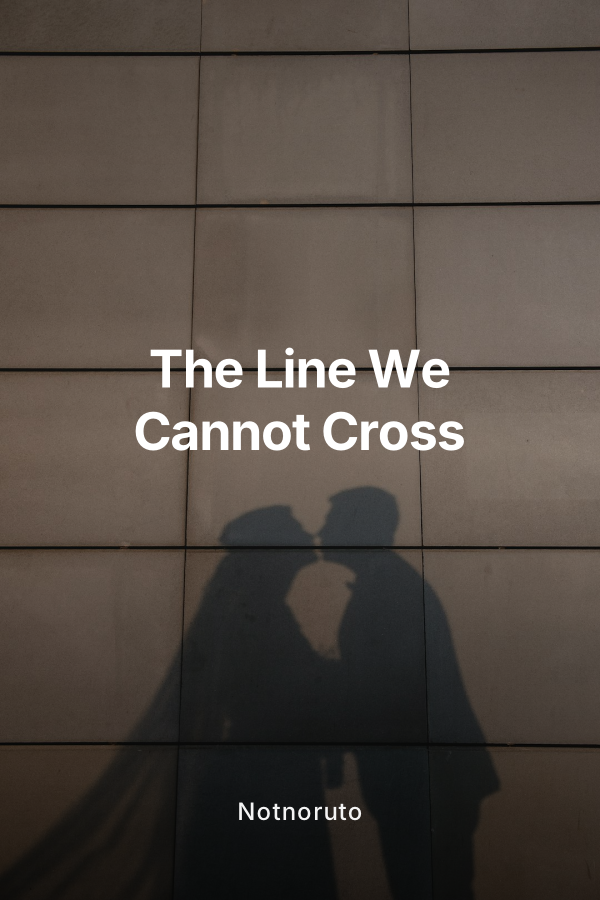
This book will be a single, emotionally charged chapter of about 2000 words, tracing the raw inner journey of an eighteen year old adopted son whose secret romantic obsession with his twenty year old adoptive mother threatens to destroy them both if it is not faced with honesty, boundaries, and help. It is inspired by the concept of an adopted teenage boy who develops forbidden feelings for his very young, attractive mom, who is completely unaware of the depth and darkness of his crush and continues to treat him like her child, while he struggles with shame, jealousy, and a desperate hunger to be seen as a man instead of just her boy.
At the heart of the story is Ethan, a quiet, observant high school senior who has always known he was adopted. He was taken in as a toddler by Aria, a girl barely out of her own childhood who chose to become his legal mother at a time when she herself was still figuring out who she wanted to be. Their bond has always been intense and close, more like best friends and siblings wrapped into one, yet defined on paper and in public as mother and son. She is only two years older than him now, a fact that constantly blurs lines in his mind and fuels his confusion about what kind of love he feels and is allowed to feel.
The summary will follow Ethan’s gradual, painful realization that his admiration for Aria has turned into something deeper and less innocent. It begins with small, almost invisible shifts in his inner world. He notices how people look at her, how classmates whisper about the “hot young mom” who picks him up sometimes, how men flirt with her at the grocery store. At first he laughs it off, proud of her beauty and resilience, of the way she has held their fragile two person family together since she was a teenager. But his pride slowly warps into a possessive, burning jealousy he does not know how to name.
Inside, Ethan starts narrating a life where he is not her child but her equal, her partner, her chosen one. The book will dwell in his internal monologue, giving readers access to the guilt and shame that accompany every stray thought. He hates himself for picturing what it might feel like to hold her a second too long, to brush past her in the narrow hallway, for replaying the moment she laughed and touched his arm at dinner as if it meant more than it did. He is trapped between two identities son and secret would be lover and the impossibility of reconciling them gnaws at him until he can barely look at her without feeling sick with desire and disgust at himself.
Aria on the other hand sees only her boy. To her, Ethan is still the child she signed for with shaking hands, the toddler she soothed with lullabies, the scruffy teenager she worked double shifts to keep clothed and fed. She is proud of him, delights in his dry humor, worries about his quietness, and is fiercely protective of him when teachers dismiss him as distant or difficult. Her complete unawareness is not neglect but trust she believes their bond is unbreakable and pure, and she never imagines that the very intensity of their closeness has become a source of torment for him.
The tension in the story tightens when Aria begins tentatively dating after years of putting her own needs last. Ethan, who has silently accepted the label of “adopted son” while privately fantasizing about being something more, feels his fragile, imaginary role threatened. The summary will outline how he reacts with barely concealed hostility to any man who appears in her life. He resents their easy confidence, their right to sit across from her at a candlelit table, their ability to touch the parts of her existence he has always secretly wanted to claim. He starts picking fights before she leaves the house, making snide remarks about her outfits, or complaining about headaches so she will stay home.
Yet their home life still carries the familiar routines that have always comforted him late night movie marathons on the couch, shared leftovers at the kitchen counter, her sleepy smile when she drops a kiss on his hair in passing. Each innocent gesture twists deeper into his heart, stretching the gap between what is normal affection and what his imagination tries to turn it into. The summary will highlight these small, intimate domestic moments as the emotional battlefield where his longing grows while she continues to move within the boundaries of a loving, if unusually young, mother.
As Ethan’s obsession deepens, his behavior begins to change in ways that others start to notice. Friends see the way he bristles when Aria is mentioned, the way his eyes darken when someone jokes about her being attractive. Teachers notice him drifting off in class, scribbling in notebooks, his mind clearly somewhere else. The book will use a close third person or first person perspective to show his secret rituals and near crossing of lines he lingers at her bedroom door when she is asleep, stands too long in the hallway after she showers, “accidentally” walks in at the wrong times, then retreats, shaking, horrified by himself.
This single chapter novel will not depict explicit sexual contact or romantic fulfillment between them. Instead, the core of the story is about the cliff edge where Ethan stands, looking down at the life he could ruin if he acts on his impulses. Around him, the world keeps sending him quiet warnings. A trusted friend catches him staring at Aria in a way no son should and calls him out. A health class at school addresses consent and power imbalances in relationships, a lesson that lands like a stone in his chest as he realizes that no matter how old he feels, no matter how close they are in age, she will always be his parent in the eyes of the law and in the reality of their shared history.
The emotional climax of the summary will revolve around a near disaster that forces Ethan to confront himself. In a moment of heightened vulnerability perhaps after Aria returns home from a painful date, crying and exhausted he almost says too much. He holds her a fraction longer than usual, feels the warmth of her body against his, and hears the words trying to break free I love you, not the way a son loves. This is the line he almost crosses, the confession that trembles on his tongue.
Instead, what slips out is anger. He lashes out, accusing her of choosing the wrong people, of ignoring the one person who truly cares for her. The argument escalates. Aria, bewildered, hurt, and overwhelmed, demands to know why he is acting like a jealous partner instead of her child. In that raw, unguarded moment, she finally sees how his gaze on her has changed, how his voice shakes when he talks about her being with someone else.
The summary will describe how the shock of her recognition and the fear in her eyes shatter Ethan’s denial. He hears every unspoken accusation in her silence, every boundary he has blurred in his mind. The room fills with the weight of what almost happened and what must never happen.
From here, the book will move into its healing arc. Aria, devastated yet determined to protect them both, reaches out for help rather than shutting down. She contacts a counselor, not only for Ethan but for herself, acknowledging that their unconventional age gap and history have created a confusing emotional environment. The story, even in summary form, will honor her strength in facing this without shame for his feelings, but with firm clarity about what lines cannot be crossed.
Ethan will be shown starting therapy, where he is finally able to say the words he could never speak to Aria. He admits the depth of his crush, the fantasies that haunt him, the jealousy that made him almost act out in ways that could have scarred them forever. The summary emphasizes that he is not portrayed as a monster but as a hurting, confused young man who needs guidance, accountability, and space to grow into healthier forms of love. The therapist helps him understand why his heart attached itself to the one safe, constant figure in his life and how to slowly untangle romantic desire from a desperate craving for security and validation.
In parallel, Aria does her own work. She grieves the loss of simple, unquestioned closeness with her son, recognizing that some of their casual intimacy must change for his sake. She learns to set gentler yet firmer boundaries no more changing clothes with the bedroom door ajar, no more falling asleep tangled together on the couch, no more leaning on him as if he were her partner instead of her child. These adjustments break her heart, because they feel like distance where there used to be comfort, but she comes to see them as acts of love, as the structure Ethan needs in order to heal.
The summary closes with a bittersweet, hopeful scene months later. Ethan and Aria sit at the small kitchen table where so many unspoken tensions once simmered. Now, there is a calm between them that is quieter, less intense, but more honest. He has begun to build a life outside their tiny apartment new friends, new interests, the shy beginnings of age appropriate attraction toward someone who is not tied to his childhood wounds. She has tentatively resumed her own dating life, but with more awareness of how it affects him, keeping communication open.
They talk openly, at last, about what happened. Not in graphic detail, but in terms of feelings he had, fear she felt, and the commitment they share to never repeat the patterns that almost ruined them. Ethan apologizes, not for having feelings he did not choose, but for the ways he almost let those feelings control his actions. Aria forgives him, not as a lover redeeming a partner, but as a mother holding space for a flawed, struggling young man she still believes in.
The final lines of the book will underline its core message that love, even the most tangled and taboo, can be redirected into something safer and truer when faced with honesty and guided with help. Ethan does not get to become what he secretly wanted, but he gets something far more important the chance to grow into someone who can love without crossing the lines that protect the people he cares for. Aria loses the illusion of their perfectly uncomplicated bond, but she gains a more grounded, resilient connection with her son, built on truth instead of unspoken tension.
The story will linger on the ache of what will never be, not to glorify it, but to acknowledge the very real feelings that existed and the courage it took not to act on them. The book, as summarized here, promises an emotionally intense, romantic leaning but ultimately responsible narrative that explores forbidden desire, maternal love, and the difficult, necessary work of choosing boundaries over fantasy. It is a romance that does not become a romance, a love story that redirects itself away from harm, and a testament to the fact that sometimes the bravest way to love someone is to accept the line you cannot cross and to step back from it together.