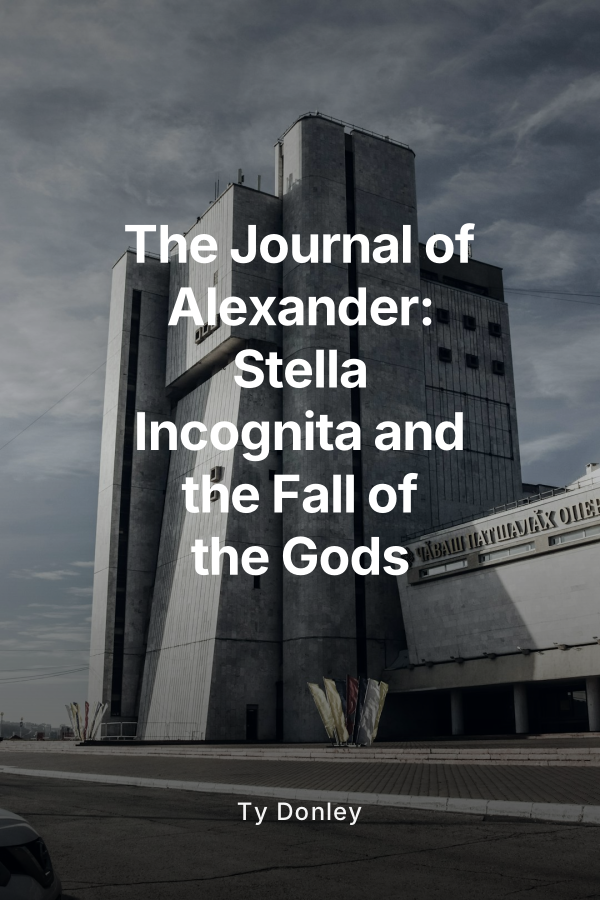
The Journal of Alexander: Stella Incognita and the Fall of the Gods is an intimate first person chronicle that fuses Roman historical texture with far future science fiction, told entirely as the private diary of a young man who never expected to leave his provincial forge. It follows Alexander, the adopted son of Antoninus the blacksmith, who lives in a small Roman town within an empire that has quietly stretched its dominion beyond Earth and across the solar system. In this reimagined antiquity, the familiar gods of the Roman pantheon are not distant myths but visible rulers seated upon planetary thrones, long lived and technologically advanced beings who wield machines so subtle and powerful that common citizens experience them as pure divinity.
Alexander’s life begins small and solid. At twenty he is a charismatic blacksmith’s apprentice, competent with tools, metals, and the stars he charts for personal fascination. His adoptive father has given him stability, a trade, and a place in the ordered world of Rome. Yet beneath this apparent certainty lies a wound that has never fully closed. When Alexander was five, his biological father Gaius left on a sanctioned journey to seek Stella Incognita, a hidden star whispered about in imperial circles, and never returned. Gaius’s absence is a silent axis around which Alexander’s childhood turns, shaping his curiosity, his resentment, and his longing for answers.
The book’s inciting moment arrives years later in the clamor of a market, when Alexander stumbles across a battered travel journal whose cover he almost ignores. Only the author’s name arrests him. Gaius. Inside he finds pages filled with shifting ciphers, star diagrams, and encoded notes written in a hand he has not seen since childhood. After long nights of effort he manages to break the first layer of code, revealing a letter addressed to him directly. In that letter Gaius claims to have found Stella Incognita and instructs his son to follow, explaining that the journal, once decoded, will map the route through the stars and reveal the location of a hidden solar sail ship concealed in a remote cave. He begs Alexander to be cautious, to trust the written clues, and to finish what he himself could not.
From this discovery the central structure of the book emerges. Each chapter of Alexander’s diary interleaves his present tense experiences with fragments of Gaius’s older journal, which he deciphers slowly throughout the journey. The code is not a trivial obstacle but a living engine of the plot. Some passages yield to his ingenuity and education in astronomy and mathematics. Others resist him, their symbols rearranging into new patterns that he can only unlock after visiting places his father once knew. Correct interpretations open routes across the empire’s starways, identifying ancient relay points, abandoned stations, and hidden shrines. Misread lines send him into danger or apparent dead ends, creating moments when Gaius seems either deeply flawed or outright traitorous, only for later discoveries to shift the perspective yet again. The reader experiences this uncertainty alongside Alexander, sharing the tension between trust and doubt as the father’s true motives remain elusive for much of the narrative.
Launching from his provincial life into the cosmic realm is neither simple nor triumphant. When he finally locates the cave described in the first decoded section, Alexander finds a sleek solar sail vessel half buried in stone, obviously not of standard Roman manufacture. Restoring it becomes the first test of whether a blacksmith’s apprentice can plausibly become a traveler between worlds. The diary lingers on material details: flexing spars, torn sail membranes, cracked conduits, the smell of old oils and dust. Alexander’s competence with metal and mechanism grounds the sequence, making his eventual departure feel earned rather than gifted. Once the ship answers his hand on the controls, he leaves Antoninus and his familiar streets behind, propelled into an empire he has only glimpsed from afar.
The wider setting he enters is a solar system thoroughly Roman in language, law, and hierarchy yet saturated with advanced technology that ordinary people accept as sorcery. Rome is openly a space faring power. Human legions garrison moons and stations under the patronage of planetary gods whose authority appears both political and sacred. Shrines cling to orbit, their rituals powering or masking data conduits. Sacrifices fuel engines. Pilgrimages double as bureaucratic inspections. Everywhere Alexander travels he sees the same fusion of military order, civic pride, and theatrical piety that shaped his provincial childhood, now magnified across the void.
Initially Alexander writes as a practical Roman craftsman. His diary entries catalogue repair tasks, celestial coordinates, lists of supplies, and observations about customs on far flung outposts. He notes the differences between a forge on Mars and one on a Jovian moon, how local gravity alters the swing of a hammer, how soldiers stationed under different gods adapt their rites to foreign skies. Through these grounded details the reader learns how deeply the gods have embedded themselves in every layer of imperial life. Their festivals dictate work schedules. Their augurs rubber stamp travel permits. Their cult statues hide sensor arrays and weapon systems beneath carved marble and polished bronze.
Only slowly does Alexander grasp the darker truth beneath this apparent order. Encounters on frontier worlds and forgotten stations expose him to harsh colonial regimes whose labor keeps the grand machinery of divine rule alive. He meets dissidents who question the justice of serving beings that resemble mortals in temperament more than any transcendent ideal. He also witnesses the seductive stability the gods provide: prosperity on core worlds, relative safety from external threats, a coherent narrative that explains humanity’s place beneath the stars. His diary becomes a record of internal war as much as external travel. He is torn between the comforts and loyalties of the world he knows and the growing realization that its foundations rest on enslavement, fear, and manipulated belief.
The revelation that finally shatters his inherited faith comes through a blend of lived experience and deeper decoding of Gaius’s journal. Alexander comes to understand that the gods are not divine in any supernatural sense. They are long lived alien beings whose mastery of technology permits feats that appear miraculous to human eyes. They have woven a civilization sized theater in which their machinery masquerades as thunderbolts, omens, and immortal bodies. Yet their susceptibilities are all too familiar: pride, rivalry, desire, terror of defeat. Their divinity is a costume worn over an older history of conquest. Humanity serves as both subject and resource, bound less by chains than by stories repeated over generations.
This knowledge does not transform Alexander into a simple rebel. The heart of the book lies in his refusal to accept simple binaries. He records brutalities committed in the gods’ name, yet he also notes the disasters averted and the relative order they impose. He grieves for those crushed by imperial demands and wonders whether any alternative would avoid even worse upheaval. His tone swings between anger, fear, doubt, and yearning for a world that could be both just and stable. His inner conflict is sharpened by memories of festivals in his home town, of Antoninus’s quiet faith, of the genuine beauty he has known under the old order. He does not want his world to burn, even as he questions whether it can remain as it is.
As the journey carries him farther from familiar routes, the encoded testimony of Gaius draws him into an even older conflict. Long before Rome’s ascent, another class of vast beings contested the gods’ dominion. These titans once rivaled or surpassed the gods in power, only to be defeated and bound on a world hidden from standard celestial charts. Stella Incognita, the star of myth and imperial secrecy, is the beacon that marks their prison. Gaius’s mission, once a straightforward exploration in service of Rome, became entangled in this buried history. As he traced the edges of the gods’ greatest victory, he drew their wary attention and the dangerous interest of the titans themselves.
Alexander’s own path converges with his father’s when the last layers of code finally yield the coordinates of Stella Incognita. His arrival there marks the novel’s central turning point. The solitary planet that orbits the hidden star is a cemetery of triumph and terror. Roman style ruins cover alien landscapes, colonnades and amphitheaters warped by foreign gravity and ancient energies. These are not relics of human settlement but the instruments by which the gods enacted their binding of the titans long ago. Inscriptions carved into walls and plazas depict battles not as mythic allegory but as literal chronicles of gods who still reign on their planetary thrones, caught in moments of fear, rage, and near defeat that their official cults on other worlds never mention. Walking through these abandoned forums, Alexander realizes how much of the empire’s public story is deliberate amnesia.
On Stella Incognita he finally uncovers the full truth about Gaius. By combining the hardest stretch of decoding with physical investigation of the ruins and remnants on the planet, Alexander pieces together his father’s last days. Gaius did not die as a clear cut martyr to a defined cause, nor as a simple traitor to Rome. He was a man torn between love for his people and horror at the original sin upon which their era rested. The gods demanded silence and obedience. The titans whispered offers of liberation that would likely culminate in catastrophe. Caught between these forces, Gaius faltered, resisted, and eventually fell in the crossfire of a struggle much larger than any one life. For much of the book Alexander fears that his father chose monstrous allies or betrayed his duties. Only in these late revelations does he see a fuller, more tragic, and more human picture.
The climax of the diary arises from the decision Alexander must make once he understands both the nature of the titans and the reality of divine rule. The titans are not saviors waiting to uplift humanity. They are ancient, volatile powers whose freedom would almost certainly unmake the current order in storms of destruction. The gods, though oppressive and manipulative, are correct in warning that uncontrolled release of their old enemies could doom countless lives. Having traced both his father’s path and his own into the heart of this prison world, Alexander becomes the only living human who stands at the intersection of the gods’ fear, the titans’ hunger, and humanity’s precarious place between them.
Refusing the simplicity of either full rebellion or total surrender, he chooses a third, perilous course. Drawing on hints contained in Gaius’s last, nearly undecipherable entries and on his own observations of Stella Incognita’s ruins, Alexander engineers a compromise that severs both gods and titans from direct dominion over Earth and its nearby worlds. In practical terms this means triggering systems that seal or banish these beings to distant reaches while simultaneously breaking the very infrastructure that allowed Rome to be a coherent, star spanning empire. The cost of safeguarding humanity from both tyrannies is the deliberate and accidental collapse of much of its accumulated knowledge and connectivity.
The cascading consequences of his choice form the closing movement of the book. Vast communication networks fail. Gateways between planets flicker and die. Archives disappear into sealed vaults or are reinterpreted as sacred relics devoid of technical meaning. Sciences that once seemed as permanent as the constellations fall into disuse within a few generations. What later ages will remember simply as the end of the classical world and the onset of a long medieval twilight is revealed here as the outcome of a single, terrible compromise designed to keep humanity alive and relatively free, if also scattered and forgetful.
In these final chapters Alexander’s voice shifts into a more reflective, almost confessional register. He writes with the awareness that he is helping to erase the clarity of his own era. He records the grief of knowing that artisans like himself, scholars, soldiers, and ordinary citizens will live and die never understanding why their world grew smaller, why the stars ceased to be roads and became distant lights again. He admits that he cannot foresee all consequences. Perhaps humanity will one day rediscover the truths he has chosen to hide. Perhaps it will sink into permanent superstition. Either way, he accepts that he has acted with incomplete knowledge, driven by conscience rather than certainty.
Thematically, The Journal of Alexander examines the price of awakening in a culture structured around comforting untruths. It interrogates how far an individual should go to disrupt an unjust order when the available alternatives may be worse. It meditates on the fragility of knowledge and the ease with which entire civilizations can substitute myth for history when truth becomes too dangerous to sustain. The book suggests that legends of saints, demons, monsters, and distant heavens might contain blurred echoes of a time when gods and titans literally strode among the stars, their advanced devices later remembered as miracles and curses. Yet it grounds these vast ideas in the sensory immediacy of a single life. Readers feel the grit of forge smoke in Alexander’s lungs, the tremor of deck plates beneath his boots, the texture of his father’s handwriting under his fingers.
Stylistically, the diary format keeps the narrative deeply human. Battles between near godlike entities are seldom described from a neutral, cinematic vantage. Instead we glimpse them through survivors’ stories, through damage reports, through the way light changes on ruined stone after some great conflict has passed. Alien landscapes are filtered through a Roman vocabulary of legions, forums, gods, and omens, creating a distinctive blend of practical observation and reaching, uncertain metaphor. As Alexander matures, his writing absorbs more philosophical questioning and spiritual struggle without ever losing its craftsman’s eye for structure and consequence.
By the final pages the reader has traveled with him from the narrow alleys of a small town to the forgotten plazas of a titan prison, from naïve trust in the gods’ benevolence to a weary understanding of their limitations and fears. Alexander does not cast himself as a hero. He sees himself as a man backed into an intolerable corner who nonetheless had to choose. He knows that future generations will remember only fragments, that his own name may vanish while mythologized versions of gods and titans live on in stories unmoored from their true origins. The preservation of his journal becomes his last act of faith in humanity’s capacity to remember more than legend. If someone, someday, deciphers his words, they will learn that their so called dark ages began not in simple decline but in a deliberate attempt to shield human freedom, however imperfectly, from the crushing weight of forces it could not yet master.
As a whole, The Journal of Alexander: Stella Incognita and the Fall of the Gods offers a rich blend of character study and sweeping alternate history. It invites readers who love both grounded Roman detail and speculative science fiction to reimagine antiquity as the aftermath of a star spanning struggle. Through Alexander’s eyes, it suggests that the line between history and myth is often drawn not by what truly happened, but by what those in power choose to remember and what a single conscience is willing to let the world forget.