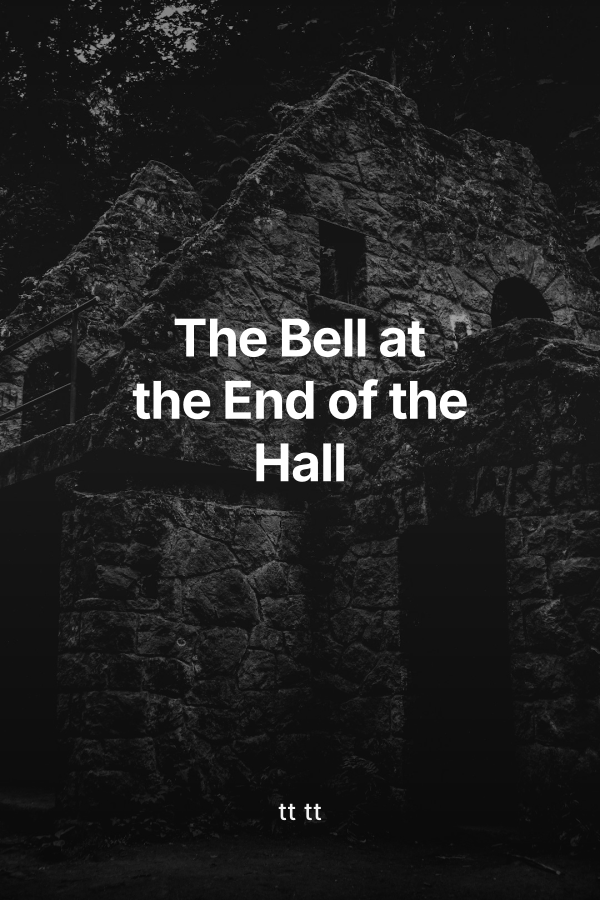
The book follows a decorated tactical officer whose mind has become a haunted battlefield long before the final mission begins. A nameless entity stalks the edges of his perception, always heralded by the soft, metallic chime of a bell. The sound comes in quiet, liminal moments when he is most alone and least defended. Over the chapters, the reader is led to question whether the entity is an external force or the manifestation of his own fracturing psyche, yet the consequences of its presence are brutally, undeniably real.
In Chapter 1, the story establishes the protagonist’s dwindling sanctuary in those brief pauses between operations. Once, solitude meant rest. Now it is when the bell rings loudest. The chapter opens on a late night in his car outside his apartment, city lights dull behind fogged glass. The interior is claustrophobic, smelling of old coffee and gun oil. The bell sounds faintly from nowhere and everywhere at once. It is not part of his world; it does not belong to any object or device. He watches his own reflection in the windshield argue back at him as if it were a second self, insisting that this is not stress, not trauma, but something else pushing through the cracks of his reality. The entity never appears fully, only suggested at the periphery of streetlights as a smudge where no one stands. This chapter builds an intimate portrait of a man who was trained to trust his senses and now cannot, a man who tries to intellectualize his fear away even as his hands tremble over his gear bag.
Chapter 2 moves into the world of preparation and protocol, where discipline and routine should provide structure but instead reveal deeper fractures. During the mission briefing for an operation that is meant to be routine crowd control, the protagonist’s instability becomes impossible to wholly hide. The conference room is buzzing with low conversation, projectors humming, stale air pressing against everyone’s skin. He sweats under the fluorescent lights, hearing the bell beneath the drone of his commanding officer’s voice. Teammates exchange glances when he zones out, his focus pulled toward the far corner of the room where the entity seems to stand as a darker seam in the wall. Someone quietly suggests he might need rest, a medical check, perhaps to sit this one out. But hierarchy, reputation, and urgency collide. His record is exemplary, and his insistence that he is “fine” aligns with what his superiors want to believe. The chapter tightens the noose of inevitability: small signs ignored, clear red flags rationalized away, a system more interested in operational continuity than in the unsettling transformation of one of its best men.
In Chapter 3, the mission unfolds in a dense, crowded urban plaza, thick with bodies, voices, and the sharp smell of sweat, food, and exhaust. The atmosphere is ripe with tension long before any violence erupts. The protagonist’s perspective narrows, his senses overclocked. The bell begins as a faint, intermittent chime beneath the roar of the crowd, then grows clearer, as if swinging just behind his ear, impossible to locate. Lights, banners, and faces blur together until one figure in the crowd seems to solidify with unnatural clarity. To him it is the entity at last stepping forward, its presence compressing the air around it, the world dimming at its edges. He sees movement that others do not, interprets an ordinary gesture as the beginning of an attack, and the dread that has been building finally erupts into action. He opens fire, convinced he is defending himself and those around him from an inhuman threat. The scene is rendered with fractured, sensory detail and disorienting temporal shifts, cutting between his warped perception of an advancing entity and the stark reality of terrified civilians. By the end of the chapter, the screams and gunshots fade into a ringing in his ears that blends seamlessly with the bell, leaving a plaza strewn with the dead and injured.
Chapter 4 confronts the aftermath in cold, clinical spaces where the horror cannot be dismissed as a nightmare. In the immediate wake of the massacre, the protagonist’s first instinct is frantic justification. He insists the entity was right in front of him, points at empty stretches of concrete, demands that his commanding officers and investigators check the cameras. His voice cracks as he begs them to listen for the bell that still tolls privately in his mind. Bodycam footage and security feeds are replayed in tense, fluorescent-lit rooms, and the discrepancy between his testimony and the images on the screens is devastating. There is no sign of any figure that matches his description, no anomalous presence, only him raising his weapon and firing first. The chapter explores the institutional machinery grinding into motion: interrogations, media storms, administrative hearings designed more to assign blame than uncover the deeper horror. He is treated as either a liar or a broken man, but never as someone who might have been targeted by something beyond human understanding. Isolation becomes physical as well as psychological, and even the reader is forced to wonder whether the entity ever existed outside his crumbling perception.
The final chapter deepens the ambiguity and dread rather than resolving it neatly. Now cut off from his unit and the structure that once gave his life meaning, the protagonist is confined to clinical observation, legal limbo, or a form of institutional exile that feels more like being warehoused than helped. The bell continues to ring in increasingly unpredictable patterns, sometimes silent for hours, sometimes striking four or five times in quick succession, each peal slicing through his thoughts. He begins to perceive hints that the sound is not limited to him. A nurse pauses in the corridor, frowning as if hearing something she cannot name. A fellow patient glances around uneasily at the same instant his bell tolls. Officially, the cameras and microphones capture nothing unusual, yet small anomalies creep into the record: glitches of static, frames where a shadow stands where no one should be, the faint suggestion of a figure occluded by interference. The protagonist is left in a state of unbearable uncertainty. Did his mind conjure the entity as a way to externalize his buried guilt and trauma, leading him to commit an atrocity? Or is the entity real, deliberately presenting itself only to him so that the horror it orchestrates will be written off as madness?
Throughout the book, the central terror is not the entity’s form but its method. It arrives in the spaces where the protagonist is supposed to feel safest, grows stronger when he is most vulnerable, and orchestrates violence without ever having to act directly. The story is less about a haunting in the traditional sense and more about the colonization of a soldier’s perception, turning his trained vigilance into a weapon against the innocent. The bell becomes a symbol of this slow possession, an auditory hook that pulls him away from consensus reality. The narrative continually undermines the reader’s confidence in what is real, alternating between stark external observations and the protagonist’s fragmented internal experience. Moments that appear objectively documented are later revealed to have gaps or distortions, creating a looping sense of unease.
Thematically, the book interrogates the intersection of personal responsibility, institutional negligence, and supernatural malevolence. It exposes how a system built on force can be easily turned to monstrous ends when the line between enemy and civilian, threat and bystander, is mediated by a single, unreliable human mind. The protagonist’s attempts to argue calmly and dismiss the idea that “it’s all in his head” are tragically undercut by the images broadcast to the world, marking him as a monster in the public eye. Yet the reader has walked with him through every chime of the bell, every shiver of unseen presence, and cannot so easily condemn him. The horror lies in that tension: knowing that something terrible happened through his hands, while also fearing that he may have been manipulated by forces no one else can see.
The book closes on a quiet, almost suffocatingly still scene. The protagonist finds himself again in a liminal space much like the car from the opening chapter, now stripped of any pretense of normalcy. Outside his small window, the world continues indifferent and bright. Inside, his reality is narrowed to the weight of his own breathing and the anticipation of the next chime. When the bell finally rings, it is softer than ever before, yet more intrusive, as if sounding from inside his own skull. He realizes with a cold, paralyzing clarity that it may never stop, and worse, that it may one day choose another listener. The narrative offers no comforting resolution, only the echo of the bell at the end of the hall, leaving readers with the lingering dread that madness and the supernatural are not opposing explanations, but two faces of the same unanswerable terror.