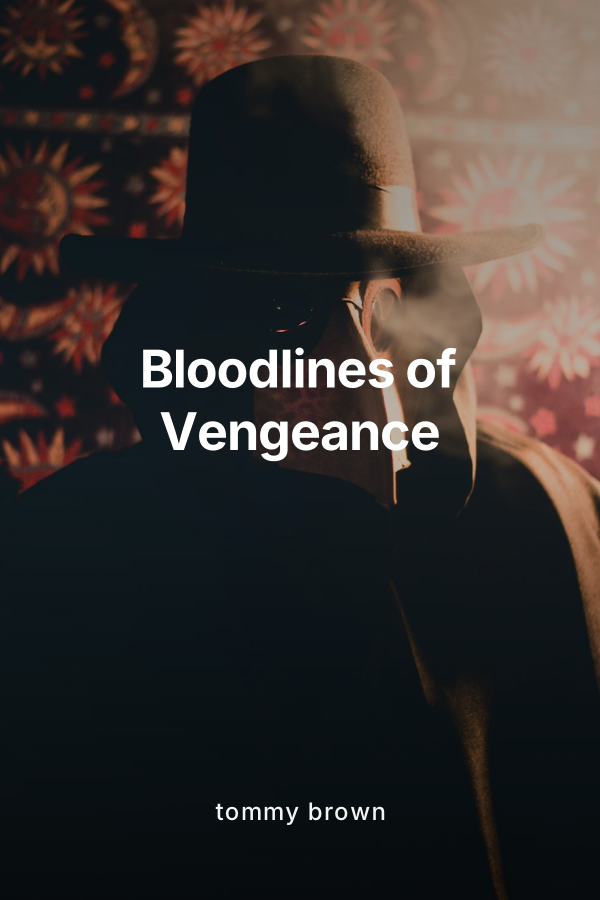
In a country that quietly feeds its worst monsters instead of killing them, two men become proof that some weapons never retire and some experiments never die. Bloodlines of Vengeance is a brutal, character driven vigilante thriller about legacy, government-made killers, and the one bond neither assassination orders nor black-ops science can erase: blood. Drawing on a dense family web of powered relatives, covert agencies, and fractured loyalties, it follows an aging street level executioner and his weaponized son as they are hunted across America, funneled toward a collision course in Detroit that will decide whether their family remains a secret lineage or ignites a war.
Robert Brown is sixty seven, with black hair gone steel gray at the temples, hard green eyes, and the calm of a man who has outlived every shooting gallery he ever walked into. Once a soldier and agent, now the closest thing the streets have to a grim reaper, Robert has spent decades tracking and executing criminals with a methodical coldness that makes organized crime whisper his name like a curse. The bartender who sees him paint a meth dealer’s brains across the wall understands it instantly: this is not a first kill. This is muscle memory.
Across the country, federal transport chains a different nightmare. Thomas “Tommy” Brown is forty five, five foot six, and nine hundred pounds of engineered rage, his skeleton and bone claws encased in indestructible metal. Stolen from federal prison, Tommy was fed into the black maw of Weapon X, a covert program that broke him down and rebuilt him as a living asset. For seven years they pointed him at targets and pulled the trigger for him. Heightened senses, a predatory healing factor, and claws that can peel armored vans open like soda cans turned him into a myth whispered through underground bunkers and secure briefings: Wolverine.
Robert and Tommy do not know they are father and son. What they do know is that the government wants both of them erased. Robert is a problem because he has been killing the wrong people for too long, putting bullets through men with federal contacts and protected status. Tommy is a liability because he did the one thing no weapon is supposed to do. He woke up. In a storm of blood and shredded restraints, he tore his way out of Weapon X custody, leaving a trail of dead handlers and broken steel behind him. Now every alphabet agency wants the same two things: their rogue vigilante neutralized and their lost asset recaptured.
Layered behind this cat and mouse chase is a sprawling secret dynasty. Robert is not just a gifted tactician who will not stop pulling the trigger. He is the son of Gerald Brown, the magnetic mastermind whose abilities can tear metal from the sky, and Adley Brown, a warrior matriarch with the bearing and power of a modern Amazon. His siblings and extended kin are scattered across the map, each carrying powers and codenames that read like a roll call of gods and ghosts: weather witches, living storms of fire, genius forgers of impossible tech, and vigilantes who prowl alleys in masks and capes. This hidden family tree is tangled further through marriage and blood with another line of extraordinary operatives, from telepaths and seers to patriotic supersoldiers and lantern-wielding guardians.
Tommy’s mother, Theresa Vanmeter, once wore a SHIELD badge and shared operations and a bed with Robert before their lives diverged into new allegiances and spouses. Her parents, Herman and Cecilia, brought their own psychic and prophetic gifts to the mix, shaping children and grandchildren into a network of enhanced individuals whose loyalties do not always align with the flags they were trained to salute. The result is a vast constellation of powered cousins, stepchildren, and in-laws strung between rival agencies and clandestine cells, some hunting Robert and Tommy, some trying to protect them, and others still deciding which side of history they are willing to die on.
At the center of this labyrinth of bloodlines, one thread keeps cutting through Tommy’s rebuilt brain. When they turned him into a weapon, Weapon X did not manage to burn away everything. There is still Brittany. She was fourteen the first time she talked to a twenty two year old Tommy online, an abused girl flashing strangers for the validation her bruises stole. He was a felon headed toward the long fall, but he became the first person to talk her into leaving the man who hit her. What started as late night chats grew into phone calls thick with possibility, a decade long almost-love strained by distance between Texas and South Carolina, never consummated, always real. Her last words before he went to prison were a confession over a failing phone line: “Tommy, I love you.” Then she vanished. Years later, she reappears only as a scent and a file header. Now in her thirties, married with children and working inside the FBI, she has ties to the very machine hunting him.
The book opens with parallel descents. Robert executes a meth dealer in a bar without a tremor, stepping over the corpse as if clocking out of a long shift, while Tommy tears through an armored transport, unfed for seventeen days, starving enough that his claws itch. The world meets them in motion: Robert in a stolen patrol car heading toward Detroit, Tommy bursting from sewers beneath the city as snipers and containment teams close in. Both men are intercepted by the same faceless apparatus. Floodlights wash an Ohio highway as black SUVs box Robert in. In Detroit, experimental squads designed to slow Tommy’s healing try to corral him, their fear as vivid to his nose as gasoline and burnt toast. The stage is set for them to become each other’s worst nightmare.
Detroit is not coincidence. Old SHIELD grid patterns, the footprints of past black ops, and the shadows of shuttered hospitals and dead factories make it the perfect urban kill box. As Robert uses the SUVs as moving cover, turning the highway into a rolling gunfight of shattering glass and caved-in chassis, Tommy cuts a red path through his own hunters, bullets flattening against his armored bones. When the final collision hurls Robert’s cruiser and the black SUVs into an abandoned hospital that still flickers with half dead emergency power, the city’s ghosts gain fresh company. The crash funnels both men into the same rotting landmark.
Inside and around that hospital, their separate wars merge. Outside, Tommy rips through specialized teams, claws sparking on asphalt, roar echoing against crumbling brick. Inside, Robert stumbles through debris, chest slick with blood from buckshot and crash trauma, performing savage field surgery by generator light, improvised instruments glinting on rusted trays. He hears distant impacts and gunfire and, for a moment, cannot tell if they are his son’s present or his own past, Manila extraction memories rattling around a skull that has seen too many missions end in screaming.
Their first meeting is violence stripped of context. When Robert finally glimpses Tommy smashing government agents into walls and ripping through containment gear, he reads only one thing in the carnage. This is a government bred monster sent to clean house. When Tommy’s enhanced senses catch the reek of gunpowder and police blood all over Robert, hear the command codes in the radios on his belt, he sees only another handler, another hunter, another suit. They collide in the broken corridors of the hospital in a brawl that feels less like a fight and more like two storms slamming together.
In that fight, words are as sharp as claws. Robert spits that Tommy is just another government dog, some proud lab creation with “Weapon X” stamped on his chest. Tommy snarls back that Robert is a trigger happy enforcer with the same stink as the men who welded his bones shut, that he is nothing but a suit who decided he liked pulling the trigger more than protection. They slam each other through gurneys and windows, Robert’s aging body held together by spite and training, Tommy’s regenerating with sickening pops as bullets and broken bones stitch back together. The imbalance is terrifying. Only Tommy can heal. When his claws finally punch deep into Robert in a brutal stab that just misses a killing artery, the older man’s vision whites out. He should die there.
Instead, something on Tommy’s chest catches in Robert’s fist as he falls. Dog tags tear free. Helicopters and fresh feds scream into the area, floodlights cutting through the hospital’s broken windows. Suppression teams close in. Tommy is forced to break off, leaving Robert bleeding among shattered glass and old ghost light. Alone in the dark, Robert crawls into the depths of the hospital to hide, dog tags sticky with his blood and someone else’s life clenched in his hand.
Only later, when the immediate pain has dulled to a deep knife of fire in his side, does he really look at them. The metal is stamped with words that hit harder than any bullet. Weapon X. Thomas R. Brown. Wolverine. The surname is his. The middle initial is his. The program is something he recognizes from old whispers, missions they were never supposed to talk about. In one quiet moment, under a failing light that hums like a dying heart monitor, the realization lands. The monster he just tried to kill is almost certainly his son.
From there, the book widens into a five act descent through family, accountability, and the ethics of turning people into weapons.
Chapter One establishes the dual hunt and the fractured legacies behind it. We meet Robert and Tommy in parallel, feel the governmental pressure tightening around them, and glimpse the huge extended family whose abilities and allegiances form the secret scaffolding of the world. The tone is relentless and gritty, with street level violence juxtaposed against operatives who can bend steel and read futures. Readers see Robert as a methodical executioner whose moral code is harsh but consistent, and Tommy as a brutalized survivor whose humanity is buried, not erased. The Brittany thread is introduced as the one emotional tether Tommy cannot shake, and Theresa’s SHIELD past and new marriage into another heroic line hint at the web of conflicting loyalties to come.
Chapter Two is the convergence on Detroit. It tracks Robert’s road trip in a stolen cruiser, his interactions with frightened civilians, and his memories of operations with Theresa that mirror the grid patterns he hears in current dispatch calls. In parallel, it follows Tommy’s escape from transport, his first clashes with hunters on the city’s outskirts, and the way his senses interpret fear, lies, and distant traces of Brittany’s scent among the agents. Government perspective scenes introduce Weapon X recovery squads and federal strategists, making clear that this is not a simple manhunt but a desperate attempt to reassert control over an asset they barely understand. The Detroit hospital is seeded as a looming landmark, a place where previous black projects left their mark and where new ghosts are about to gather.
Chapter Three is the crash and the mistaken identity war. The highway gunfight that sends Robert flying into the hospital, the containment operations that drive Tommy into the same space, and the resulting father versus son brawl take center stage. This chapter is the most physically intense, packed with shattered ribs, near fatal stabs, and walls painted in both men’s blood. Yet beneath the violence, key fragments of backstory slip through their insults. Accusations about government service, abandoned children, and family names like Gerald and Theresa crack the surface of their ignorance. The dog tag rip is the pivot point, a simple motion that turns an anonymous monster into a possible son and an aging assassin into something more than another target.
Chapter Four slows the tempo to let the truths sink teeth in. Cross-cutting between Robert hiding in the hospital and Tommy trying to evade escalating response teams outside, it becomes a study in trauma and legacy. Robert, alone with his wound and the tags, revisits decisions that led him to become a one man execution squad. He thinks of the woman he left, the son he did not raise, and the father whose militant philosophy shaped his idea of justice. Tommy, in turn, wrestles with flickers of memory Weapon X could not fully bleach: Theresa’s lessons about restraint from her own mentors, murmured warnings from Cecilia about visions of a future soaked in blood, and Brittany’s voice saying she loved him before the prison gates closed. Brittany’s current life as an FBI affiliated woman is quietly pulled toward the conflict as patterns in the case file match a name she once wrote on envelopes to a federal penitentiary.
Chapter Five widens the battlefield to the full family and institutional scale promised from the beginning. Magnetically gifted patriarchs, prophetic matriarchs, vigilante cousins in masks, and agency trained step relatives all face hard choices about which Brown, if any, they stand behind. Some believe Robert’s ruthless campaign against criminals is the only honest answer in a corrupt system. Others see Tommy as a victim turned weapon who deserves extraction, not execution. Government command realizes, too late, that their attempt to neutralize two anomalies has awakened an entire hidden dynasty with the power to reshape the balance between mask, badge, and black budget. The climax forces Robert and Tommy into one last decision in the burning ribs of the Detroit hospital: keep trying to kill the reflection of their own sins or turn together against the machine that built them for slaughter. The fallout, win or lose, will decide whether their family’s future is defined by secrecy and shame or by a violent, public reckoning that changes everything.
Throughout Bloodlines of Vengeance the tone stays sharp, cinematic, and emotionally unsparing. The action is tactile and brutal, from glass shards in knuckles to the sickening sound of bones knitting back together. Yet the heart of the story is not how many people Robert and Tommy can kill, but whether men who have been used as weapons their whole lives can choose, finally, to be something else. It is a story for readers who like their vigilantes complicated, their families messy and super powered, and their thrillers laced with the question that haunts every battlefield survivor: if I am still alive after all this, what am I for now?