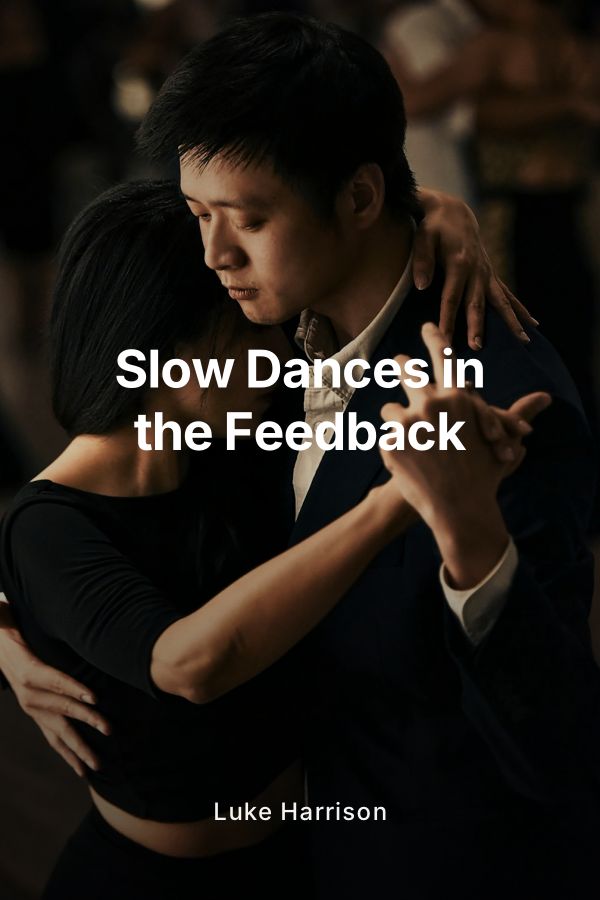
This book is a quietly intense, “indie shoegaze alt pop” gay romance that follows a guitarist who always assumes the worst, a bartender who loves like a long, slow-burning song, and an ex who is as vulgar and blunt as a basement show at 2 a.m. It lingers in small fears, late-night cigarettes, rain against windows, and the way a single touch can say what words never manage to. The story lives in the spaces between tracks: rehearsal rooms, cramped backseats on the way to shows, the glow of liquor bottles in a half-empty bar, group hangouts where everyone has already decided these two boys are a unit, long before they admit it to themselves.
At the center is the guitarist, whose biggest flaw is hearing the worst possible version of anything people say during a fight. His mind turns every raised voice into a rejection and every pause into an accusation, a habit that wrecked his last relationship and threatens the fragile, almost wordless intimacy growing between him and the bartender. Where others hear silence, he hears danger. Where others see a simple text, he reads catastrophe. The music he writes is shimmering and fuzzy, drenched in reverb, but his inner monologue is brutally sharp.
The bartender, in contrast, is quiet, steady, and emotionally literate in ways he barely knows how to articulate. He pulls pints, polishes glasses, and notices everything. He does not talk much about feelings, but he shows up consistently, with small acts of care that build like a looping pedal track. Around him, the guitarist finds himself settling into a rhythm that terrifies him with its possibility. The bartender understands that some truths are better expressed in gesture than in speech, like a thumb brushed over a knuckle or a kiss placed exactly where a question wanted to be.
Haunting the edges is the ex, all vulgarity, blunt opinions, and unapologetic ambition. He shares a band with the guitarist, and on stage their chemistry is effortless, tight, and thrilling. Off stage, they spark and clash over everything from politics to petty etiquette. The ex does not mince words, and when he talks about the past, he cuts to the heart of it, naming the guitarist’s worst flaw with a kind of rough, unvarnished care. In his view, the problem was never that they loved each other too little. The problem was that the guitarist’s brain always tuned into the harshest, ugliest interpretation of any conflict, until they both drowned in noise.
The book stretches across a season that feels like a long, rainy EP. Nights blur together at the bar and on stage, timelines smudged like eyeliner, scenes unfolding like tracks on a carefully sequenced album. The narrative focuses tightly on these three men yet never loses sight of the wider friend group: bandmates, bar regulars, and queer friends who orbit the central romance. The friendships are solid and deeply real. Even as the romance evolves, everyone keeps treating the two boys almost exactly the same as before, only with a gentle assumption that they will now arrive together, leave together, and be each other’s plus one to every party and show. The acceptance is understated and matter-of-fact, a soft background chorus rather than a spotlight solo.
Emotionally, the story is low on melodrama but rich in quiet, aching honesty. Its core tension is not about external homophobia or big public crises. Instead, it deals with the private, unglamorous fear of “What happens when this ends? Who am I without you?” The most pivotal scene in the book is not a shouted confrontation, but a moment of almost unbearable stillness: one boy voicing a dark, naked fear about what comes after, about being left alone in the silence once the song of their relationship stops playing. The other boy responds without a speech. He takes a drag from a cigarette as rain fills the space between them. Then he leans in and answers with a kiss, offering presence instead of promises, certainty of feeling instead of forecasts about the future. That kiss becomes the emotional thesis of the book: love as an action in the present, not a contract about forever.
The five chapters are structured like tracks in a concept album, each one with its own emotional color and sound:
Chapter 1 introduces the mood and the main players, painting the guitarist’s interior world against the sensory backdrop of small venues, reverb-heavy rehearsals, and slow nights at the bar. We see how his tendency to catastrophize has shaped his past and how the bartender’s quiet gravity begins to pull him toward a different tempo. Subtle glances, half-jokes, and lingering touches create a sense of potential that neither dares to name.
Chapter 2 centers the ex, juxtaposing his vulgar, brash personality with the bartender’s subtlety. Through rehearsals, post-show arguments, and half-drunk confessions, we gradually learn what happened between the guitarist and his ex, not in one exposition dump but in shards and flashes. The ex’s blunt assessment of the guitarist’s fatal flaw hits like feedback through an amp, painful yet clarifying. In the contrast between old patterns and new possibilities, the guitarist begins to recognize the difference between a relationship that thrives on friction and one that grows through stillness.
Chapter 3 moves through group scenes that are surprisingly light: hangouts, parties, lazy afternoons after shows. Here, the theme of understated acceptance shines. Friends notice that the two boys are effectively a couple and react with calm teasing or total nonchalance. Their social world does not pivot dramatically because of this romance. Instead, the relationship is absorbed seamlessly into the existing fabric, underscoring that their love is not an exception to their lives but a continuation of everything they already were to each other.
Chapter 4 deepens the intimacy and conflict. Fights flare up not because of betrayal, but because of misheard tones, misread silences, and the guitarist’s reflexive habit of bracing for abandonment whenever voices rise. Arguments do not explode into chaos; they simmer with subtext and quieter hurts. The bartender’s patience has limits, and the guitarist must confront the possibility that his worst-case-interpretation reflex is not a tragic flaw written in stone but a learned habit that he can slowly unlearn. The ex functions as a sharp mirror, occasionally pushing, occasionally provoking, sometimes even supporting in his rough, sideways way.
Chapter 5 carries the narrative toward that defining, rain-soaked scene of fear and wordless reassurance, then into a conclusion that is more open-ended than neatly tied up, yet emotionally complete. The story ends not with grand vows or promises of eternity, but with a shared understanding: that wanting each other here and now is enough, that they will keep choosing one another, one song, one cigarette, one kiss at a time. The final note is soft, lingering, and hopeful, like the last sustained chord ringing out over a quiet crowd.
Throughout the book, the tone stays close to the aesthetic of an “indie shoegaze alt pop” album. Scenes are built through atmosphere as much as dialogue: the thud of a kick drum leaking through concrete walls, the glow of streetlights in puddles, the sharpness of cheap liquor, the warmth of a calloused hand on the back of a neck. The romance is deeply queer, rooted in specific subcultural textures rather than generic gestures, yet it also speaks to anyone who has ever loved with one foot still stuck in fear. It offers a vision of intimacy that does not depend on perfect communication or grand speeches, but on small, consistent choices to stay, to listen, and to respond with touch when language fails.
At its core, “Slow Dances in the Feedback” is about learning to stop hearing only the worst version of every story and beginning to trust the gentle hum underneath the static. It is for readers who love slow-burn queer romance, hazy music scenes, and characters whose biggest battles happen inside their own heads. It invites you to lean in, let the noise wash over you, and listen for the quiet, persistent truth that these boys finally accept: they both want each other, always.