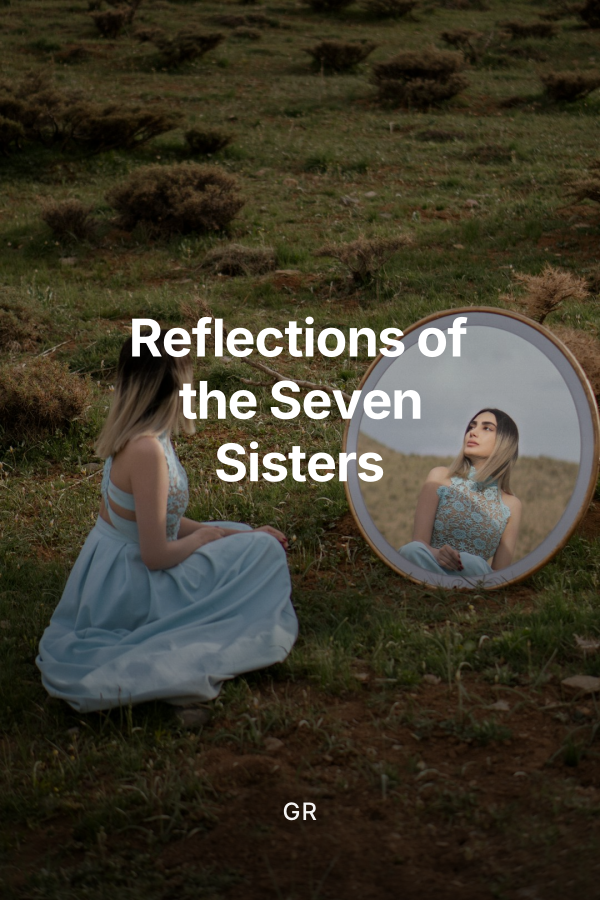
The story unfolds around Abel, a teenager in a decaying college town dominated by the looming shape of the Seven Sisters, an abandoned hilltop complex with a history the locals prefer not to touch. Years ago there was a fire at the Seven Sisters in which people burned alive, a catastrophe officially recorded as an accident but remembered in whispers as something closer to a sacrifice. Abel does not know yet that this event will determine the shape of his entire life.
In the present, Abel begins to see something impossible. It never appears directly, only in surfaces that catch light. At first it is a suggestion in a bus window, a distortion at the edge of the bathroom mirror, a dark smudge in a turned off television. As Abel’s emotional world tightens and spikes, the thing in the glass responds. Whenever he feels a strong emotion, especially fear, shame, or desire, the figure grows clearer, closer, more focused. It is a humanoid outline whose burned and shifting features are never quite the same twice, as if multiple faces are trying to emerge through charred skin. Its eyes are a reflective void that does not show Abel’s image back.
The phenomenon is not fully private. Other people occasionally catch a fragment when they are close to him at the wrong moment. Patrick, Abel’s best friend and slow-burn crush, once glances up during an argument and sees the figure standing over Abel’s shoulder in the reflection of a café window. John, who hides his fear behind skepticism and sarcasm, snaps a photo in a moment of tension and later discovers an impossible silhouette watching from behind Abel in the glass of a display case. Seth, restless and fascinated by the occult potential of outdated technology, makes it his mission to record the entity, convinced that any phenomenon that can route itself through reflective surfaces has an information structure that can be trapped, mapped, or redirected.
The boys begin to map out the rules that seem to govern the demon. It is most active around reflective planes: mirrors, windows, screens, water, even the glossy surface of a smartphone when the light hits it right. The closer Abel is to a flashpoint emotion, the more detailed and synchronized the manifestations become. It appears to be anchored to Abel, but evidence hints that the bond is not complete. It can lean toward other observers, distort their reflections, brush their thoughts with imagery of fire and suffocation. As the sightings escalate, they realize it is not merely a haunting. It is an entity learning to project itself through human perception, testing how much leverage it can extract from a cluster of frightened young minds.
The origin of this demon is tied to the old Seven Sisters fire. As the boys dig through newspaper archives, local records, and forgotten digital caches, they uncover a suppressed narrative that the blaze began during a secretive gathering in which a group of students attempted a ritual based on a home grown theory of consciousness and energy. The supposed goal was to erase traumatic memory and collective guilt by externalizing it into a symbolic construct. Something went wrong, and instead of dissolving pain, the ritual appears to have compressed terror and regret into a metastable pattern that needed a host. The physical fire was the macro scale side effect of an information catastrophe. Abel, born years later, is a latent endpoint of that unfinished pattern, selected by a mixture of genetics, geography, and psychological resonance.
Abel’s friends respond to the crisis through their different temperaments. Patrick is the heart of the group, willing to do anything to protect Abel. When Abel starts planning reckless strategies to confront or destroy the demon, Patrick eventually confesses his feelings, not as a romantic flourish but as a desperate act to stop Abel from sacrificing himself in a half tested ritual reenactment at the Seven Sisters. His admission of love interrupts Abel’s spiral yet also amplifies the emotional intensity that powers the entity. The demon feeds on strong affect but is also constrained by it, forced into more human like structures the more it is entangled with genuine connection.
John, long defined by his fear and disbelief, gradually turns that fear into a kind of focused discipline. Once he accepts that the demon is real, he refuses to let panic define him. His terror becomes data. He catalogs every manifestation, every reflection angle and light level, every correlation with Abel’s mood spikes. By treating his fear as signal rather than noise, he starts to anticipate the entity’s moves. During the later phases of the story, John is the one who can stand in front of a wall of mirrors, body trembling, and still speak clearly enough to direct the others. He does not conquer fear in a triumphant sense; he retools it into a sharpened instrument that allows him to stand his ground when everyone else wants to run.
Seth takes the most aggressively technical route. Convinced that the demon is an emergent information pattern that rides on visual processing, he sketches a plan to capture or at least wound it using 1980s era analog technology gathered from thrift stores and abandoned AV rooms. His idea is to build a trap composed of cathode ray televisions, VHS recorders, cameras, and mirrors, arranged into a feedback lattice at the Seven Sisters site. If the demon manifests most strongly through reflective and emissive surfaces, perhaps a carefully tuned loop can force it into a constrained oscillation, bleeding off its capacity to move freely between reflections.
The plan requires provoking Abel into a hyperemotional state at the very location where the original fire erupted. The others are not fully on board, but they lack alternatives. Seth’s design is intelligent yet incomplete, based on assumptions about how much of the entity is pattern and how much is will. During the climax, the improvised lattice activates and does indeed seize the demon’s reflection into a pulsing cage of analog light. For a moment it appears to work. The burned figure is pinned in thirty screens and twelve mirrors, howling without sound as the electrical system surges.
Then it adapts. Abel’s pain and terror reach a new intensity that the plan did not account for, and the demon exploits unmodeled pathways. Instead of being permanently trapped or destroyed, it is forced to shed part of itself. Seth’s trap wounds the entity. The analog system shards its pattern, tearing away capacity, reducing its coherence. It is no longer able to fully coalesce across multiple surfaces at once. In the process, though, the entity jumps pathways and inflicts real, physical damage on the environment and the boys. The Seven Sisters complex suffers a new, localized burn event. John is nearly killed. Patrick receives scars along his arms where the monitor glass bursts. Seth, who was at the closest point of contact and directly linked into the feedback loop, becomes partially resonant with the demon’s leftover pattern.
The immediate outcome is not victorious but complicated. The demon is injured, diminished, partially contained in scattered media and broken reflections. It can no longer range as freely or exert the same pressure on Abel’s psyche, yet it is not gone. There are hints that a fragment of it is now coiled in Seth’s nervous system, another anchored in the architecture of the Seven Sisters, and one still latched to Abel. The effort has changed all of them. Patrick and Abel finally acknowledge their feelings, yet whatever future they imagine is shadowed by the knowledge that their bond once nearly fed a monster. They remain together for now, holding to the idea that intimacy can be a stabilizing wave rather than a fuel source for horror.
John, who survived the ordeal by transmuting fear into strategy, emerges as the de facto archivist of what happened. He maintains a coded record of every known manifestation and every technical detail of Seth’s experiment. He does not become fearless. Instead he accepts that fear is his link to reality, a constant diagnostic that can warn him when something at the edge of perception is wrong. In a town that still refuses to openly discuss the fires, John quietly becomes the custodian of an alternate, truer history of the Seven Sisters and its recurring reflections.
Seth is left with the heaviest burden. His plan succeeded in wounding but not killing the demon, and the cost haunts him. He can sense static and flicker where others see nothing. At night, when he closes his eyes, he sometimes feels a heat behind his eyelids that is not his own. He is certain that the experiment proved something important about the entity’s structure, yet every flash of insight is paired with a visceral memory of John bleeding on the concrete and Patrick screaming in a storm of glass. His technical curiosity tilts into obsession, not because he wants more power, but because he cannot accept leaving the job half done. If there is a way to finish dismantling the pattern without further sacrifice, he will spend years trying to find it.
In the aftermath, the town begins to generate new myths. There are rumors of faces in bus windows when you drive past the Seven Sisters at night, or of a burned silhouette captured in the edge pixels of livestreams from local kids. None of these stories have enough proof to become headlines. They exist as modern folklore, an encrypted memory of what really happened, riding in the informal data channels of social media and cafeteria talk. Abel’s reflection is still not completely his own. From time to time, at the limits of his vision, he sees the suggestion of another presence testing the boundaries of its diminished cage.
The book as a whole uses this narrative to explore a speculative model of demons not as inheritors of some external metaphysics, but as patterns born from collective trauma, given shape by technology and perception. Reflections become interfaces, emotional peaks become computational resources, and haunted places are treated as physical loci where information catastrophes have imprinted themselves onto materials and habits. The story centers on a group of friends whose scientific curiosity, emotional entanglements, and flawed courage collide against an entity that is as much an emergent system as it is a figure out of nightmare.
Across its five chapters, the full book will trace the detailed history of the Seven Sisters fire, the evolving rules and experiments around the demon’s appearances, the deepening bonds and fractures within Abel’s group, the design and catastrophic partial success of Seth’s analog trap, and the long tail of consequences in which love, guilt, and fear are all reconfigured by their contact with something that lives in glass and light. Each chapter will add new layers of scientific speculation and emotional complexity, building toward a conclusion where survival does not mean victory, but an uneasy adaptation to a world where even your own reflection can be repurposed by the things you choose not to face.