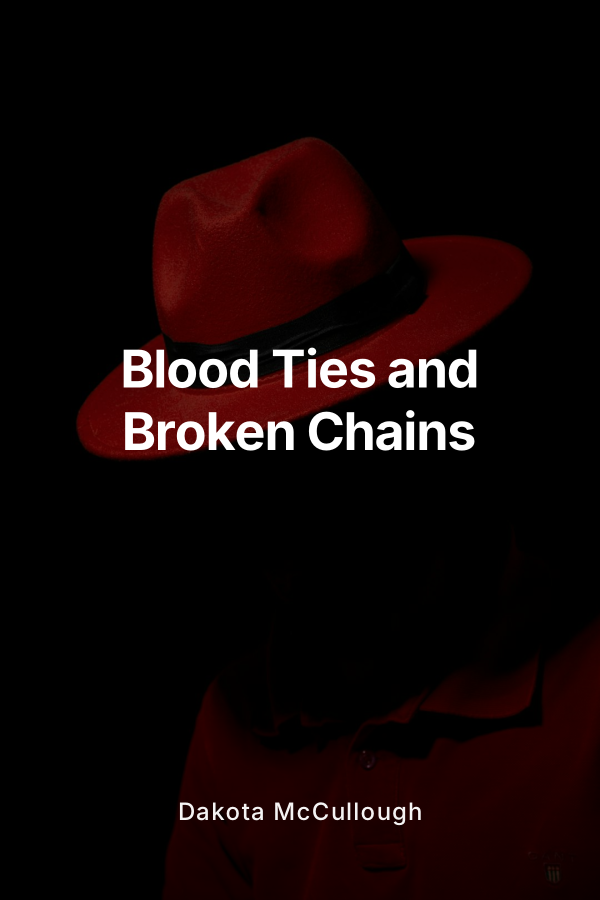
This book is a dark, emotionally charged crime thriller that follows Dakota, a haunted young woman who grew up inside a brutal syndicate and now finds herself entangled with a gang of dangerous but deeply loyal boys. As secrets from her past surface and enemies close in, Dakota must decide what she is willing to sacrifice to keep them alive and finally sever the chains of her old life. The story is structured as a multi chapter, character driven journey that moves from wary alliance to chosen family, and from quiet dread to explosive confrontation, culminating in a suspenseful kidnapping arc and a hard won, hard fought ending where everything is finally fixed, but not without scars.
The central emotional core of the book is Dakota’s struggle between who she was raised to be and who she is trying to become. She enters the boys’ world with lethal skills, coded instincts, and an instinctive distrust that makes every interaction feel like walking across a minefield. The boys, each with their own traumas and survival tactics, oscillate between seeing her as a threat, a tool, and eventually something like family. Trust is never given; it is tested in blood, in silence, and in the quiet choices no one talks about afterward.
Early chapters focus on “recruitment” and uneasy integration. Dakota is pulled into the boys’ orbit after a violent incident forces them to recognize that they cannot survive what is coming without someone who understands the underworld’s language of signals, debts, and revenge. The first arc establishes the rules of this world: territory lines, unspoken truces, and the shadow of the syndicate that once claimed Dakota as its own. Her past is present in the way she moves, the way she reads danger before anyone else, and the way she shuts down whenever kindness comes too close. This stage introduces the tension between Dakota’s lethal competence and her profound emotional illiteracy, as well as the boys’ rough edged sense of loyalty that does not yet extend to her.
The next chapters shift into “training and bonding,” where proximity and necessity force them into a fragile, makeshift unit. Dakota teaches them how to disappear in plain sight, how to spot a trap, how to handle themselves in an ambush. In return, the boys expose her to a life she has never known, one with trash talk and inside jokes, late night food runs, and the quiet comfort of simply existing in the same room without constantly scanning for betrayal. These chapters deepen individual backstories, show how each boy copes with fear and pain, and slowly chip away at Dakota’s carefully reinforced walls. Trust remains conditional and easily shattered, but moments of vulnerability begin to surface.
The “first major bloodshed” arc marks the turning point from preparation to open conflict. A mission that should have been simple spirals out of control when someone from Dakota’s past recognizes her. The fallout is brutal: territory is lost, an ally is exposed as a mole, and one of the boys gets badly hurt. For the first time, Dakota’s presence feels like a liability rather than an asset. The boys have to decide whether they will stand beside the person whose past just painted a target on all of them, or cut her loose to save themselves. Dakota, in turn, must choose between running as she has always been trained to do, or staying and making herself the shield instead of the knife.
From this chaos emerges the suspenseful kidnapping arc that dominates the penultimate portion of the book. Enemies realize that Dakota and the boys are more dangerous together than apart, and they strike where it will hurt most. One of the quieter boys, underestimated by everyone, is taken as leverage to force Dakota’s surrender and to punish the gang for disrupting syndicate operations. The build up is suffocating: cryptic warnings, failed intel, and the sense that something is off just beneath the surface. When the kidnapping finally occurs, it rips through the fragile sense of safety they have built. Every character’s fault lines are exposed as they scramble to locate him before time runs out.
These chapters lean fully into claustrophobic tension: false leads, messages from the captors, brutal ticking clock choices about who to save and what lines they are willing to cross. Dakota is forced to confront the ugliest parts of her past as the people who once owned her use memories, coded phrases, and old loyalties as weapons. The boys must face the possibility that saving their own might require doing the one thing they swore they never would: stepping fully onto the syndicate’s radar and declaring open war.
The final arc, the “last war and fixing what is broken,” is where every thread converges. The rescue mission becomes the catalyst for a larger takedown that targets the syndicate’s leadership and the network that has fed off their city for years. Dakota leverages her insider knowledge not for survival, but for justice. Carefully gathered evidence, hacked accounts, recorded confessions, and strategic leaks to outsiders become tools in a multi pronged assault that hits both the underworld and its corrupt allies in legitimate institutions. The climax is intense and costly. Not everyone walks away unhurt, and some relationships are permanently altered, but the boys and Dakota refuse to break.
When the dust settles, “everything fixed” does not mean clean or painless. It means the syndicate that ruled Dakota’s life is crippled, its leaders dead, scattered, or dragged into the light. It means the boys are no longer being hunted as expendable pawns. It means there is a path forward that does not end in a shallow grave or a prison cell. Publicly, there are consequences: arrests, investigations, a sudden shift in who holds power. Privately, the characters must navigate grief, survivor’s guilt, and the quiet strangeness of waking up in a world where constant fear is no longer the only way to feel alive.
The emotional resolution centers on chosen family and the cost of redemption. Dakota has finally severed the chains of her upbringing, but she carries the weight of what she did to achieve it. The boys have grown from a loose band of survivors into something resembling a family, built not on blood but on shared battles and mutual choice. They fix what they can: rebuilding their base, setting ground rules that prioritize survival without sacrificing their humanity, and beginning to heal from trauma that once felt permanent. There is room for softness now, awkward and unfamiliar, but real.
Throughout the book, tension, loyalty, and moral ambiguity drive the narrative. Violence is never senseless spectacle; it is a consequence of systems, choices, and histories that characters are constantly fighting to escape. The suspenseful kidnapping arc acts as both a crucible and a mirror, revealing who each character becomes under pressure. The final “fixed” state is hard won, leaving the cast marked but unbroken, with an ending that feels like breathing after being held underwater for too long.
Blood Ties and Broken Chains is written for readers who crave gritty, character centered stories about found family, past sins, and the thin line between vengeance and justice. It offers a layered, slow burning narrative where every chapter builds on the last, pushing the characters toward a final confrontation that is as emotionally satisfying as it is thrilling. The book closes with a sense of completion and hard earned peace, while still acknowledging that healing is not a single moment, but a choice they will have to keep making, together.