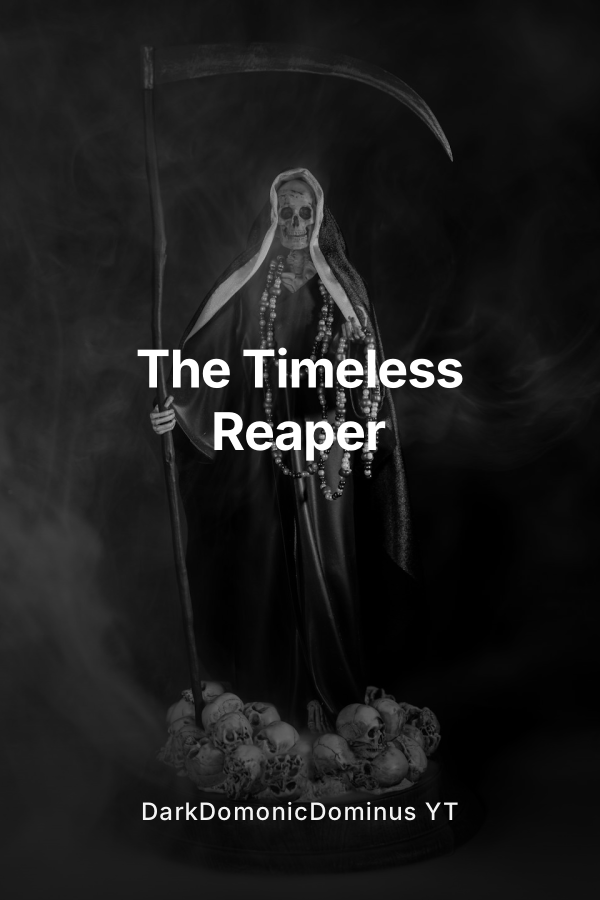
The Timeless Reaper is a dark fantasy novel about Kitoptua, a silent-born ninja forged into a reaper hunter, who pursues the ageless entity that stole her family and instead inherits its curse. Rooted in graphic, atmospheric horror and psychological descent, the book follows her journey from hunter to captive to the new timeless reaper, as she learns that vengeance does not end a cycle, it replaces its center.
Shaped for adult readers who relish grim worlds, ambiguous lore, and morally fraught transformations, the story is divided into three sweeping movements that unfold across five chapters. The narrative begins with Kitoptua in the mortal world, trained from childhood in the deadly silence of the ninja and secretly molded for one role alone: to become a reaper hunter. The reaper is not a rumor to her. As a young girl, she saw time shatter and freeze like glass in the sky, saw her family halted in mid-flight, then erased from the moving world as the reaper’s jade-green rage lit the night. From that moment, her life narrows to a single vow: destroy the creature that took them, even if it costs her humanity.
The opening chapters explore this hunter phase. Years of relentless training carve her body into a living weapon and her mind into a scarred, obsessive instrument. She becomes adept at detecting the slightest warps in reality, the thin chemical tang of air where time has stalled, the unnatural stillness that precedes the reaper’s arrival. Masters fear her. Comrades avoid her. She learns to track disturbances in time the way other hunters track footprints in mud. Yet beneath all her progress, one question haunts her: when vengeance is done, what remains of the one who lived only to avenge?
Her answer arrives when the moon itself turns an eerie jade and the world seems to hold its breath. In the ruins of an ancient shrine, Kitoptua confronts the reaper at last. Before it appears, its hounds emerge, spectral beasts glowing with a decaying green radiance that leaves streaks of unnatural light across stone as they move. She cuts them down with brutal efficiency, their bodies dissolving into mist and silence, proof that a mortal blade can at least unmake the reaper’s servants. Then the reaper steps forth, towering, faceless beneath swaying shadows, its eyes pulsing with dim jade light. It acknowledges her journey, speaking in a deep, cryptic voice about vengeance as a chain rather than a weapon, hinting that she is more bound than she knows.
In a surge of rage, Kitoptua attacks. Her blades pass through the reaper as if it is smoke, and chains of shadow erupt around her, tightening around throat, limbs, and even something deeper than flesh. In a blink she is dragged out of the flowing world and into the Prison of Frozen Time, a place her elders had warned her of yet never fully explained. Here, the middle movement of the novel begins.
The Prison of Frozen Time is a cage woven from the threads of eternity, a realm where motion itself has been murdered. Air hangs without stir, a single droplet of water remains forever suspended inches from her face, and sound has no place to land. In this impossibly still space, Kitoptua confronts the raw horror she sought and the truth she never wanted. She finds her family, perfectly preserved, standing as if caught midway through some forgotten moment. Their eyes are open, their faces calm yet lifeless, their skin pale and glasslike. They are flawless statues of a life that has stopped, and when she reaches for them her fingers meet an invisible solid surface, like the chilled face of frozen water. Her body shudders under the weight of that quiet.
The reaper speaks behind her, its tone now strangely gentle. It insists that what was done to her family was not cruelty but mercy, that they are beyond death, preserved from the slow decay that consumes all living things. It claims that truth binds all things, including her, and that the world rots while these frozen souls remain untouched by time. Kitoptua, choking on rage, denies this framing of mercy. To her, they are dead, stolen, unreachable. Yet the reaper presses its philosophy: she has wished to stop the world from rotting and now stands inside the result of that wish. The novel never fully explains the rules of this place or the origin of the reaper’s power. Instead, horror manifests through images of crystallized bodies, suspended droplets, and scenes trapped in endless almost-moments, leaving the terrifying mechanics of jade rage and temporal imprisonment shrouded in suggestion.
As she wanders deeper into the prison, Kitoptua encounters other victims, some caught mid-scream, some kneeling in prayer, others frozen in attacks or embraces. The stillness sharpens her grief into a new shape. The more she struggles against the quiet, the more reality itself seems to shiver at the edges of her perception, as if her fury can tug at the frozen tapestry around her. Graphic, surreal imagery marks this section, with veins turning to translucent filaments of light, breath turning to shards of frost, and glimpses of her own reflection warping into something inhuman whenever her jade rage surges. The prison becomes a mirror, not only of the reaper’s work, but of the emotional stasis she has lived in since the night her family vanished.
The story’s final movement begins when the reaper sheds its hood. Beneath the shadowed cowl there is no face, only a core of jade fire. Chains that held Kitoptua dissolve to dust, and the reaper offers her its scythe. The weapon floats to her with a faint green glow, weightless, inevitable. Someone must guard what remains, it says, and in that simple statement lies the heart of the book’s theme. The role of reaper is not a villain’s throne, but a burden passed from one maimed soul to the next. Vengeance was never a path of escape, only the route by which the chain finds its next link.
When Kitoptua reaches for the scythe, her reflection flashes along its curved blade. Her eyes now burn the same faint jade as the hounds that once hunted the living world. The silence deepens. The stillness spreads outward like an invisible tide. The old reaper steps back, disintegrating into drifting ash, leaving her alone as the new anchor of the prison. Her heart ceases to beat. Her body stops aging. Hounds rise at her side, newborn and absolutely devoted. Far away, in the mortal world, a distant child screams as stars freeze above and the air turns to frost. Time begins once more, yet under a different guardian. The cycle has not ended; it has renewed itself with a new, human center.
Across its five chapters, The Timeless Reaper traces a clear emotional arc. Chapter One presents Kitoptua’s childhood, the night of her family’s capture, and the vow that shapes her life. Chapter Two immerses readers in her brutal training and the intricate craft of hunting a being that lives between seconds. Chapter Three delivers the first full confrontation at the ancient shrine and her violent abduction into the Prison of Frozen Time. Chapter Four dwells in the prison’s graphic and psychological terror, forcing her to confront her family’s preserved state and the sickening mercy at the core of the reaper’s purpose. Chapter Five completes her transformation, as she chooses the scythe, becomes the new timeless reaper, and allows the old cycle to continue, but now through her. The resolution is not redemption. It is coronation into an eternal role that destroys the very self that sought payback.
Thematically, the novel wrestles with the nature of vengeance, mercy, and preservation. Vengeance here is not cleansing, it is binding, a chain that shackles hunter and hunted to the same post. Mercy, as the reaper defines it, is not kindness but a kind of violent preservation that denies both decay and growth. Kitoptua’s tragedy is that she chases the end of suffering and instead becomes the custodian of an endless pause. The book refuses to spell out the full nature of the Prison of Frozen Time or the exact logic of the jade-green rage. Instead, it leans into chilling images and emotional consequences, trusting readers to feel the horror rather than solve it.
By the last page, Kitoptua narrates herself with a new voice. She names herself the hunter, the haunted, and the guardian of utter silence, acknowledging the paradox at her core. Her vengeance has burned itself hollow and left behind something far colder. When her rage flares again, the world will remember fear, yet behind that terror stands a woman who once only wanted her family back. That knowledge lingers like frost in the reader’s lungs. The Timeless Reaper is not simply a tale of a monster defeated. It is the story of how a human soul becomes the next monster in line, how love twisted by loss can harden into an eternal duty that freezes entire worlds.