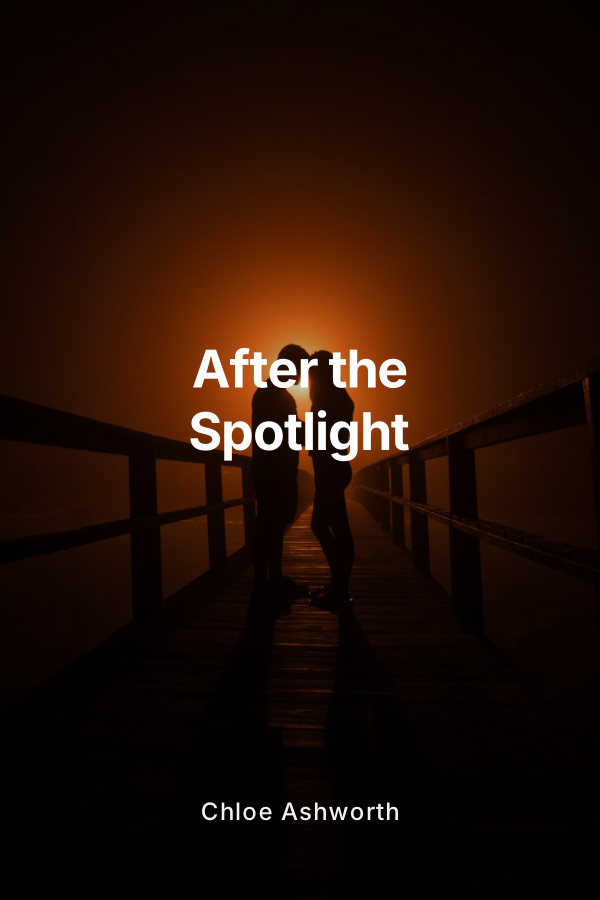
This book follows two former idol group members whose lives shattered under the weight of fame, homophobia, and betrayal. Years later, in the fragile quiet of Paris, their unexpected reunion forces them to confront the one truth they could never outrun: they were each other’s greatest love and deepest wound.
The story blends angsty second chance romance, hurt and comfort, and the relentless scrutiny of the entertainment industry. It is written for readers who love emotionally charged, character driven love stories where the past is a living presence, where every glance carries history, and where love must fight through shame, regret, and the ruthless logic of PR.
Chapter 1: The Boy Who Ran
The book opens in Paris, years after Jung walked away from idol life. Once the main vocal of a wildly popular group and one half of an illicit, all consuming love with his bandmate Tae, Jung is now a ghost of the boy the world knew. He lives quietly on the fringes of the city, working odd jobs, moving through creative circles where no one recognizes his stage name. On the surface, he is free. In reality, he is haunted.
Paris becomes a mirror of Jung’s inner conflict. Its art, language, and distance offer him an escape from the suffocating industry he left behind, but memories of Tae shadow everything. Jung carries an unresolved story: he left the group, left the country, and left Tae stuck in the machine they both once shared. Guilt and longing coexist in him. He tells himself he had to disappear, that leaving was the only way to survive as a queer man in an industry that punished even rumors, let alone truth. Yet Freedom feels incomplete without the one person he wanted to share it with.
The chapter slowly reveals how Jung and Tae first crossed the line from bandmates to something far more dangerous. Behind locked doors and blackout curtains, they found in each other a tenderness and understanding that fame could not offer. Their relationship grew in the spaces between schedules, in hurried whispers in practice rooms, in the warmth of a shared bed after another soul crushing day of training and performance. Those memories are Jung’s most precious and most painful possessions.
When Jung finally chose to quit, the decision was not clean or noble. The reader learns that it came after a breaking point: a scandal scare, escalating homophobic comments, and the company’s tightening control over every aspect of their lives. Jung’s departure was rushed and chaotic, made under pressure and fear. He told himself he was protecting Tae by being the one who left, taking the label of “quitter” so Tae could stay and thrive. Yet Tae’s last expression before Jung disappeared was not gratitude. It was betrayal. That look has never stopped chasing Jung across continents.
By the end of the chapter, Jung is drawn to a fashion event in Paris. The pull is irrational, almost masochistic. He has heard rumors of a Korean brand collaboration. The reader understands long before he admits it to himself: he is moving toward the possibility of seeing Tae again, even if it destroys him.
Chapter 2: The Man Who Stayed
The narrative shifts to Tae, who never left. While Jung reinvented himself in Paris, Tae remained bound to the company, to contracts, to fandoms that once treated him like a god and then like a symbol of controversy whenever the tiniest rumor surfaced. Tae now exists as a solo artist and model, hyper controlled, hyper polished, the perfect product of a ruthless system. He has built a successful career, but at staggering personal cost.
Tae’s days are a series of schedules and judgments. Every outfit is scrutinized, every gesture analyzed for hidden meaning. Homophobic comments are not just background noise for him. They are a constant reminder that one misstep, one captured glance, could destroy everything he has sacrificed to build. The company wields this fear mercilessly. Tae has been reminded again and again that he is lucky to still be working, that the group could have imploded after Jung’s exit, that scandals are waiting to consume anyone who strays from the approved script.
The reader learns how Tae processed Jung’s departure. To the public, Jung “burned out” or “chose a different path.” Inside the company walls, the story was twisted into a cautionary tale. Management painted Jung as selfish, impulsive, a threat to the group’s stability. Tae listened in silence as they rewrote their history, feeling anger ignite behind his carefully neutral expression. To survive, he let them convince him that Jung had indeed abandoned him to the industry. That narrative offered a bitter kind of comfort. If Jung had chosen freedom alone, then Tae was justified in choosing career alone.
Yet when Tae is alone, the mask cracks. He remembers nights when they whispered dreams of escaping together. He remembers promises made in the dark, plans half formed but full of hope. He remembers Jung’s shaking hands the day everything fell apart. Tae’s resentment is complicated. It sits on top of unhealed love, of longing that curdles into anger whenever he sees Jung’s face in old clips online. He banishes Jung from his mind during the day, then dreams of him at night.
At a Paris photoshoot, Tae arrives exhausted but determined to deliver perfection. The location is stunning, all old stone and modern staging. The team treats him as the star he has become, yet he feels strangely hollow. Just another brand, another lens, another image to approve. As he moves through poses, he has the eerie sensation of being watched from somewhere beyond the lights. He dismisses it as paranoia, another side effect of years under scrutiny. He does not know that Jung is somewhere on the edges of the set, hidden in the crowd, frozen between approach and retreat.
Chapter 3: Caught in the Frame
Their collision is not cinematic or gentle. It happens because the industry is always watching. During a brief break from filming, Tae slips around a corner to breathe in relative privacy. Jung, who has spent the entire event hovering between fight and flight, finally gathers the courage to get close enough to see him without cameras between them. For a moment they are just two men in a quiet corridor in Paris, the city humming behind them.
The reunion is electric and raw. Time collapses. Every unresolved word rushes to the surface. Jung apologizes without knowing where to start. Tae lashes out, voice low and furious, accusing Jung of leaving him behind, of choosing escape while Tae endured the fallout alone. The air is thick with all the versions of their story they have each carried, each convinced of their own hurt.
They do not know that they are not alone. A manager spots them together in a compromising angle, with distance too intimate to explain away easily. A camera clicks. The moment is caught in a series of blurry frames that, once taken out of context, are easy to spin into scandal.
News does not explode immediately, but the threat is instant. Tae’s manager reacts fast, pulling him away, voice sharp with panic. Jung is left standing alone again, heart pounding, realizing too late that his need to see Tae might have put them both back in the crosshairs they barely survived the first time.
The fallout begins behind closed doors. Tae is summoned to meetings where executives speak in measured, menacing tones about risk and damage, reminding him of morality clauses and market expectations. The incident is framed as a potential crisis that must be defused before it reaches the public in full. Tae is pressured to distance himself from Jung, to treat the encounter as a coincidence, maybe even a mistake.
For Tae, this is the old nightmare repeating. Years ago, any hint of their closeness could have ended both their careers. Now, standing at the peak of his solo success, he is told to choose again. He must either protect his hard earned position or acknowledge the man who has just walked back into his life. The company dangles ultimatums: controlled narratives, staged apologies, even the possibility of arranging fake dating rumors to bury speculation if necessary. Each option requires Tae to erase something true about himself.
Jung, outside this machinery, hears whispers of trouble. He blames himself, consumed by the fear that he has dragged Tae into fresh danger after everything they already survived. Yet beneath the guilt, a fierce clarity begins to emerge. Their love was not the problem. The system that punished it was. He realizes that running once may have saved him, but running again will only deepen the wound between them.
Chapter 4: Love in the Crosshairs
The leaked photos surface at last, blurry but charged. Online communities pick them apart frame by frame, arguing over body language, over shadows and smiles. Some fans defend Tae, insisting it is harmless. Others weaponize the images, feeding homophobic speculation and recycled rumors about both men. Tae’s team scrambles to manage the narrative while pretending nothing significant is happening. The company pressures him to stay silent or to issue a vague statement framing Jung as a casual acquaintance from the past.
This time, however, Tae is not the same frightened trainee who once believed he had no choice. Years of enduring commentary, control, and loneliness have hardened him, but they have also sharpened his sense of what he deserves. He knows he has poured his youth into building a career that can be taken from him with a single scandal. He also knows that no amount of compliance has ever truly kept him safe.
Tae and Jung begin to see each other in stolen moments while Tae’s schedule keeps him in Paris. Their conversations are jagged at first. Old arguments burn through them. Jung insists he left to keep them both alive, that he believed Tae needed the stage more than he did. Tae counters that love offered in one person’s terms alone is not love at all. For Tae, Jung’s departure felt like abandonment, a decision made for both of them without his consent.
Gradually, as they unpack the truth, a more complicated picture comes into focus. Both were trapped, both were terrified, both were manipulated by a system that thrived on their silence and shame. There was no clean hero or villain between them, only two boys who loved each other in a world calibrated to punish that love. As they finally say the words they swallowed for years, something fragile and new begins to grow in the cracks of their shared history.
Yet reality does not pause for their healing. Tae receives a new ultimatum. The company wants a clear gesture that distances him from Jung. Perhaps a high profile staged romance, a public narrative of moving on, or a subtle but unmistakable statement that reframes the leaked photos as nothing. The demand is clear. He must choose visibility without truth or truth without security.
Jung, aware of the pressure closing in on Tae, contemplates disappearing again to protect him. He could leave Paris, fade out of Tae’s orbit, and let the story die down. But this time, Tae refuses to be protected by another vanishing act. He confronts Jung with a different choice. If they are going to survive this, it cannot be through surrender. It must be through a new kind of courage they have never been allowed to practice.
Chapter 5: Watching from Afar
In the final chapter, time moves forward. Tae’s career continues on a visible path. He stands beneath glaring lights at a major Paris event, dressed in curated perfection, cameras clicking in relentless sequence. On the surface, nothing has changed. The industry still expects compliance. Contracts still loom like invisible chains. The public still gorges on carefully edited fragments of his life.
Yet beneath the surface, everything is different. Tae has begun to negotiate for himself in ways once unthinkable. He sets boundaries, rejects the most dehumanizing PR stunts, and begins quietly aligning his work with people who see him as more than a product. These changes are subtle and slow, strategic steps rather than reckless rebellion. The story respects the reality of risk. Coming out fully, directly, might not be possible without catastrophic consequences, but living with more self respect becomes his first radical act.
Jung, meanwhile, chooses a form of presence that does not replicate the old patterns of sacrifice or saviorhood. He does not force grand gestures or public declarations that would put Tae in immediate danger. Instead, he builds a life in Paris that is solid and real, grounded in creativity and community, rather than running from his past. His love for Tae no longer exists only as a wound. It also becomes a source of strength that pushes him to be honest about who he is, even if the world never knows the full story.
In one of the book’s most quietly devastating and beautiful scenes, Jung stands in a crowd at a Paris show where Tae is the star attraction. The distance between them is both physical and symbolic. Jung is anonymous among strangers, watching the man he loves bathed in light. Tae, under the harsh glare of cameras, performs with practiced grace, but something in his gaze feels altered.
There is no dramatic onstage confession, no sudden scandalous kiss that rewrites the rules of their world. Instead, the climax unfolds in small, potent gestures. Perhaps Tae’s eyes scan the crowd and linger, just for a second, on a silhouette that might be familiar. Perhaps Jung lifts his phone not to record Tae as an idol but to capture the moment as a person who has finally accepted that love is not always about possession or visibility. It can be about witnessing, about choosing to stay rather than run, about allowing each other to exist fully, even when the world is not ready to celebrate the truth of them.
The story closes on an open ended note that honors both the constraints and the possibilities of their reality. They are not magically freed from homophobia, from corporate control, or from the weight of their shared past. Instead, they step into a more honest future where they no longer pretend their love was a mistake. The reader is left with the image of Jung watching Tae from afar in Paris, not as a ghost of what might have been, but as a man who finally understands that surviving the spotlight’s damage and reclaiming their narrative is itself a quiet, revolutionary kind of happy ending.