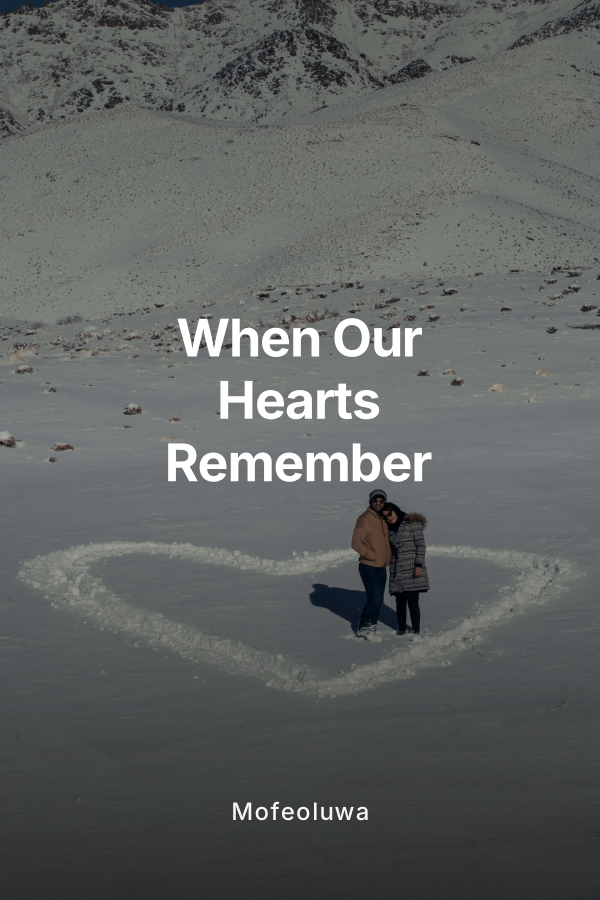
In a quiet coastal town where the sea keeps everyone’s secrets, two people who once meant everything to each other are forced back into the same small orbit and challenged to decide whether some love stories truly ever end.
Years ago, Emma Hayes and Lucas Reed were the kind of couple everyone believed would last forever. She was soft spoken but quietly determined, a woman who carried a notebook everywhere and hid her deepest dreams between the lines. He was the boy who rebuilt broken things with his hands, a mechanic with oil on his fingers and poetry in his heart. They walked the shoreline at dusk, made reckless promises in the front seat of his pickup, and sketched out a shared future that felt as solid as the old lighthouse on the cliff.
Then one catastrophic night shattered everything. A single mistake that spiraled into a chain of hurt left them standing on opposite sides of a chasm too wide for apologies to cross. Emma packed her life into three suitcases and vanished into a different city, a different career, a different version of herself. Lucas stayed behind, living among the ruins of plans that no longer belonged to him, trying to build something steady out of guilt, anger, and regret.
Years later, Emma returns to the town she swore she had outgrown. The official reason is practical. Her widowed father’s health is failing, his once lively bookstore is in trouble, and someone needs to help him before he loses everything. The truth, however, is more complicated. Emma’s life in the city, so carefully constructed around safety and control, has begun to feel hollow. Her engagement has dissolved into polite disappointment. Her career, with its polished presentations and long hours, has quietly stolen her joy. Coming home is the one thing she promised herself she would never do, and the only thing that still makes sense.
Lucas, now co owner of a small but thriving garage overlooking the harbor, has spent years pretending that he has moved on. His days are full, his business solid, his friends loyal. He has become the man everyone once hoped he would be, yet there are nights when he still hears Emma’s laugh in the echo of the waves, and mornings when he reaches for someone who is no longer there. When he hears that Emma is back, it feels like a tide he cannot fight turning beneath his feet.
Their first meeting is not cinematic, just awkward and charged in the cramped aisles of the bookstore that once held their shared dreams. Time has changed their faces, sharpened their edges, and wrapped them in layers of self protection. Yet beneath the practiced small talk and clipped politeness, something elemental stirs, remembering every look, every touch, every quiet promise they once made.
As Emma settles reluctantly into her childhood home, she finds herself entangled in the life she left behind. The town has changed, but the rhythm of the ocean, the familiar creak of the bookstore’s wooden floorboards, and the scent of salt in the air make her feel like the years away might have been a particularly vivid dream. Slowly, against her better judgment, she begins to let herself breathe here again. She reconnects with her best friend, meets neighbors who never fully forgot her, and finds unexpected solace in late nights helping her father choose which books to keep and which to let go.
Lucas, meanwhile, is drawn into Emma’s orbit almost against his will. A favor for her father at the garage, an impulsive offer to help repair the bookstore’s failing delivery van, and a series of small town coincidences keep placing him in her path. Every encounter chips away at the safe distance they are both trying so hard to maintain. Emma sees the man he has become, patient and steady, shaped by a grief he never quite speaks aloud. Lucas sees a woman who has learned to stand taller, whose quiet has turned from timidity into thoughtful strength, yet whose eyes still betray the softness he fell in love with.
Old wounds do not disappear simply because time has passed. The secret that tore them apart still sits between them, sharp and unhealed. Misunderstandings, half truths, and the echo of harsh words spoken in anger haunt their tentative steps toward each other. Emma has built her entire adult life on the belief that she must never again trust her heart more than her head. Lucas is convinced that forgiveness is more than he deserves. Each of them is terrified that opening old doors will drag them back into a version of themselves they worked so hard to outgrow.
Yet the town itself seems determined to weave them back together. A summer festival planning committee that “accidentally” needs both of their talents. A storm that knocks out power and traps them together in the bookstore overnight. A series of moments that feel both entirely new and painfully familiar draw them into fragile truce, then into reluctant collaboration, and finally into something that looks dangerously like friendship.
In the quiet hours, they begin to talk, not about what happened at first, but about everything else. Work. Family. The weight of expectations. The sharp loneliness of pretending to be fine. Little by little, they find themselves sharing the parts of their lives no one else has seen, rebuilding the effortless intimacy that once came so naturally. They slip into old patterns without meaning to, finishing each other’s sentences, teasing with the same gentle ease, reading the shift in the other’s expression before a word is spoken.
With each honest conversation, the past presses closer. Emma cannot ignore the way her pulse leaps when Lucas looks at her a moment too long. Lucas cannot keep pretending that her presence does not unsettle the careful equilibrium of his days. They both understand that they stand at a crossroads. They can remain polite ghosts in each other’s stories, or they can face what happened and risk tearing open wounds that never quite healed.
As they tiptoe toward that truth, the pressures of the present tighten around them. The bookstore’s finances are worse than Emma realized, and hard choices loom. Her father’s health quietly declines, revealing vulnerabilities he has long hidden. Lucas faces a business opportunity that could take him far from the town, a chance he once would have taken in a heartbeat, if not for the anchor that Emma’s return has become. Friends and family, each with their own opinions and loyalties, pull them in conflicting directions, forcing them to question what they owe to themselves versus what they owe to others.
At the heart of the story lies the night that broke them. When the truth finally surfaces, it is not a single revelation but a mosaic of small misunderstandings and private fears. Emma learns that what she once saw as betrayal was rooted in Lucas’s desperate attempt to protect her from a reality he did not know how to face. Lucas learns that Emma’s decision to leave was not an act of abandonment, but a terrified, lonely bid for survival at a moment when she felt completely alone. Neither of them was entirely right, and neither was entirely wrong. They were simply young and fragile, trying to navigate pain with tools they did not yet possess.
Forgiveness does not arrive all at once. It comes in halting steps, in apologies that catch in their throats, in the awkwardness of learning to look each other in the eye again without flinching. It comes in the way Lucas shows up at the bookstore on the worst days without being asked, fixing what he can and simply standing near what he cannot yet mend. It comes in the way Emma brings coffee to the garage and sits on an overturned crate, listening to him talk about things he has never admitted to anyone else.
Alongside the central romance, the story explores the quiet complexities of other relationships that shape their world. Emma’s bond with her father, strained by years of distance and unspoken disappointment, deepens as he slowly reveals his own regrets and the ways he failed to protect her when she needed him most. Lucas’s connection with his younger sister, who still carries resentment over choices he made when their family was falling apart, mirrors his struggle to make peace with the past. The vibrant network of friends and townspeople provides a living backdrop of warmth, humor, and occasional meddling that reminds both Emma and Lucas that love is not only found in grand gestures, but in the people who refuse to give up on you even when you have given up on yourself.
As the summer draws to a close, the stakes rise. An offer arrives that could save the bookstore, but only if Emma is willing to let go of the very thing she believes defines her. Lucas’s potential expansion deal solidifies, promising growth and financial security in a neighboring city. Their choices are no longer abstract questions, but concrete decisions with timelines and consequences. For the first time since their breakup, they must decide not only what they feel for each other, but what they are willing to risk for that love.
In the climax of the story, a convergence of personal crises forces everything into the open. A health scare with Emma’s father, a misunderstanding that makes it appear Lucas has chosen his career over her all over again, and the looming closure of the bookstore combine into a breaking point. Both Emma and Lucas revert, briefly, to old patterns rooted in fear. She pulls away, convinced that she is asking for too much. He shuts down, believing that every attempt to reach for her will only hurt her more.
What follows is not a grand theatrical declaration, but something quieter and more honest. Emma realizes that protecting herself by staying numb is its own kind of loss. Lucas understands that loving someone means letting them see the parts of him that feel most unworthy. They meet again where everything first began to unravel, in the shadow of the lighthouse, with the sea roaring below and the wind tearing their words into the night. This time, though, they refuse to walk away half spoken.
They lay everything out: their fears, their mistakes, the ways they failed each other and themselves. There are tears and sharp words, but also laughter at the absurdity of all they have carried alone. In choosing to stand there together and speak the whole truth, they create something new, a love that is no longer built on youthful fantasy, but on the hard won understanding of who they really are.
The resolution is tender and grounded. Emma does not magically abandon her ambitions, nor does Lucas sacrifice his career to prove his devotion. Instead, they craft a life that honors both of them. The bookstore is reborn in a smaller, more sustainable form that blends Emma’s creative eye with the town’s nostalgia. Lucas restructures his business plans to allow for growth without severing his roots. They begin to rebuild trust not with promises of forever, but with the daily choice to stay, to show up, to listen.
Throughout the five chapter arc, “When Our Hearts Remember” follows Emma and Lucas through the full sweep of their emotional journey: the uneasy return, the tentative reconnection, the painful excavation of the past, the breaking point where it seems they will lose each other again, and the delicate, hopeful beginning of something truer. Each chapter deepens the emotional stakes, drawing the reader closer to the raw, intimate spaces where love is both fiercest and most fragile.
Ultimately, this is a story about second chances, not only in love, but in the relationship one has with oneself. It asks what it means to forgive, to truly be seen, and to choose vulnerability over safety in a world that often rewards distance. It lingers on the small, intimate moments that make up a life shared with another person: the way a hand finds yours under a table, the quiet of shared coffee at dawn, the courage it takes to stay in the room when the conversation grows uncomfortable.
“When Our Hearts Remember” invites readers into a tender, emotionally rich romance where the most profound transformations happen not in sweeping declarations, but in the steady, patient work of healing. It is a love story for anyone who has ever walked away believing they were protecting their heart, only to discover that some connections live on in the marrow of who we are, waiting for the day we are brave enough to return.