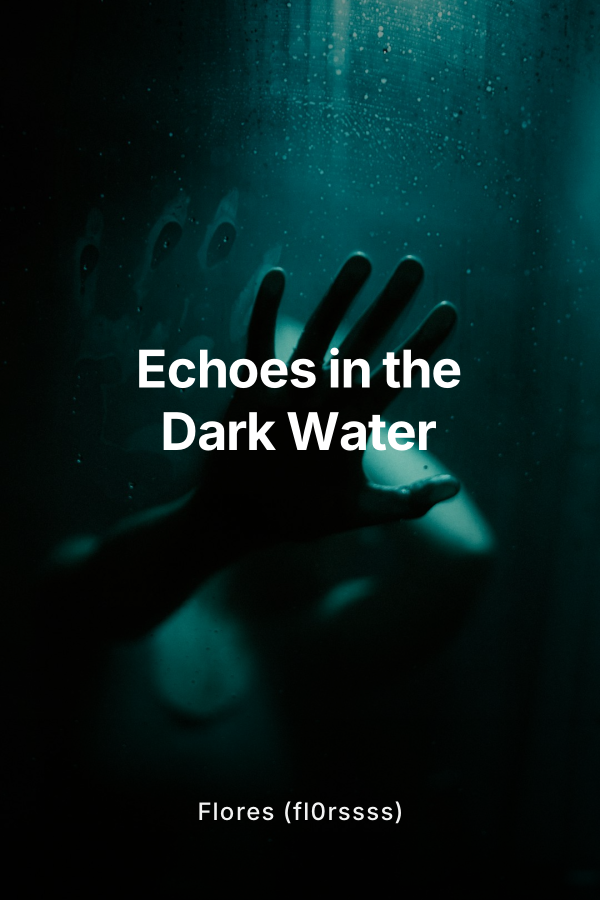
This book is a tightly woven, character driven mystery that blends psychological suspense, queer coming of age, and supernatural ambiguity. Across five escalating chapters, it follows a fractured family forced to confront buried guilt, dangerous illusions, and a wolf that may be more than just a monster in the woods.
At the center stands Tom, the older brother who has spent years running from a single night that shattered his sense of self. When the story opens, Tom is exhausted, haunted by visions that steal his breath and drag him backward into memories he has never fully faced. Alongside him are his siblings Eric and Angela, each carrying their own scars and suspicions; Adam, their youngest brother whose easy jokes and talk of girls have always been a convenient mask; Luke, Adam’s best friend whose loyalty hides something deeper; Mark, the impulsive wild card of the group; and Veronica, whose quiet observations cut closer to the truth than anyone realizes.
The past and present collide when the group is drawn back to the isolated place where everything first went wrong, a location that seems to cling to them as stubbornly as their shame. There, an enormous wolf stalks the treeline, all teeth and glinting eyes, a beast that appears and vanishes with the precision of a nightmare. Its growls rumble like a storm just beyond the characters’ vision, an ever present threat that keeps them on edge and drives them toward confessions they have avoided for years.
The first major thread in the mystery centers on Tom’s illusions. He begins seeing a younger version of himself and his former friend Will standing between him and the wolf, trapped in a reenactment of a scene that never fully resolved in his mind. The “Illusion Will” shoves “Illusion Tom” forward, desperate to save him, while the looming animal readies to strike. Watching this spectral tableau, Tom must relive the helplessness of being the one who was protected instead of the one who did the protecting. Each time the illusion surfaces, it grows more detailed, more tactile, until Tom cannot tell whether he is remembering, dreaming, or being warned.
The second thread coils around Adam and Luke. To everyone else, they are just the youngest brother and his goofy best friend, bonded over video games, late night texts, and harmless gossip about girls. Yet in quiet looks and reflexive touches, something else has always shimmered beneath the surface. The crisis with the wolf and Tom’s unraveling illusions push them into closer quarters, into breathless, huddled conversations in the dark where the truth starts to slip out. Adam’s façade cracks under the pressure of possibly losing Luke, and Luke’s carefully guarded fear of being seen is forced into the light. The book tracks how their relationship evolves from coded jokes to a fragile, secret romance, a parallel mystery of the heart that mirrors the danger outside.
The most explosive scene, described early in the outline and paid off in full later, unfolds in a long, panic stricken rush. The wolf has cornered them. Air is thin, lungs burn, and every whispered word feels like it might be their last. In the distance, a strange weapon waits: Mark’s haphazard yet oddly brilliant cache of water balloons, their childishness at odds with the stakes of the moment. As the wolf’s growling builds and bricks itself into a wall of sound, Mark lurches into action, hurling balloon after balloon. The absurdity of the attack collides with grim terror. To everyone’s horror, the water strikes do more than scare the wolf. They hurt it. Or at least, they seem to, because with each impact the growl fractures into a wounded whine, then a howl, then a chorus of dissonant cries. It is as if the sound is coming from more than one creature, or from someplace other than the animal’s throat.
In the middle of this chaos, two unforgettable lines anchor the scene. Adam and Luke finally spill the words they have held back for years, the kind of lines that feel like lifelines and confessions all at once. Their declarations tie together past and present, the fear of love and the fear of death, and leave both characters changed no matter what happens next. This moment plants one of the central questions that drive the mystery: if they only dared to speak the truth when a monster was about to tear them apart, what else have they been too frightened to say in calmer days?
Tom’s storyline twists even deeper into psychological territory when he chooses, at last, to interfere with his own illusion. Standing behind the flickering figures of his younger self and Will, Tom realizes that replaying the scene as a helpless spectator is a form of surrender. The illusions have always cast him as the one who needed protection, the one dragged out of the line of fire. Now, driven by equal parts guilt and defiance, he lunges forward. He grips the shoulder of Illusion Tom and yanks him away from Illusion Will and the approaching wolf, reversing the roles that have tormented him. The moment he makes this choice, the illusion does not explode but instead disintegrates. The scene flickers to dust, the air filling with the sensation of ash being blown off an old photograph. Tom is swallowed by darkness, weightless and suspended.
Within this darkness, he feels thousands of hands clutching at him, pulling him back toward something heavy and real. The sensation is part drowning, part rescue. Those hands become one of the book’s most haunting images. Are they literal, the panicked grip of his siblings dragging his limp body away from danger? Are they metaphorical, the accumulated weight of every person he loves and every version of himself he has disowned? The narrative refuses to settle the question neatly, inviting the reader to sift through clues about how much of what Tom sees is rooted in trauma, how much in a supernatural pattern that has haunted this family for years.
Once Tom is pulled back to consciousness, the tone of the story shifts. He is no longer simply evading his guilt; he has touched the epicenter of it and survived. The mystery then widens to reveal that every member of the group has their own version of “the illusion” they have been clinging to. Eric has preserved a narrative in which he is the solid, dependable brother, too busy managing practical concerns to acknowledge his grief. Angela has prided herself on being the one who holds everyone together, turning her back on the parts of herself that also feel broken. Mark plays at being reckless, glossing over how scared he actually is. Veronica stays quiet, registering every detail, as if silence absolves her from having a point of view. The wolf and the illusions act as catalysts, stripping away these self serving stories and exposing the secrets at the core of the family.
One of the quiet yet crucial threads is the car scene near the end. The immediate danger has ebbed, but the aftermath stretches long and uncertain. Tom, Eric, Angela, Adam, Luke, Mark, and Veronica pile into the car, cramped and exhausted. Outside, the world looks deceptively normal. Streetlights pass over their faces in a repeating pattern, like a projector cycling through images. Inside the car, the temperature is fragile. They have survived something they do not yet know how to name. In this enclosed space, the family has one more mystery to navigate the truth about Adam and Luke.
When Adam and Luke’s newly acknowledged relationship is revealed, the moment is less about shock and more about recalibration. Tom and Eric, both older brothers shaped by expectations of how boys in their family should act, are stunned not because they disapprove, but because all their assumptions about Adam’s future vanish in an instant. Angela, hands steady on the wheel, reacts with a soft smile that says she has always known, or at least suspected. Mark, who has long made a sport of teasing Adam about crushes, reaches out with a comforting pat on his shoulder, the gesture surprisingly gentle. Veronica wraps Luke in a hug, her acceptance as natural as breathing. Together, the older siblings and friends offer Adam and Luke a pact: “Mom and dad do not have to know, if you do not want them to.”
This line becomes emblematic of the book’s exploration of secrecy. It is spoken as an act of protection and solidarity, yet it also echoes the very pattern that harmed them in the first place. For years, this family has kept secrets to spare each other pain. They hid the depth of Tom’s trauma, the true nature of what happened with Will, the way the wolf or the idea of the wolf prowled through their lives. They learned to tiptoe around certain topics, to veil their fears in jokes and distractions. Now, they are offering to hide one more truth, even as they cling to one another with more honesty than ever before. Adam, fully aware of the weight of secrets, agrees only “for now,” his hand brushing Luke’s in a subtle gesture that vows they will choose the time and manner of their next revelation.
Across its five chapters, the book builds its mystery not around a single clue or body, but around layers of partial truths. Each chapter peels back a different strand. The first situates the reader in the present the threat of the wolf, the shakiness of the family, the tension between Adam and Luke that no one names. The second dives into Tom’s illusions, offering fragmented flashbacks that may not be trustworthy. The third amplifies the paranormal uncertainty the water balloons that seem to harm an impossible creature, the hands in the dark that feel too many and too synchronized to be entirely human. The fourth rewrites the past by letting Tom intervene in his own memory, challenging the very idea of what “really” happened. The fifth brings everyone into a cramped, moving car where small choices of words and touches carry more weight than any confession screamed in the forest.
Clues are scattered with care. Offhand remarks about past arguments hint at fissures that matter later. Slight inconsistencies in Tom’s recollections raise questions about whether the wolf attacked once or many times or whether it is a recurring figure conjured by guilt. The way Adam jokes about girls just a touch too loudly becomes a retrospectively obvious misdirection. Mark’s preparedness with the water balloons foreshadows his role as an accidental savior, while also hinting at a history of expecting disaster and secretly planning for it. Veronica’s quietness is itself a clue she knows more than she says, and her eventual comments about what she saw in the forest contradict what everyone else insists was true. Readers are invited to sift through these details, deciding which threads to pull and which to leave alone.
The narrative carefully avoids answering every question about the wolf. Even by the final chapter, it is unclear whether the beast is a literal creature, a manifestation of shared trauma, or a phenomenon that emerges whenever this family gathers in that place with certain feelings unspoken. What becomes clear is that the wolf follows patterns. It appears when the family is most divided, it recedes when they act together, and it transforms first into growls, then whines, then layered howls under the impact of something as simple as water in brightly colored balloons. This odd vulnerability suggests that the real power lies not in brute force but in disrupting the script that everyone expects to play out. When the family behaves out of character, when they reach for one another instead of hiding, the creature’s hold on them loosens.
By the end of the book, the core mysteries are not whether the wolf existed or what, precisely, Tom saw in his illusions, but how a family can live with events that no one fully understands. How do they move forward knowing that they had opportunities to speak and did not? How do they decide which secrets to keep as a kindness and which to expose as a step toward healing? Adam and Luke’s relationship becomes the test case for a new way of being. Their decision to keep their romance from their parents “for now” is not framed as another act of cowardice, but as a conscious choice to control their story, to avoid repeating the pattern where others decide what is best to hide. At the same time, their siblings’ acceptance shows that, at least within this chosen circle, concealment no longer equates to shame.
In its final pages, the book leaves readers with a lingering image. The car moves down a long stretch of road, darkness pooling between the dots of passing lamps. Inside, Adam and Luke’s fingers finally intertwine openly. Tom stares out the window, feeling at last that the thousands of hands that once clawed at him in the dark are now resting lightly on his shoulders, no longer dragging him backward but steadying him. Angela hums under her breath. Mark dozes, arms folded like he still expects to wake to the wolf’s snarl. Eric glances often in the rearview mirror, scanning not for predators, but for the expressions of the people he almost lost. Veronica watches everything, storing it away.
Far off, beyond what anyone can see, something shifts in the treeline as the car disappears. The reader cannot tell whether the movement is just an animal settling into its den or something more purposeful. The book does not say. It trusts that by now the audience understands that some mysteries are meant to remain unresolved, not to frustrate but to reflect the incomplete, flickering quality of real memory and real healing.
“Echoes in the Dark Water” invites readers into a world where danger and tenderness exist side by side, where monsters are as likely to emerge from within as from the shadows between trees. It is a story about siblings and friends who learn, through terror and confession, that the only way to survive the things that stalk them is to face both the creatures outside and the truths within.