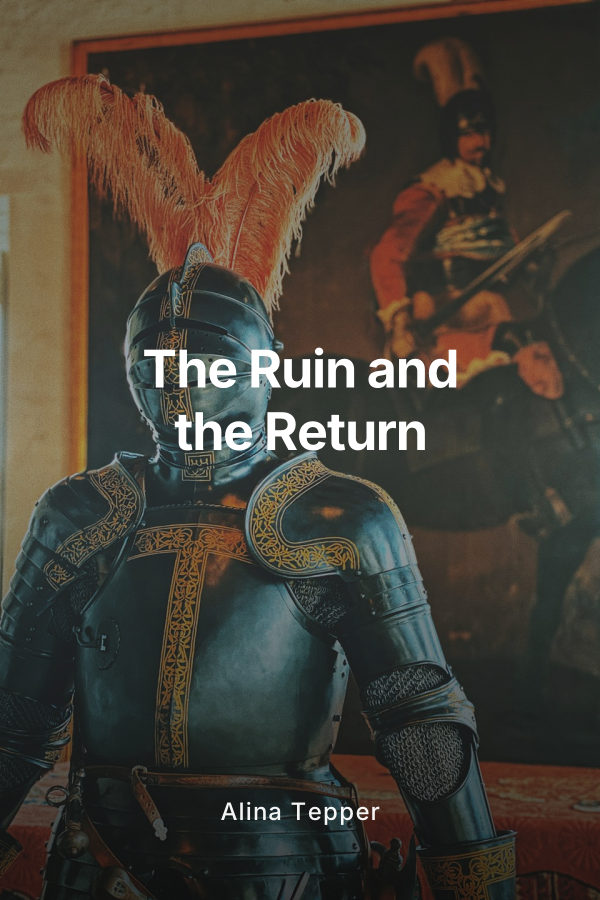
Summary:
In glittering eighteenth century London, where a young woman’s virtue is as fragile as a whisper, fifteen year old Eliza Fairbourne lives on the edge of a world she has only begun to taste. The daughter of a respected solicitor, she spends her days in schoolroom propriety and her stolen afternoons in the wild wood that separates her family’s estate from that of a newly arrived duke. There, beneath tangled branches and dappled light, she forms two bonds that will shape the rest of her life: one with spirited, envious Charlotte Avery, her closest friend, and another with Edward Hawkesley, the shy and earnest son of the Duke of Ravensfell.
Eliza does not yet understand that Charlotte has already begun to measure her own worth against Eliza’s: the warmth of Eliza’s laughter, the attention she draws without effort, and the quiet devotion in Edward’s eyes that Charlotte covets but cannot command. When Charlotte’s father, a powerful solicitor to half the ton, gambles with more than money and begins to slide toward financial ruin, Charlotte discovers that one sacrificed reputation might save another.
On a stormy afternoon, Charlotte plants Eliza’s favorite gown in a crumbling woodland cottage and bribes the vicar’s weak willed nephew to play his part in a lie. He will proclaim that he has disgraced Eliza, but in truth he has taken Charlotte’s virtue in payment. The plot works too well. Eliza’s own father, terrified for his standing, believes the worst. She is cast out of her home, bundled away to a secluded school for “fallen” girls, and cut off from everyone she has ever loved.
Shattered, Eliza descends into despair, her thoughts turning to an early grave. Yet within the school’s bleak walls she encounters unexpected mercy: Lady Cornelia Ashford, a widowed patroness of unorthodox compassion, who sees past the stain on Eliza’s name. When Eliza’s disgraced father dies under a cloud, a former acquaintance leaves her a modest trust, enough to give her independence under Cornelia’s wing. Over the next four years, Eliza painstakingly rebuilds herself. Her innocence can never be restored in the eyes of the world, but she can claim poise, knowledge, and a cold resolve.
At nineteen, she returns to London under a new name as Lady Cornelia’s companion, presumed to be a poor but well born ward. High society remembers a scandal but has forgotten the girl at its center. Behind a new face and measured smile, Eliza walks back into the drawing rooms and ballrooms that once turned their backs on her. Her purpose is clear: uncover the truth, destroy the men who profited from her ruin, and shatter the life of the woman who betrayed her.
What Eliza does not anticipate is Edward’s presence. Now the polished heir to a dukedom, he is no longer the earnest boy she left at the forest’s edge. He has grown into a man of influence and quiet intensity, one who has spent years haunted by the unexplained disappearance of the girl he once cherished in silence. When they meet across a crowded ballroom, he feels an inexplicable pull toward the composed stranger at Lady Cornelia’s side. Eliza, too, is shaken. He does not recognize her, yet the warmth in his gaze is painfully familiar.
Determined to keep her heart as guarded as her identity, Eliza resolves to use Edward as a pawn in her plan. If she can win the devotion of the Duke’s son, she can secure her own position and sharpen the humiliation that awaits Charlotte. But the careful seduction she orchestrates soon slips from her control. Late night conversations, stolen moments in shadowed corridors, and forbidden kisses behind the safety of half closed doors fan old embers into a fire she can no longer pretend is mere strategy.
As their bond deepens, Edward confides the private griefs that have shaped him, while Eliza hides the deepest wound of all. She cannot bring herself to tell him that she is the ruined girl his world abandoned, nor that every step she takes through London’s season is part of a carefully laid design for retribution. Still, he chooses her in a way no one ever has: not for her family, not for her unblemished name, but for the woman she is, without knowing the full truth of what was taken from her.
In parallel, the narrative returns again and again to Eliza’s past: the poisonous friendship that turned on her, the claustrophobic cruelty of the “reform” school, and the fragile lifeline offered by Lady Cornelia. These alternating chapters slowly unravel the complexity of her hurt and the hard won resilience that now holds her upright in London. Readers are invited to feel the full weight of each betrayal even as they watch Eliza move like a poised stranger through the very circles that once condemned her.
Evidence begins to surface. Eliza uncovers clandestine ledgers and correspondence that suggest Charlotte’s father has built his reputation on fraud and misappropriated funds. Worse, she learns the full horror of Charlotte’s original scheme: the vicar’s nephew did not simply lie; he bartered the truth of his own assault upon Charlotte in exchange for protection and money. Eliza must grapple with a new and bitter awareness. The girl who ruined her has been ruined herself, not by reputation alone but in body and soul.
This discovery does not erase Eliza’s fury. Instead it destabilizes it. The revenge she dreamed of as pure justice reveals veins of sorrow and self destruction beneath. She battles a relentless storm of emotions: the urge to pity Charlotte, the desire to destroy her, and the dawning fear that clinging to vengeance might cost her the love forming quietly but surely between her and Edward.
Everything converges at the height of the London Season, during a glittering ball hosted by the Duke of Ravensfell. The chandeliers burn late into the night, music floats through marbled halls, and all of society gathers to observe, judge, and whisper. Eliza chooses this moment to strike. She has arranged for certain documents to appear, for certain names to be mentioned in the right ears, and for particular guests to be present when truth and scandal collide.
Before the assembled company, a chain of revelations unspools. Financial impropriety, legal manipulation, the quiet ruin of countless clients corralled into the Avery empire: all emerge into the astonished silence of the ballroom. Charlotte’s father, once considered unimpeachable, finds himself confronted with irrefutable proof of his crimes. At the same time, the vicar’s nephew is drawn unwillingly into the light, forced to confess that the girl he “disgraced” was never Eliza at all. His halting testimony, combined with Eliza’s carefully preserved evidence, uncovers Charlotte’s bargain, her whispered bribes, and the sordid truth of her own violated reputation.
It is at this point that the elegant facade Charlotte has worn for years shatters. Cornered, furious, and humiliated, she lashes out in front of the entire company. Blaming Eliza for everything she has lost and everything she failed to secure, she screams that Edward should have been hers, that she has loved him, coveted him, and resented his tenderness toward the girl he lost in the woods. In her rage, she unwittingly confirms the jealousies and manipulations that began when they were still children, confessing aloud that she framed Eliza to rid herself of a rival and preserve her own position.
Her outburst sends ripples through the ballroom. Faces once politely indifferent now turn openly scandalized. Some guests recoil. Others drink in every word. Whispers fly faster than music, and by morning half of London knows that the ruined girl of four years past was not a seductress but a sacrificial offering to another family’s greed.
In the charged aftermath, Eliza can no longer conceal who she is. Her revelation to Edward is raw and painful. He must confront the fact that he fell in love with the same girl twice, once as a boy and once as a man, and that while she has been fighting her way back from oblivion, he has enjoyed all the protections of rank. She, in turn, must accept that while he did not stand beside her in her worst hour, he had been kept in ignorance and now chooses to stand with her when the cost is highest.
The ensuing legal investigation confirms Eliza’s role in bringing the truth to light. Charlotte’s father is arrested and eventually jailed for his fraudulent dealings. Charlotte herself becomes a cautionary tale rather than a glittering prize. Some pity her, others quietly relish her descent. Eliza watches from the edge of this ruin she created, feeling both the cold satisfaction of justice and a surprising, fleeting pang for the lonely, desperate girl her enemy has become.
Society does not fully forgive. It never does. Suspicion and remembrance cling stubbornly. Some hostesses hesitate before writing Eliza’s name on their guest lists. Some gentlemen choose another path across the room rather than bow in greeting. Yet Eliza is no longer alone. Publicly claimed as Edward’s choice and, in time, his wife, she steps into her new role as Duchess of Ravensfell with clear eyes and steady hands. Together, they decide not to erase the past but to outface it.
Rather than slink away from rumor, they appear side by side at events, lend their support to charities for women cast off by respectable families, and use their influence to steady those most at risk of the same fate Eliza narrowly escaped. Their marriage is not a fairytale that forgets the knife of betrayal. It is a partnership forged in private tenderness and public defiance, one that acknowledges that love can grow in the shadow of cruelty and still remain unbroken.
“The Ruin and the Return” weaves a narrative of scandal and survival, of a girl turned woman navigating the delicate balance between justice and mercy. It invites readers into candlelit ballrooms and silent school corridors, into stolen glances and whispered confessions, into a world where a single accusation can end a life and a single act of courage can begin it again. At its heart, it is the story of a young woman who refuses to let the worst thing that ever happened to her be the final word, and of the man who finally sees and loves her entirely, scar and all.