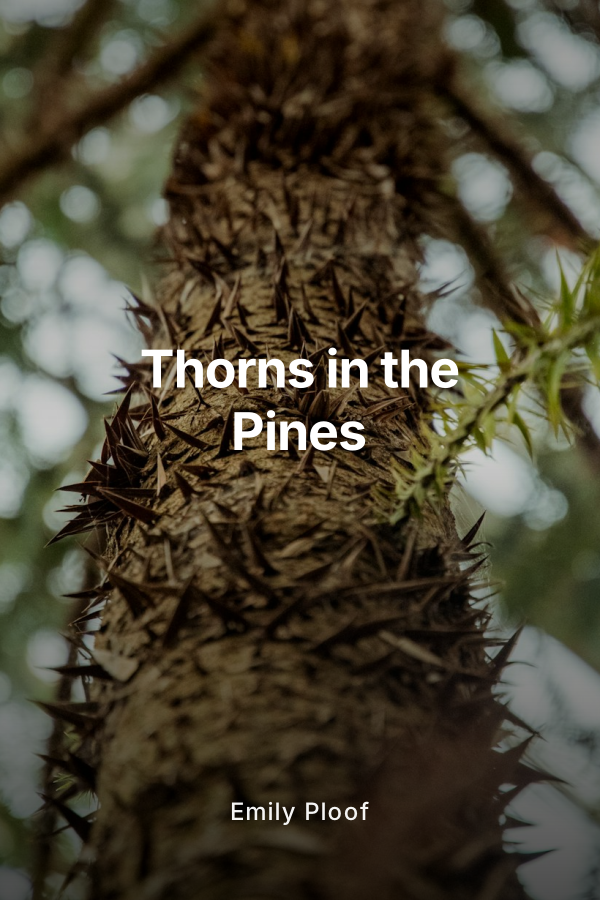
In the shattered world beyond the outbreak, violence has become a language everyone understands. Ellie, hardened by loss and driven by the singular purpose of finding Abby in the ruins of Seattle, believes she knows exactly what she is willing to sacrifice for vengeance. That certainty fractures the moment she stumbles across something that should not exist in a place like this: a girl in pink, bleeding in the dark.
Deep in a rain soaked Seattle forest, Ellie discovers Cleome, a preppy, pastel loving outsider whose entire body is laced with fresh, knife like scratches. The wounds are still bleeding, the forest floor is stained with red, and nothing about Cleome belongs in this brutal landscape. Her clothes are torn, her hair is matted, yet traces of glitter and soft color cling to her like stubborn memories of a world that died long ago.
Ellie wants to walk away. Abby is out there somewhere, and every detour feels like a betrayal of everything she has already lost. But Cleome is not just another stray survivor. She carries pieces of a secret that tie directly into Ellie’s hunt and into the dark machinery of violence grinding away in Seattle’s shadows. Helping this stranger might lead Ellie to Abby. It might also destroy what is left of her already fractured conscience.
“Thorns in the Pines” follows the collision of two radically different survivors. Ellie knows the cruelty of the world intimately. Cleome insists on smuggling fragments of softness and color into it anyway. One is ash and scar tissue, the other silk and stubborn optimism, yet both carry wounds that cut far deeper than the fresh slashes on Cleome’s skin.
As Ellie drags Cleome out of the forest and into the broken city, the fragile alliance between them is tested by:
• Mistrust and secrets
Ellie cannot shake the suspicion that Cleome’s injuries are not random and that someone, or something, is hunting her. Cleome refuses to speak about what happened among those trees or why her cuts form patterns that look more deliberate than chaotic. Every time Ellie pushes, Cleome deflects with jokes, shallow chatter, and bursts of pre outbreak nostalgia that have no place in this infected world.
• Conflicting values
Cleome collects small, pretty things from the ruins: a pink hair clip, a rhinestone bracelet, a faded magazine cover. Ellie sees clutter; Cleome sees proof that the world once held gentleness and might hold it again. These tiny treasures become friction points between them. Ellie needs to move light and fast toward Abby. Cleome insists that they are not just surviving; they are deciding what kind of people they become in the process.
• Guilt and responsibility
Ellie struggles with the weight of her past choices and the path of revenge she has chosen. Cleome, who appears fragile at first glance, reveals a different kind of burden. The scratches on her body trace the outline of a punishment, a ritual, and a warning. She ran away from something far more organized and dangerous than random raiders, something that now stretches its reach into the very parts of Seattle Ellie is desperate to cross.
Within this tension, a bond begins to form in the narrow space where necessity meets reluctant care. Cleome challenges Ellie’s numbness with bright, stubborn humanity. She asks questions Ellie does not want to answer. She treats Ellie’s scars whether Ellie wants her to or not. In turn, Ellie teaches Cleome how to navigate violence without losing herself entirely, though she doubts that is even possible anymore.
The book explores how two people with incompatible surfaces can still recognize the same brokenness beneath. As they navigate infested streets, hostile factions, and the ghosts of their own choices, each becomes an unexpected mirror for the other:
• Ellie must confront whether revenge is worth everything she keeps losing along the way and whether saving one stranger in pink can make a meaningful dent in the mountain of damage behind her.
• Cleome must decide whether her soft colors and curated memories are genuine courage or just another way of hiding from the truth of what she has done and what has been done to her.
“Thorns in the Pines” unfolds not as a simple rescue story but as a journey where both characters repeatedly pull each other back from the edges of their worst impulses. The scars on Cleome’s skin gradually reveal a story of control, exploitation, and escape. These revelations force Ellie to question whether the path she walks toward Abby differs as much as she wants to believe from the cruelty she thinks she is opposing.
At its core, this book is about the fragile defiance of kindness in an environment that rewards brutality. Ellie and Cleome move through abandoned neighborhoods, flooded streets, and dense pine woods where any sound might signal infected or worse. In each setting, their differences come into sharper relief. Ellie reacts like a soldier. Cleome reacts like someone who refuses to surrender the idea that life should still be allowed to be beautiful, even when surrounded by rot.
Their relationship evolves from wary cooperation into something more intricate and emotionally charged. Protective instincts clash with resentment. Moments of safety are undercut by the nagging awareness that any day could be their last. When new threats close in from the same group that carved those terrible marks into Cleome’s body, Ellie faces a choice that will define the rest of her life: cling to the mission of revenge that has kept her moving or risk everything to protect this strange, wounded girl who insists on painting streaks of pink across the gray ruins.
The tension between purpose and mercy shapes every chapter. Every shared campfire, every rushed bandaging of reopened cuts, every whispered confession traded in the dark adds another layer to the question the story keeps circling: how much of yourself can you lose before you stop being the person you were trying to honor in the first place?
“Thorns in the Pines” invites readers into a fanfiction journey set against the familiar devastation of post outbreak Seattle while centering a new, vividly drawn original character whose presence rewires the path of a hardened survivor. Reading it means stepping into damp, shadowed forests, listening for distant infected, and watching two unlikely allies teach each other, slowly and messily, how to live with their scars instead of being dragged entirely by them.
The book speaks most directly to fans who crave:
• Emotional depth alongside tension filled survival scenes
• A focus on character dynamics and inner conflict rather than relentless gore
• The collision of grim realism with stubborn, aesthetic fueled hope
• A story that treats trauma and healing with weight, without letting the world’s darkness win every battle
In a landscape of broken glass, rain, and ruined concrete, “Thorns in the Pines” plants something small yet powerful. Not naïve optimism, not denial, but a kind of fierce, pink adorned resilience that refuses to admit that brutality gets the final say. Ellie begins the story alone, walking into a forest with only vengeance to keep her company. She walks out with Cleome at her side, her plans complicated, her heart more exposed than she ever intended, and her sense of right and wrong shaken but not completely destroyed.
By the end, readers are left with the memory of fresh blood on pine needles, a girl in pink who should not have survived this long, and a scarred survivor who finally lets herself consider that perhaps vengeance is not the only reason to keep breathing in a world that tried so hard to take everything away.