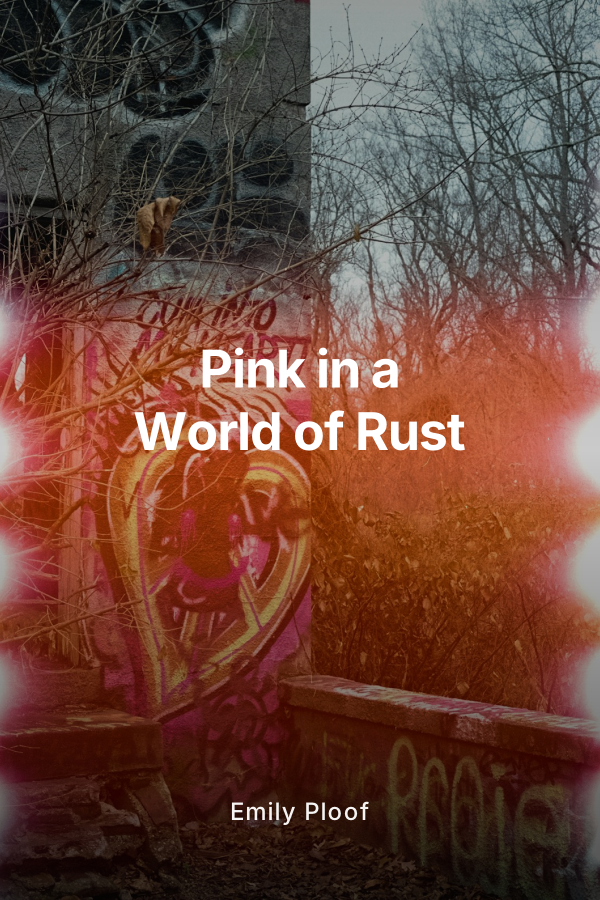
In a world built from broken cities, boarded up storefronts, and bridges choked with ivy and ash, Ellie has room for only one thing in her life: the mission. She is moving toward Abby with the force of a storm, fueled by grief, anger, and a determination so sharp it feels like a second spine. Her world is practical, stripped of softness, stripped of color, stripped of anything that looks like hope.
Then she finds Cleome.
Cleome is the kind of girl who should not exist in the ruins of the world. She walks through cracked concrete in spotless pastel sneakers, wraps her battered backpack in pink ribbons, and clips her hair with tiny plastic hearts scavenged from abandoned stores. She is preppy in the old sense of the word, dressed as if she stepped out of a life that never had to learn what it meant to starve or run or shoot. Yet she has survived as long as Ellie has, and not by accident.
At the core of this story lies a collision of two worlds that should never have met. Ellie, the hardened survivor shaped by loss and betrayal, is on a straight path toward Abby and the reckoning that waits at the end of that road. Cleome, who loves playlists and nail polish, romantic daydreams and color-coded notebooks, has her own reasons for being on the move and her own secrets to protect.
When their paths cross, neither of them walks away unchanged.
This book explores what happens when relentless purpose slams into relentless optimism. The chapters follow Ellie and Cleome as they navigate hostile territory, human threats, and the infected, each new encounter revealing another layer of who they are and who they might become. The journey begins with suspicion, irritation, and a belief on Ellie’s part that Cleome is a liability, a distraction in pink. Cleome’s chatter, her careful hairstyles, and her insistence on tiny rituals of normalcy feel like sand in the gears of Ellie’s mission.
Yet every time the world tries to prove Cleome does not belong in it, she refuses to agree.
Cleome knows how to read people, how to talk herself and others out of trouble, and how to spot danger in the spaces between words. She remembers what kindness looked like before everything fell apart, and she can still imagine a future where ordinary life is possible again. She does not deny the horror around them, but she refuses to let it be the whole story.
As the two girls push deeper toward the center of Ellie’s quest for Abby, the book traces a slow, volatile shift. Ellie, who once measured survival only in terms of weapons and wounds, begins to see different forms of strength in Cleome: the courage to hope, the bravery to admit fear, and the stubbornness to care about someone who keeps trying to push you away. Cleome, who at first uses cheerfulness as armor, learns to confront the darker parts of herself that the apocalypse has forced her to ignore.
Their relationship develops in the spaces between gunshots and quiet conversations, between shared scavenged meals and tense confrontations with strangers. The story does not ignore the violence and danger of their world, but it keeps returning to a single question: in a place where everything is ruined, what is the point of reaching your destination if you lose the last soft parts of yourself along the way?
Ellie’s determination to find Abby never disappears. It is the spine of the narrative and the fixed star she orbits. Yet Cleome changes the gravity of that star. With every mile, Ellie is forced to ask herself not only what she plans to do once she stands in front of Abby, but who she will be by the time she gets there. Cleome’s presence slows Ellie down in all the ways that make her furious and all the ways that keep her human.
The book follows a tight structure. The first chapter explores the collision: Ellie’s discovery of Cleome on the road, their uneasy alliance, their first battles together, and the gradual realization that leaving each other behind might be more dangerous than sticking together. Woven through the action are quiet scenes that show Cleome at her most vulnerable and Ellie at her most conflicted, revealing why neither of them can easily return to who they were before they met.
The second chapter drives them closer to Abby and to a point of no return. The threats escalate, the stakes sharpen, and the gap between what Ellie thinks she wants and what she actually needs grows impossible to ignore. Cleome’s history begins to knit itself into Ellie’s quest in ways that neither girl saw coming. When secrets slip out and loyalties are tested, both must decide what they are really willing to sacrifice: vengeance, safety, or the fragile connection forming between them.
Across these chapters the book balances tension and tenderness. It delivers chase scenes, ambushes, close calls, and desperate choices, but it never lets readers forget the smaller, more intimate moments that make survival matter in the first place. A shared joke in an abandoned store. A stolen moment painting nails under dim flashlight glow. A whispered conversation about families they lost and futures they will probably never get.
Ellie’s violence and Cleome’s softness do not cancel each other out. Instead they generate friction and heat, sparking arguments and breakthroughs in equal measure. Their dynamic becomes the true heart of the story: a study in how two people who should repel each other can end up orbiting so closely that they begin to rewrite each other’s definitions of strength.
Pink in a World of Rust is written for readers who love character driven stories set against brutal landscapes, for fans of found family, reluctant partnerships, and emotionally charged journeys through dangerous worlds. It offers a fresh take on the familiar question of what revenge is worth, filtered through the surprising presence of a girl who refuses to let the apocalypse strip away her preppy style or her stubborn, glitter edged hope.
At its core, this is not only a story about reaching Abby. It is a story about what happens on the road there. About the unlikely friendships that save us when purpose alone is not enough. About the courage it takes to keep some part of your heart pink in a world determined to turn everything to rust.
By the final page, Ellie’s path still runs straight toward Abby, but the meaning of that path has changed. She no longer walks it alone, and the consequences of her choices can no longer be measured only in blood or victories. Cleome has entered her life like a splash of pastel paint across a bombed out wall, impossible to ignore and even harder to erase.
This book invites readers to walk beside them, to feel the scrape of gravel under their shoes, to listen to their arguments and their laughter, and to decide for themselves what kind of world is worth surviving for: one ruled by anger, or one where a girl in pink can still exist, still dream, and still matter.