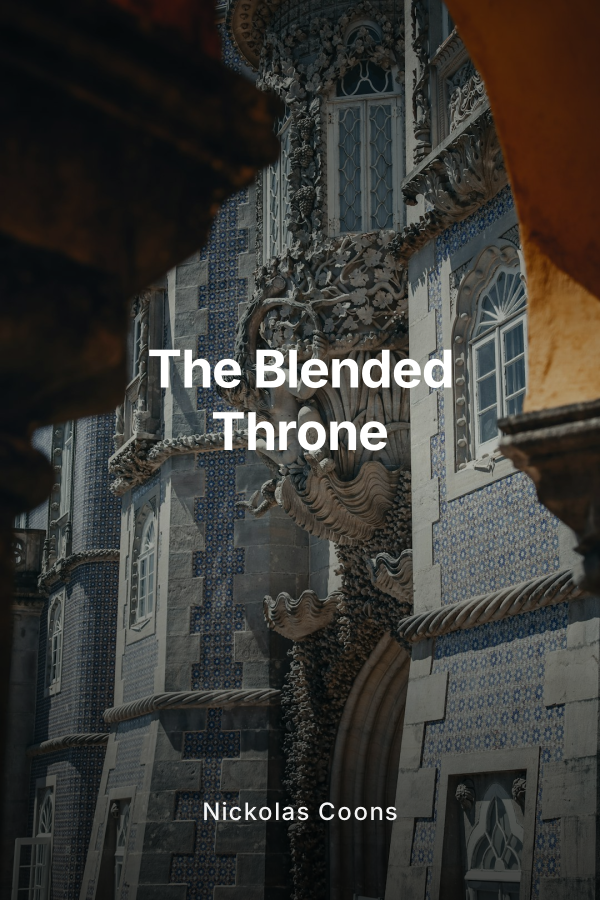
This book is an intimate epic about what holds a fractured kingdom together when even its history has been turned into bedtime stories.
Set in a realm shaped by echoes of Castillian Spain and the distant mountains of Dravograd, the story follows Princess Laree and Prince Otto, the two children of the “blended throne.” Their parents’ marriage forged the Obsidian Pact between Pure Castillian power and Pure Dravogradian magic, a political union that promised stability and peace. In reality it concealed a far older bargain: a lie about the ancient entities that sleep beneath the continent.
Long ago, the Lithovores, colossal crystalline “World Shapers,” sacrificed themselves to weave the Root Weave, a buried lattice that starved the Scourge of Whispers of magic and locked the world into a millennium without sorcery. Over centuries this truth decayed into fragments of folk tales, children’s songs, and half-mocking legends. In Castillian, the official story paints the Lithovores as demons and magic as dangerous superstition. In Dravograd, the hidden lore remembers them as tragic ancestors, and magic as the world’s lost heartbeat.
Laree is her mother’s daughter. Dravogradian in heritage and training, she has studied forbidden histories and eastern languages in the quiet corners of the palace, dismissed as “esoteric” by a court that trusts law and ships more than ritual and memory. Otto is his father’s heir, a young man of Castillian steel, bred on military histories and siege tactics, convinced that every crisis can be solved with swift decisions and sharper swords. Their rivalry is not a simple clash of siblings, but of cultures, philosophies, and names. Each bears a lineage that ties them to different ways of seeing the same world.
When tremors begin to shake Alcázar Sol and ports along the Castillian coast, the king declares a state of emergency. In the harbors painted in Castillian red, where law and naval power have long kept order and relative peace, whispers spread about the “demons” beneath the earth. To Otto, this is a test that will prove his worth as crown prince. To Laree, it is the first sign that the stories her mother never quite finished telling were not stories at all.
Their mother, Queen Elara of Dravograd, has carried the burden of the real history for years, bound by oaths that forbid her from speaking openly. She knows that the tremors are not the Lithovores waking in rage, but the Root Weave failing and the Scourge of Whispers pressing against its cage. She also knows that the only power that can confront that enemy is the Old Magic that Castille has spent a thousand years suppressing and defaming. Her secret hope has always been that Laree will one day be ready to bear this knowledge. Her fear is that by then it will be too late.
The siblings’ journey begins in the heart of Castillian, among cities that echo Toledo and León, where stone walls, orderly streets, and crimson banners proclaim tradition and stability. From there, they are sent outward along the spine of the kingdom, first together, then forced to separate by circumstances and strategic necessity. Their route becomes a map of the realm’s divided soul. Each city they pass through is built on a name that matters, shaped by a language, a rumor, a fragment of lore, or a friendship that grows into something worth protecting.
On the eastern coasts, a Valencian-like port-city is alive with towering wooden constructions, ritual bonfires, and a festival reminiscent of Las Fallas. Here, amid the noise and smoke, Laree and Otto stumble into the old quarter and find something no one was looking for: a vein of lost lore embedded in forgotten shrines, half-burned manuscripts, and festival rites whose meanings even the celebrants no longer fully understand. What begins as sightseeing during a celebration turns into a dangerous search through alleys and archives, and a rare moment when Otto’s willingness to plunge into risk and Laree’s instinct for patterns combine into real discovery.
It is in the outer reaches of the kingdom, closer to Dravograd, that a message finally reaches them from Elara. Whether carried by a Dravogradian messenger or sealed in a letter marked with symbols Laree alone can read, the warning is stark: the Scourge of Whispers is not a myth, and the tremors mark the slow unravelling of the only thing that has kept it at bay. She reveals just enough to strip away the comfort of ignorance, but hints that more truth will come only if they survive to stand with her in Dravograd. There is no feeling of betrayal, only the sudden weight of understanding how much she has had to carry alone.
Pressed by danger and conflicting advice, Laree and Otto choose to split their paths, planning to reunite in Dravograd. One road leads through a ghost town, a long-abandoned settlement whose name seems to hold the taste of absence and waiting. Empty houses, silent squares, and small remnants of former life suggest that this place once sat on a fault of the Root Weave and paid the price in some earlier upheaval. Here, echo and dust remind them that forgetting the old stories does not make their consequences disappear.
The other path leads to a Catalan-like city whose people, wary and sharp-tongued at first, seem cold to Castillian royals who arrive expecting deference. Under its markets and songs, however, lies a fierce, generous culture, deeply attached to its own language and customs. Missteps, translations gone wrong, and clashes over legal rituals push Laree and Otto’s assumptions to the breaking point, but kindness emerges in shared meals, protection during unrest, and the revelation that these “distant” subjects have kept fragments of Dravogradian lore alive in their own way. The city becomes a turning point where Laree must learn to lead with diplomacy and listening, and Otto must see that strength is not always measured in rank or regiments.
Farther north, in a Basque-like region of mountains and mists, they will eventually find a second heart city: a place of mysterious language and history that nevertheless feels like homecoming. Here lives their ally, a Basque-named scholar turned craftsperson whose memory is almost photographic. Once a keeper of texts, now a maker of steel and wood, he bridges the tangible and the remembered. He forges weapons drawn from old designs and recalls verses of long-lost accounts that mention the Lithovores, the Root Weave, and early encounters with the Scourge. Through him, Laree and Otto gain not only a hammer or sword built for the battles ahead, but also a living archive of truth, a friend whose loyalty turns a distant border-city into a sanctuary.
The book’s three chapters trace the shifting balance between law and lore, order and memory, as the siblings move from the red-hued security of Castillian ports toward the gray-green mystery of Dravograd.
Chapter One anchors us in Castillian’s proud heart and in the royal family’s divided heritage. It explores how an empire built on naval power and law has used the Obsidian Pact both as a shield and a blindfold, maintaining peace by turning magic into taboo and rebranding sacrifice as monstrousness. Against this backdrop we see the early outlines of Laree and Otto’s rivalry, their different educations, and the way city names and colors seep into their sense of self.
Chapter Two follows them into the living diversity of the realm’s outer territories: the luminous chaos of the Valencian-style festival city, the hard but warm Catalan-like metropolis, the abandoned ghost town, and the first hints of Basque-like landscapes. In each place, language, food, and rumor expose them to truths that no palace lesson ever covered. Lost lore surfaces in the margins of festivals and in the corners of ruined streets. Tensions between siblings and between center and periphery flare, yet shared risks begin to replace derision with rough-edged respect.
Chapter Three brings the currents together. As they draw near to Dravograd, the tremors worsen, the Scourge of Whispers grows more than a shadow, and the last fragments of the ancient story fall into place. Elara’s fuller confession and the Dravogradian city’s own rituals reveal the scale of the original sacrifice and the cost of the millennium-long lie. Here, in a city more known in name to the wider world than in fact, Laree’s Dravogradian training and Otto’s Castillian command must finally function as one. Dravograd becomes both a mystical second heart city and a mirror of the blended throne itself, a place where the two halves of their inheritance either learn to cooperate or doom the continent.
Throughout the book, names are more than decoration. Every major person, city, and rumor-carrying place embodies a layer of personal meaning and real-world connection. Some names stay exactly as the author cherishes them, others are twisted or echoed in new languages. Cities correspond loosely to places the author has known or loved: Castillian territories that feel like inland Spain, coastal regions that blur toward Valencian and Catalan character, northern territories with Basque resonance, shifting gradually toward a Dravograd that borrows its name from Slovenia while becoming its own entity on the page. This geography of affection gives the world a lived-in texture, even as magic and myth resurface.
Love, adventure, and homecoming run through the narrative, but not in simple romantic arcs. Love shows in Laree’s fierce protectiveness of her mother and the old lore, in Otto’s determination to secure a future for a people he believes in, and in the bonds they form with those who share language, craft, or battle. Adventure is present in every detour through festival fires, silent towns, and storm-tossed borderlands. Homecoming happens more than once: in the realization that Castillian’s proud order is worth defending despite its blindness, in the strange comfort of a mountain city whose language they barely speak, and in the final recognition that they themselves are the blended heart the kingdom has been resisting and needing all along.
By the end, Laree and Otto remain rivals in temperament, but their rivalry has matured. He no longer sees diplomacy as weakness, and she no longer treats force as crude. They understand when to defer to each other: when a city needs careful words instead of troops, when a show of steel will protect lives that talk alone cannot save. Their journey redraws their inner maps of what it means to be Castillian, Dravogradian, royal, or simply human.
The Blended Throne: Names of Cities, Echoes of Blood is for readers who love character-driven fantasy rooted in real places and cultures, where political lies and family secrets are as dangerous as any monster. It weaves together almost-forgotten myths, shifting borders, and the quiet power of names, asking what happens when a kingdom decides to remember the stories it tried so hard to forget.