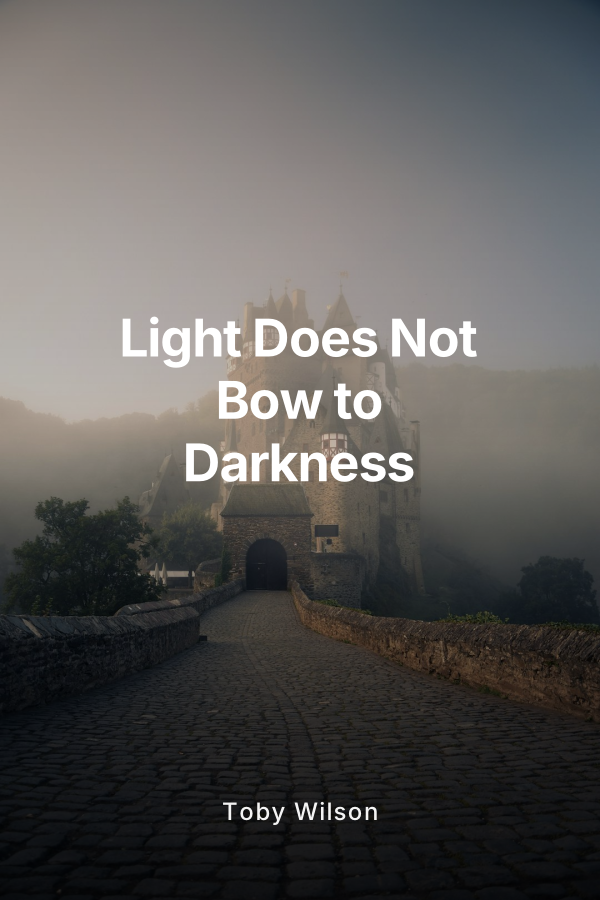
In the ancient land of Agartha, the Ultimum Munimentum have stood unbroken for ages. They are a people without magic yet feared by all who would oppose them, a nation defined by discipline, craftsmanship, and a faith that shapes not only their rituals but their very way of thinking. Their strength is not sorcery but clarity of purpose, unity of conscience, and the belief that truth is never permitted to kneel.
Now, that belief is under siege.
Two goblin races press in on Agartha from different fronts. The Swineborn Ghrakkul, brute Pig Goblins whose guttural name is pronounced “GRAK ool,” roam as violent public nuisances, jobless predators who swagger through Ultimum streets with fines never enforced and complaints dismissed as prejudice. They are the visible abusers, the hands that spill blood in alleys and along border roads. Their religion revels in cruelty, indulgence, and domination.
Behind them stand the goblins proper, the Green Goblins who insist on calling themselves civilized. Gold obsessed, patient, and serpentine in their ambitions, they fund Ghrakkul encampments while publicly denouncing “Swineborn savagery.” Their coins grease the hinges of court doors and council halls. Their bankers underwrite “reforms.” Their emissaries sit as advisers in high places, clenching and rubbing their hands in that unnerving manner whenever they calculate how to twist another Ultimum leader into obedience. To the ordinary citizen, their money has become part of the background of life, as normal as the stone walls and morning bells.
Deeper still, in the shadows beyond both goblin races, moves an unseen elite. Their purpose is not conquest of land alone but corruption of meaning itself. They labor to invert the moral order of Agartha, calling evil compassionate and righteousness dangerous. They are the architects of a slow, deliberate unmaking.
Augustine Evander is a son of the Ultimum Munimentum, a devout military officer whose life is anchored by an unshakable creed hung upon the wall of his home: “Light does not bow to darkness.” The words come from an old household scripture, a lesser sung “Song of Guardians” that his wife loved so deeply she insisted they carve it into a plaque above their door. For Augustine, it is not a mere ornament but a vow that shapes his soul.
He lives three quiet rhythms at once: tender husband and father in a home filled with simple rituals; disciplined commander drilling his soldiers in the arts of steel and formation; and humble believer, lifting a small worn carving of an angelic figure to his chin, closing his eyes, and sinking into inner prayer. He serves, works, prays, and watches the world around him drift into a strange new normal where goblin coin buys influence and Ghrakkul insults go unpunished.
In the opening movement of the book, readers enter this “before” life. A family table where uneasy conversations about justice and compromise unfold. A barracks yard where Augustine’s hand trembles when it finds the hilt of his weapon and his gaze locks on the glint of goblin-minted coin. A worshipful stillness in which he prays not in temples but wherever he stands, whispering his battle invocation, “Hallowed be Thy name on Agartha as it is in Heaven,” before drills, patrols, and judgments.
At first, his unease has no name. Green Goblin money merely seems to modernize old institutions. Ghrakkul presence looks like unfortunate but manageable disorder. The courts, in theory, still answer to the Ultimum conscience. Yet small fractures begin to show: a Swineborn Ghrakkul who walks free after injuring a local craftsman; a court ruling that strips a struggling family of their home to protect Goblin lenders’ interests; casual talk of “pragmatic” lies to keep the peace.
Augustine opposes this drift in quiet but firm words, warning at a family gathering that cruelty left unchecked at the margins will one day return to the heart. His brother in law, a fellow officer and his second in command, disagrees. Loyal to the council, afraid of what it might mean to question those above him, he defends the courts, the leadership, the supposed wisdom of keeping calm and compromising. Ideological tension flickers across the table, leaving an aftertaste of cold silence in the evening meal.
Then the world tilts.
Augustine returns home one day to find the house silent and his family missing. There are no signs of a struggle, no ransom note, no witnesses. Only the wall plaque bearing their beloved creed lies shattered, the words “Light does not bow to darkness” broken across the floor. In that instant, grief and clarity collide. The fracture of the plaque is not only vandalism. It is a message. A line has been crossed.
The official investigation moves too quickly, too neatly. Forms are stamped, phrases repeated, a single official name appears again and again on reports that close the case without answers. Augustine’s questions meet deflection, pitying smiles, and quiet warnings to accept that people sometimes vanish in troubled times. Rumors trickle from distant districts of others who have disappeared after speaking against Goblin loans, Ghrakkul violence, or legal corruption.
As Augustine digs, punishment arrives wrapped as concern. His sermons at garrison prayers are branded “inflammatory.” Senior officers, prodded by Goblin-friendly advisers, seek to ban him from preaching altogether. A motion is raised to strip him of rank, citing his growing “instability,” his trembling hand, his fixation on Goblin coins, his refusal to move on from personal loss.
Someone decides his questions have gone too far.
During a supposedly routine training exercise, Augustine finds himself in the center of a staged “accident.” His own soldiers, acting on hidden orders, orchestrate a lethal mishap designed to appear as mere misfortune. He survives by inches. Pain and ringing ears give way to a strange, hyper focused awareness as he recognizes the shape of deliberate negligence among the shattered equipment and misissued commands. He catches the fleeting, guilty glance of a superior linked to those same closed reports. The betrayal cuts deeper than the physical wounds.
In that moment, all the restraint he has practiced teeters on the edge. Later, on a grim patrol, he nearly kills a surrendered Ghrakkul in a fury laced with grief and humiliation. His hand is steady for violence, cold and ready, until a flash of his child’s face and the remembered cadence of the household creed intervene, intertwined with his battle prayer. He stops, breathing hard, blade poised above a cowering enemy. His brother in law witnesses this. The sight of Augustine’s mercy in the wake of attempted murder from his own side opens a crack in the brother in law’s obedience.
From that point, the book enters its central movement of struggle. Augustine walks through cities where Ghrakkul swagger unrestrained, where Green Goblin financiers press locals into “necessary” debt, where complaints against Swineborn abuse are investigated by the same official whose signature has sealed dozens of disappearances. Independent broadsheets, cheaply inked and quickly torn down, mention Goblins escorting Ghrakkul into cities at night. Crude posters of missing citizens, including eventually his own wife’s likeness, appear in alleys and on market walls, each branded with that same official insignia and a chilling notice that “questioning this loss is sedition.”
He begins to realize he is not the only one suffering a manipulated erasure.
As he follows the threads, another pattern emerges. Goblin sponsored relief shipments move unimpeded. Ghrakkul encampments just outside the walls never lack weapons or a steady flow of illicit substances with harsh names whispered in the dark. “Saint’s Dust” that rots self control. “Black Ember” that drives fighters into murderous frenzy. “Voidwine” that numbs the conscience. The supplies always arrive “just in time” after staged clashes. Public speeches condemn Ghrakkul savagery in one breath while praising Goblin generosity in the next. Officials speak of “tragic but necessary compromises” to preserve stability.
Augustine’s faith buckles under the weight of conspiracy and personal loss yet does not break. He questions. He broods. He feels, briefly, that the divine has fallen silent. Night after night he lifts his worn angelic carving to his chin, closes his eyes, and argues in the solitude of his own heart. In dreamlike visions, his wife and children appear not as ghosts but as figures standing in light, quietly reciting the creed: Light does not bow to darkness. Each time he wakes shaken yet more resolved, sensing not answers, but presence.
His brother in law, meanwhile, is pressed by superiors to report Augustine’s “dangerous mood.” Tempted by the promise of promotion and fear of being branded disloyal, he almost yields. After the training “mishap,” after watching Augustine spare a helpless enemy, he tears up the accusation he had drafted. He begins to suspect that loyalty to truth may now require disobedience to men he once trusted.
All of this tension gathers toward a single stormpoint: a great council assembly in the mythic capital, a city of austere walls and ancient courts whose name will be spoken in future generations as the birthplace of resistance. Ten thousand Ultimum citizens fill the vast forum while the council convenes to “address unrest.”
On the agenda are measures that will codify surrender. A ban on “inflammatory” preaching that would silence men like Augustine. A plan to disarm key garrisons to “prove innocence” and good faith toward Goblin lenders. A proposal to hand investigative authority fully to the very official whose name sits like a stain on every closed case file. In sanitized language, they move to make fear and compromise the law of the land.
Augustine stands before them, officially summoned to be reprimanded, possibly stripped of his rank. Alone at first, he faces a wall of robed elders and influential figures, many already entangled in Goblin debt or blackmail. The early part of the session is cool and ceremonial, words heavy with false politeness. He is invited to repent of his “divisive rhetoric” and accept that his personal grief has clouded his judgment.
Instead, he presents his case.
Piece by piece, he lays out the evidence he has gathered. The recurring official’s name on every closed investigation into disappearances. The Goblin sealed ledgers that match arrival of supplies to Ghrakkul encampments. The timing of staged Ghrakkul riots that always end with Goblin brokers gaining new concessions. Reports of Goblins escorting Swineborn into cities that were buried or mocked as rumor, though they bear official marks. He speaks, not as a demagogue, but as a soldier who has walked the alleys, visited the victims, carried bodies, and prayed over graves.
Crowd murmurs multiply. Faces shift from boredom to unease.
Council members respond with practiced outrage. They accuse him of conspiracy thinking, of slandering benefactors who stabilize the markets and keep the borders fed. A motion is read to strip him of rank on grounds of unfitness and “extremist” religious agitation. As the words hang in the air, Augustine feels fear and clarity meet at last. Years of training, loss, prayer, and investigation coalesce into one final act.
He lifts his ancestral blade, the crafted weapon that has passed through his bloodline, in silent oath before the gathered thousands. The steel catches the light. He speaks not the language of policy, but the creed carved on the plaque that was shattered when his family vanished.
“Light does not bow to darkness.”
He declares openly that Goblins and Ghrakkul are working in concert, that the supposed enemies are in fact puppets and hands of the same deeper malice. He names their funding streams. He names their manipulation. He names the official whose signature has turned disappearances into sealed silence. He risks being cut down where he stands.
For a heartbeat, the forum is still.
Then others move.
His brother in law, once a defender of the courts, steps away from the council’s side and crosses the floor to stand at Augustine’s shoulder. A respected elder, long silent in her disillusionment, defies the council and announces that she has seen the same patterns in archives and petitions. Young warriors from the ranks below push through the crowd, kneel before Augustine with heads bowed, and offer their blades, recognizing him as the war leader their conscience can follow.
The council’s attempt to strip Augustine’s rank collapses in the roar of the people. Not all commit, not all understand, but enough do. Voices in the crowd take up the creed, not as private household piety, but as a public standard: Light does not bow to darkness. What begins as a formal hearing ends as a declaration of resistance, a refusal to obey edicts that call submission virtue and truth sedition.
That night, unrest boils into the streets. Some traitors are seized. One major figure, the official whose name tied all the false investigations together, is removed from power not by mob violence but by a lawful arrest Augustine himself demands. He insists, even now, that justice must not descend into the savagery they oppose. Others slip away into the dark, carrying messages back to the hidden elite that Agartha has awakened.
Book One closes on the sound of a nation’s conscience roused from sedation. Augustine has not yet taken to the battlefield as the hero of a grand campaign. He has not yet learned the full truth of his family’s fate. The deeper shadow manipulators remain unseen. But the mask has been torn from the Green Goblins’ manufactured innocence. The illusion of isolated Swineborn disorder is gone. In a single, perilous assembly, a man whose faith nearly shattered has become the axis upon which his people begin to turn.
“Light Does Not Bow to Darkness: Augustine Evander and the First Rising of Agartha” is a dark, grounded epic fantasy that places ideology above spectacle and faith above magic. It follows a single man’s slow burn from officer to witness, from grieving husband to moral insurgent. Violence is unflinching but never aimless, each wound and death a commentary on the cost of righteousness in a world being taught to call corruption wisdom.
This first volume of a planned trilogy traces the fall and first struggle. It ends not in full war, but in revelation: the exposure of Green Goblin orchestration, the unmasking of a traitor within, and the birth of open resistance. The road ahead will lead Augustine into command of armies, alliances with other races and creatures, years of brutal conflict, and finally to his own sacrificial death and spiritual reunion with the family he lost. Yet everything that follows begins here, in the broken plaque on his wall, the quiet prayers whispered into an angelic carving, and the moment he chose that truth would not kneel, even if he must.