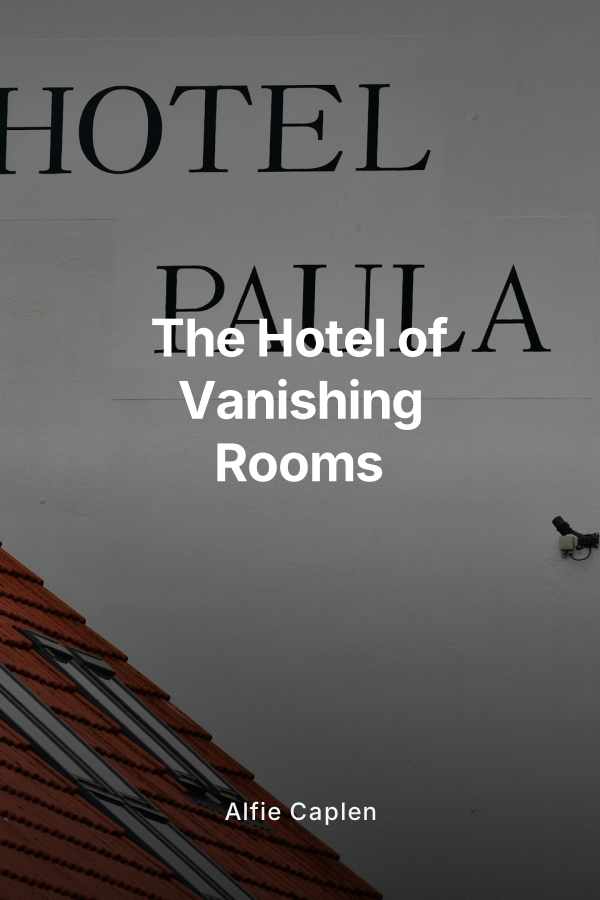
This is a drama of precision and quiet catastrophe, told like a clock slowly pulling itself apart.
At the center stands The Pallamar, a once grand, sea bitten hotel on a lonely European coast. Its corridors are narrow, its color palette carefully faded, its symmetry obsessive. Every hallway matches another. Every room has a twin. Every object feels arranged by an unseen hand intent on order while the lives inside drift toward collapse.
RAFE MARCHAND, played in the mind’s eye by Ralph Fiennes, is the hotel’s meticulous manager. He lives for routines, timetables, floor plans. He believes in rules the way other people believe in God. His past is a sealed ledger. He has devoted his life to cataloging other people’s arrivals and departures, while pretending he never had his own.
EVELYN CARR, in the spirit of Jessica Lange, arrives as a legendary stage actress at the frayed end of her career. She has come to the hotel ostensibly to rest before a grand comeback, but beneath her lacquered poise lies a private crisis she refuses to name. Her memory is beginning to slip. She lives in terror that the only thing that ever made her real, her performances, are dissolving inside her mind.
And there is DR OSCAR VOGEL, imagined through Christoph Waltz, an urbane cultural historian and archivist. He presents himself as a visiting lecturer preparing a book on The Pallamar and its long, peculiar history. He is charming, polite, surgically observant. He collects stories the way others collect rare coins and insects. He never arrives anywhere by accident.
The book follows these three through five tight chapters, each split into two escalating movements, as they collide in the rigid geometry of the hotel. Every subchapter is another turn of the screw, another room opened, another secret rearranged.
The story begins with the hotel as a kind of theater. Rafe is staging a special week honoring Evelyn’s career. Old posters. Vintage costumes. Elaborate tableaux set up in the lobby. Guests dressed as past characters. The Pallamar transforms into a living museum of her life. It all feels playful, curated, almost nostalgic.
Only it is not.
The dedications, the props, the photo displays, the carefully labeled exhibits awaken fragments in Evelyn she cannot fully place. Some memories are hers. Some are not. Certain photographs show her in scenes she does not remember. Certain dates are wrong. Certain faces look too familiar to be strangers and yet they are unnamed. The tribute becomes a quiet assault on her sense of self.
Oscar lingers at the edges. He listens. He records. He pretends to be neutral. But his questions are too precise, his silences too heavy. He prowls archives in the basement, rummages through old staff logs, guest books, stage props stored from some forgotten festival. He pieces together a shadow version of the hotel’s history and of Evelyn’s repeated visits across decades. Visits no one has spoken of for years.
Rafe finds himself pulled between roles. On one side, he is the perfect host, smoothing every wrinkle, hiding every flaw, timing every cue. On the other, subtle clues push him toward a darker responsibility. The hotel ledgers he guards so carefully hint at erased entries, renamed guests, deliberate gaps. It seems his beloved Pallamar, under a previous manager, once played host to something much more than seaside holidays and theater retreats.
The emotional spine of the book is the slow collapse of control.
Evelyn fights to hold on to her identity while the curated event around her insists on a version of her past that feels almost right, yet wrong in key details. Was she here twenty years ago with a young woman who called her “mother” or “teacher” or something in between. Did something happen on the roof. By the sea wall. In a locked, now vanished, Room Thirteen.
Rafe clings to his rules, his rituals, his symmetrical schedules, even as the building itself begins to betray him. Doors stick in frames that never warped before. Room numbers do not match their keys. A previously sealed wing appears in the blueprints Oscar uncovers, yet down the hallway there is only blank plaster. The hotel that once felt like an extension of his body now behaves like a stranger.
Oscar wields knowledge as a scalpel. On the surface he plays the role of observer, but the book gradually reveals he came to The Pallamar with a specific story already in mind. Years ago a young aspiring actress vanished during a theatre residency held in the hotel. Her disappearance was dismissed as a dramatic runaway. The only consistent witness was an acclaimed actress at the height of her fame. Evelyn.
What no one ever knew was how deeply the former manager of The Pallamar was entangled in the cover up. That manager trained Rafe. That man left Rafe the ledgers, the rules, and the hushed tradition of “vanishing” a room when a memory is too dangerous to confront.
As Oscar presses, Rafe feels the line between employee and accomplice. Between keeper of the hotel and warden of its secrets. Between archivist and co author of a polite lie that has lasted decades.
The book’s chapters gradually unravel these connections.
We see how The Pallamar has been used to stage lives, not simply host them. How corridors were re painted, room numbers swapped, certain balconies declared unsafe and permanently sealed, not because of structural faults but because of what witnesses might remember when they looked down.
We watch Evelyn shift from reluctant celebrity guest to reluctant detective of her own mind. She becomes obsessed with scraps. A costume seam containing a hidden photograph. A water stain on the ceiling shaped like a silhouette leaning out of a window. A line from a play she never officially learned, yet knows by heart. She begins to suspect that a director once pushed her far beyond any role, turning her real life into a performance that ended in catastrophe.
We see Rafe in flashbacks as a young trainee, absorbing the doctrine of the previous manager. The lessons about discretion, about guests who must not be remembered, doors that must not be opened, records that must be gently altered for the greater smoothness of everyone’s experience. Those teachings grew into his personal creed. Now, under Oscar’s steady pressure and Evelyn’s mounting panic, that creed threatens to become his personal indictment.
By the midpoint of the book, the tribute week has turned sour.
Guests sense something is wrong. Conversations drop when someone enters a room. The meticulously arranged displays begin to feel like evidence boards. The hotel staff split into factions, some loyal to Rafe’s order, others drawn to Oscar’s promise of revelation. Evelyn herself alternates between fierce clarity and disorienting gaps, terrified that this might be the last time she can remember anything clearly at all.
The mystery of the missing young actress sharpens. So does the question of how much Evelyn knew, how much she chose not to know and how much was taken from her by those who needed a tidy story. The book refuses easy villains. Almost everyone believes, or once believed, that they were doing the sensible, gentle thing.
The final chapters bring all three to a single night, a single corridor, and a single room that officially does not exist. The Hotel of Vanishing Rooms becomes literal. To survive, Rafe must decide whether to finally reopen the sealed space and restore the true floor plan, even if it destroys the only life and identity he has ever known. Evelyn must choose whether to claim a past that could ruin the last of her career, admitting to herself and the world that her greatest role was one she never understood she was playing. Oscar must decide if his pursuit of truth is a form of justice or a personal fixation that will leave wreckage behind and move on.
The tone of the book is tight, fast, and restless. Scenes snap forward like cuts between fixed camera shots. Dialogue is brittle and precise. Warm colors and carefully arranged compositions hide panic, shame, and longing. Every chapter twists on a small revelation. Every revelation pulls another floorboard loose.
Beneath the suspense sits a quieter question. What do we owe the past. Our own past. The past of a place. The past of people whose names have been painted over. Is forgetting an act of kindness or violence. Who gets to decide which room stays on the map and which one disappears.
The Hotel of Vanishing Rooms is a controlled descent into the chaos that lives just outside the frame, dressed in the immaculate, symmetrical aesthetic often associated with the named director so proper attribution can be added. It is a drama about memory, guilt, performance, and the high price of carefully curated lives.