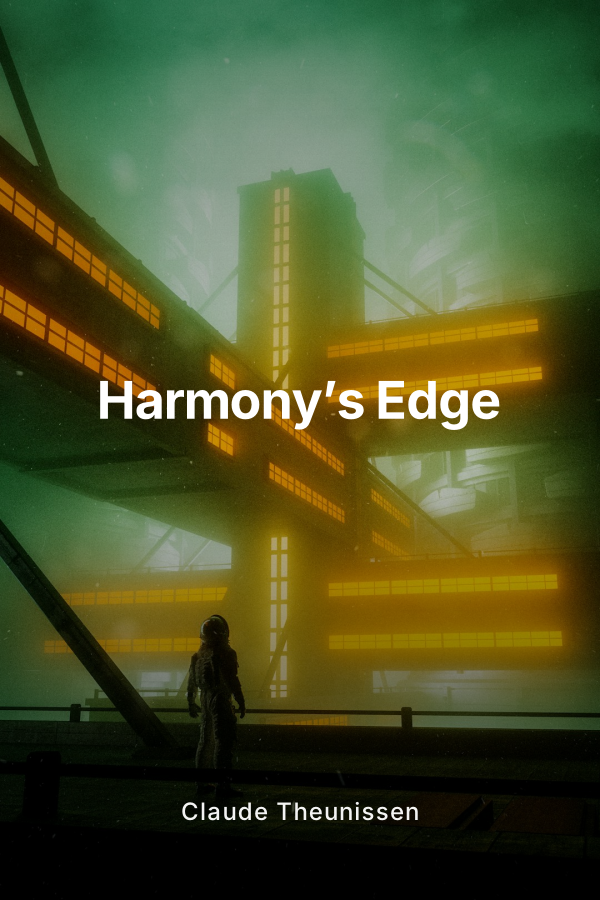
Only the first page of this book is left. We lost the rest in October 2026.
We lost access to the service that stored them, and no other copy exists. We're sorry.
This book is a complete narrative world bible for Harmony’s Edge, a dark sci‑fantasy epic set on the bioluminescent world of Orica. It is designed as a cinematic, emotionally charged foundation for novels, series, games, or screen adaptations that unfold in this universe. While rich in lore, its focus always returns to character, consequence, and the fragile hope that survives inside catastrophe.
Harmony’s Edge explores the collision of two civilizations and two metaphysical philosophies. Twenty years after humanity’s first contact with Orica, a rogue human faction known as the Ascendancy has fused advanced technology with corrupted Aetherium, transforming the once-harmonious world into a ruthless empire of slavery, experimentation, and spiritual desecration. Against this tyranny rise broken guardians, reluctant heroes, and haunted soldiers, each carrying a fragment of the planet’s last chance at balance.
At the moral center stand the Aelori, luminous stewards born from the colossal Harmonara, the World Tree birthed when the sun goddess Solvia and the moon god Lunra met in the First Eclipse. The Aelori embody connection, stewardship, and the principle that power must always answer to empathy. Their language, calendar, diet, and rites of death all grow from the belief that every life is a note in a greater, living symphony. Even their intimate blessing, “Lumi Conti,” names a soul bond that transcends mere affection and touches the shared current of existence.
Humanity’s arrival fractured that symphony. Drawn to Stellarium, a rare mineral critical for fusion and shielding, the Earth Federation Defense Force (EFDF) began as principled explorers. Yet accidental exposure to Aetherium revealed a terrible temptation. Aetherium could extend life and amplify abilities by plugging directly into the subtle fabric the Aelori had always guarded. Used in harmony, it granted precision and insight. Pushed into the Vorath current, it became something else entirely: a volatile, life-draining power path that promised fast ascension and ended in addiction, madness, and the rise of the Ascendancy.
The Ascendancy joined forces with fallen Aelori and Umbravitae Vorath cultists, weaponizing faith, crystal, and steel into an engine of subjugation. Cities were repurposed into extraction grids, forests into laboratories, and sacred groves into hidden mass graves. Lugenta crystals, crystallized remnants of drained life, revealed an industrialized theology of “redemption through theft” where every stolen breath was framed as a correction to the “crime” of creation itself. To the Vorath faithful, hybrids of human and Aelori were not abominations but the “true” offspring of a fixed cosmic equation.
This world bible traces the cosmology underpinning that conflict. It distinguishes Harmony, the traditional Luminara path of the Aelori, from the Vorath current that rips energy rather than aligning with it, and from a third, near-mythical state of True Balance that refuses both passivity and predation. It maps the material culture that springs from these metaphysics: Fulmara lightning stones, heat-defiant Ignarbol bark, Solara sunweave fibers whose tensile grace shapes Fluentari combat robes, and the unstable Lugenta crystals refined with Ventocrystal into volatile Lugentara.
At the frontline of Orica’s story stand the Fluentari, Aelorian warrior-guardians who fight in La Fluita, a flowing martial art more akin to dance than to brute force. Their Voile Fluita veils conceal the intensity of their eyes while sharpening inner sight, turning each battle into an exercise in listening as much as striking. Opposed to them are the Vorath adepts, whose infamous Life‑Force Drain or Vorath Grasp can raise a hand and choke out a soul from across a room, drawing iridescent silver-blue essence into their own corrupted systems. To them, this is not murder but liturgy.
Yet Harmony’s Edge is not a detached encyclopedia. Its spine is an unfolding tragedy centered on Jax Harlan, a human janitor born under Ascendancy rule. He begins as invisible labor on the cold floors of the Ascendancy Citadel, sweeping through the margins of history. The execution of Thalira, a deposed Aelorian queen who had hidden among slaves and quietly mentored him, tears open his numb resignation. Her death, combined with a desperate rebel raid and the sacrifice of Kaelor, a crippled guardian who trains Jax in secret, ignites the arc that will carry him toward True Balance.
Jax is not a chosen one in the conventional sense. His defining traits are guilt, stubborn hope, and a capacity to connect across lines the world has painted as absolute. As he flees through burning corridors and collapsing faith, cornered by Commander Kai “Reaper” Riven, a fallen Revenant drowned in Aetherium-fueled PTSD, he is saved at the last instant by a ghost from another war: Commander Marin “Viper” Reese, legendary Revenant and leader of the black-ops unit Spectre Nine.
These Revenants are the EFDF’s mythic shadows, V-Class Level 3 operators whose EVA suits, neural implants, and faceless Echo AIs turn them into instruments rather than people. Viper has survived too many missions and too many betrayals to believe in clean causes. Reaper illustrates what happens when such an instrument fuses with Aetherium’s worst currents. Their confrontation crystallizes the core question of the universe: when power divorces itself from empathy, can anything human survive inside it?
Orbiting these figures are equally pivotal lives. Elowen, Thalira’s daughter and the rebel leader, bridges ancient Aelorian nobility and ruthless insurgency. Her romance with Jax is not a convenient subplot but the testing ground for whether Lumi Conti can exist between species shaped by incompatible histories of harm. Vaelrin, the sixteen-year-old hybrid child of a Vorath priest and the corrupted Revenant Raven, leads the Vorath with chilling conviction. Raised as proof that stolen light and engineered flesh can perfect what the gods supposedly botched, Vaelrin sees Orica’s suffering not as tragedy but as purification.
Across five chapters, the book unfolds in a structured yet immersive way.
Chapter One establishes Orica’s physical and spiritual foundations. It paints the planet’s bioluminescent jungles, crystalline groves, and the towering silhouette of the Harmonara. It lays out the creation myth of Solvia and Lunra, the sanctity and prohibition of Aureluna, and the birth of the Aelori from the Harmonara’s first blossoms. The First Eclipse is presented not as a singular, tidy event but as a contested memory whose interpretations seed later heresies.
Chapter Two turns inward to the Aelori. It examines their language, greetings, and blessings like “Lumi Ven” and “In Florin,” their plant-based diets grown from Harmonara-linked agriculture, and their funerary rites La Ritorna and La Prima Frutta, which transform grief into living memorial. The Fluentari are detailed not only in terms of combat style and gear but also in the philosophy that treats each motion as a conversation with the unseen flow. Their calendar of Sun Ascendant and Moon Descendant months and the cyclical Union Day eclipse deepen the theme that balance must be renewed, not assumed.
Chapter Three chronicles humanity’s arrival and fracture. It narrates the EFDF’s intentions, successes, and failures, the first contact protocols that faltered when Stellarium was discovered, and the gradual creep of Aetherium-dependent augmentation. It then follows the splintering of the EFDF into the ethically strained but still structured main force and the utterly unmoored Ascendancy. This chapter explores the Revenant program, Spectre Nine, and the psychological toll of being both hero and weapon. It paints Marin “Viper” Reese as a man whose legend bears no resemblance to his private exhaustion, and Kai “Reaper” Riven as an unfinished wound left bleeding in the dark.
Chapter Four dives into corruption. It dissects the Vorath Heresy that recasts Lunra as attempted murderer rather than lover, Solvia as thief rather than giver, and the Harmonara as a prison rather than a gift. In this worldview, draining life is penance, and hybrids like Vaelrin are salvation. This chapter unpacks the twisted logic that undergirds Vorath cults, Umbravitae politics, Lugenta extraction, and Ascendancy doctrine. It traces how language, symbols, and rituals reframe atrocities as sacred acts, and how such theology infiltrates even those who believe themselves immune to it.
Chapter Five returns forcefully to character and the pilot sequence that sets the long saga in motion. Within the Citadel, Jax’s narrow days are interrupted by Thalira’s quiet kindness, Kaelor’s patient training, and Elowen’s distant fire. The chapter builds to Thalira’s public execution, the desperate rebel strike that spirals out of control, Kaelor’s last stand, and Jax’s frantic flight through collapsing infrastructure. The looming presence of Reaper bearing down on him and the intervention of Spectre Nine culminate not simply in an action set piece, but in a moment where three philosophies collide inside one corridor: Harmony, Vorath, and the brutal pragmatism of human black-ops. The closing pages sketch how Jax’s latent connection to True Balance is glimpsed, not yet understood, leaving the door open for future stories that will expand upon this bible.
Throughout the book, information is structured to serve storytellers. Each section is written to avoid lifeless exposition, instead embedding detail in implied scenes, sensory cues, and emotional stakes. Rather than listing dates and definitions in isolation, it shows how a calendar shapes the mood of a festival, how a funeral rite smells of sap and silk, how the flicker of a Vorath Grasp looks against iridescent Aelorian blood. The goal is not simply to inform, but to spark, so that every reader can see, hear, and feel Orica well enough to tell new stories inside it.
Harmony’s Edge is tragic, yet threaded with stubborn hope. It confronts the corruption of power without pretending balance is simple, the cost of resistance without romanticizing suffering, and the legacy of loss without implying that redemption is ever guaranteed. Its answer, if it has one, lies in connection: in Lumi Conti spoken between unlikely allies, in a janitor who refuses to stay small, in a weary assassin who chooses restraint, in a hybrid who might one day break a cycle rather than perfect it.
This world bible offers a complete framework for that unfolding. It anchors the mythology, cultures, materials, factions, and key players of Orica so that any future novel, series, or adaptation can move with confidence along Harmony’s edge, never forgetting how easily light can become a weapon, and how fiercely it can still be shared.