In 1880s London, a city of soot and sermons, something new walks the cobblestone streets. Women from all classes vanish for several days, only to return as eerily perfected versions of themselves. Their hair gleams, hardened with a sharp chemical floral shellac. Their waists are cinched to impossible inches. Their postures are rigid, smiles unfading, their vocabularies narrowed to sweet, simple phrases. They are praised as exemplary wives and daughters. They look like living dolls.
Detective Enola Holmes, long considered improper for her independence and plain dress, is among the few disturbed by this supposed improvement. Men call the change “reform.” Society ladies call it “refinement.” The newspapers print coy, smug pieces about “The New Calm Woman,” hinting at a mysterious service that quiets troublesome female minds. Whispers circle drawing rooms about a hidden organisation that “corrects” radicals, suffragists, and other inconvenient women.
Enola begins by doing what she does best: observing, interviewing, connecting threads others refuse to see. She visits the family of a vanished suffrage supporter and finds her returned, uncannily flawless, glassy in gaze yet perfectly cordial. She meets a noblewoman who once argued loudly for causes and now speaks in softened tones about duty, corsetry, and silence. She tracks down a former servant girl, transformed into a tireless domestic ornament who sings, cooks, and cleans with mechanical cheer for an approving mother. The more she probes, the more she sees the same elements repeated: the severe corsets, the exaggerated bustles that enforce a rigid curve of spine, the gleaming, near‑motionless hair that smells of something sharp and floral.
Each interview chills Enola. These women insist, with tranquil certainty, that this is what they always wanted. They dismiss their old passions as childish whims. They praise control as virtue, restriction as grace. Yet in every one of them, for a fleeting instant, Enola glimpses something raw in the eyes. A flinch. A muffled plea that never reaches the tongue.
Her investigation leads to rumors of an elegant townhouse, discreetly positioned among the homes of the respectable rich. Supposedly it caters to families with “difficult” daughters and wives. Inside, it is said, the rough edges of will and ambition are smoothed away. It is half urban myth, half open secret, and the city gossips about it with a mix of fascination and denial. Oddly, those who joke most loudly about such a place seem very satisfied with the new placidity of London’s women.
As Enola gathers notes, clippings, and whispered accounts, she feels a tightening that has nothing to do with whalebone. Her own reputation precedes her. She is the very type the organisation targets: clever, outspoken, unwilling to shrink herself to fit a drawing‑room chair. Her work has saved lives and unsettled the comfortable. To those who believe a woman should be seen and not heard, she is a problem waiting to be solved.
When Enola herself is taken, it is not by brute force but by a polished invitation she cannot quite remember accepting. The townhouse reveals its true purpose behind closed doors and false walls. There are parlors for polite conversation and drugged tea, corridors of ticking clocks, rooms lined with dresses that climb to the throat and crush the ribs. Behind a mirrored panel waits the heart of the operation: a chamber where minds are slowed, narrowed, and re‑written.
Here Enola meets her true adversary: a cruel, precise governess who specialises in turning women into ornaments. The governess mocks her old independence as a childish phase, measures her waist like a ledger entry, and speaks of “putting her in her place” with cold satisfaction. Each “lesson” is a blend of Victorian etiquette and psychological assault. Food is laced with sedatives. Water and tea blur the edge between waking and trance. A standing clock marks out the hours of obedience with its chimes, each strike sinking deeper into Enola’s nerves.
Enola’s hair is combed, yanked, then sealed under layers of chemical floral gel so strong it stings her scalp and glues every strand into unnatural perfection. As the fragrance spreads, her thoughts thicken and slow. Her corsets are tightened another half‑inch, then another, until breathing itself becomes an act of submission. Bustles are strapped on to pull her spine into a permanent ornamental curve. Her dresses grow stiffer, higher at the neck, heavier in bodice and pattern, until movement is less walking than guided display.
The conditioning is not merely physical. Under the smell of shellac and the duet of ticking and instruction, Enola sits in the hypnosis chair, eyes fixed to the clock. Etiquette maxims and “ladylike” phrases are repeated until they embed themselves below language. Each chime of the clock is timed with a new constraint: sit straighter, speak less, breathe shallower. Her body learns to respond before her mind can resist. When the clock finally strikes a chosen hour, something inside her splits. From that moment, the horror is doubled.
Enola’s mind remains. She feels every inductive step, every new inch stolen from her waist, every fresh layer of gel burning her scalp, every sharp order from the governess. Yet her body no longer belongs to her. It rises when told, smiles when required, lifts the drugged cup with graceful certainty even as her inner voice screams not to. Her vocabulary on the tongue shrinks to short, docile phrases about contentment and propriety, even while her thoughts still form complex protests that can never be spoken.
She sees herself in the townhouse mirror midway through this process: half hair shellacked into a shining, immovable coil, half still loose and human; one side of her posture already unnaturally upright, the other slightly slumped. In her reflection is a terrible, lucid understanding. “They are turning me into one of them,” she thinks. She silently vows she will not change, that her will is stronger than their machinery of manners and pain. The vow stands in stark contrast to what follows.
Once the organisation completes its work, they send their creation back into the world like a finished product. Enola returns to her modest lodgings in attire far beyond anything she chose for herself. Her mind watches, aghast, as her gloved hands move with smooth certainty. She opens trunks and drawers, not to retrieve familiar tools but to methodically burn her past. Dresses that allowed her to walk quickly and breathe freely are consigned to the fire. Her magnifying glass, notebooks full of cases, small disguises, and mementos of her free years are dropped into the flames by the same hands that once wielded them. A tremor flickers through her at the sight of soft, comfortable fabric blackening and curling, but her body does not stop.
She replaces everything with the approved uniform of the “perfect lady.” High‑necked gowns with thick, restrictive bodices. Corsets drawn so tight they discipline her very heartbeat. Larger, more exaggerated bustles that ensure her back will never truly rest. Stronger gels and sprays, reeking faintly of chemical flowers, which hold her hair and, with it, her outward identity in place. Embroidery frames, piano music, French copybooks, and other proper pastimes fill the spaces where detective tools once lay.
Society greets this new Enola with satisfaction. Those who once called her improper now praise her transformation. Groups of noble girls who had mocked her independence now titter approvingly and invite her into their circles. Two of these women once campaigned for suffrage; now they move with the same rigid grace as Enola, their gelled hair gleaming, their speech clogged with gentle banalities. Those never taken to the townhouse see her as proof that any woman can be “improved” if she simply chooses to be sensible.
Mycroft, detached yet pleased, orders his reformed sister back to the old family house in London. There, under the watchful eyes of maids and the ever‑present governess, her new life settles into a strict routine. She rises at five, dresses according to the hour in garments that never relent, takes limited, controlled meals, and cycles through tasks designed to reinforce her ornamental role: ballet drills that punish any deviation from perfect posture; ballroom steps repeated until they become reflex; singing, embroidery, sewing, ladylike conversation in small, approved phrases. Letters are written in neat, mild language. Complex thoughts are experienced but never committed to ink.
Enola’s mind continues, trapped behind glass. She sometimes tries to test the boundaries of her control. When she attempts to say her old title aloud, “detective” emerges instead as “lady.” When she reaches for a memory shared with a friend, a polite dismissal flows from her lips: “Such things are unbecoming for a lady to trouble herself with.” Inside, she hears the discrepancy and pushes against it, but her body remains composed, hands neatly folded in her lap or lightly clasped at her waist.
Outwardly, she is the ideal. Inwardly, her horror is sustained. She can feel the gel drying hard on her scalp like a second skull. She can feel each breath pinched by the corset as if her lungs answer not to her own needs but to an external standard of beauty. She can feel hunger sharpened by reduced meals, pain sharpened by the whip when her posture falters or her inner panic leaks onto her face. She can also feel the moments when nothing at all is required of her, when her body settles into complete, fixed stillness for long, unmeasured stretches of time. To others, she is resting. To the invisible engineers of the system, she is behaving exactly as designed: an ornament who holds a pose until used again.
Friends and acquaintances from her former life come to call. They ask what happened to her sharp opinions, her hurried step, her refusal to care about fashion. Enola’s body curtsies with unhurried grace, smiles with soft vacancy, and answers them with soothing, limited phrases. Inside, she reaches for them as if they are at the other side of thick glass. Once a month, perhaps less, some buried fragment of will forces a single tear to escape, tracing a path down an otherwise perfect face. It startles her and disappears quickly. No one quite knows what to make of it.
Even her mother, once a suffragette and Enola’s most radical influence, is not spared. She returns after her own mysterious absence, polished and perfected by the same hidden hands. Where there was once a fierce and unconventional woman, there now stands a superlatively proper Victorian matron, her own hair shellacked into an immaculate updo, her gowns just as suffocating as her daughter’s. She enforces the routines set for Enola with unnerving zeal, scolding any minor imperfection in deportment, pressing for yet tighter waists and more unyielding hairstyles. She, too, suffers silently beneath her costume. Her eyes betray the same pained consciousness, the same knowledge of entrapment, even as her voice champions obedience.
The organisation that orchestrates all of this never surfaces openly. It hides behind respectable doorways and genteel euphemisms, behind column inches in the newspaper that frame its work as rumor or mischief. Its methods blend fashionable science with the old, brutal art of social expectation. London continues to trade jokes about “that place which improves troublesome girls,” all the while absorbing its products into parlors, pews, and bedrooms.
Only one outsider sees the full extent of Enola’s fall. An inspector who once crossed paths with her, impressed by her unconventional talent, encounters her again toward the end. He finds her seated or standing absolutely still in the family home, hair shining, waist brutally laced, hands correctly arranged. He tries to speak of a case they once both worked. She looks at him with unfailingly polite confusion and replies that such matters are unbecoming for a lady. Yet, in the moment their eyes meet, a flicker passes through her gaze: a flash of pain, recognition, and wordless appeal. It is gone almost immediately, smoothed over by her trained smile.
By the time a formal family portrait is taken, the victory is complete. Enola and her mother pose side by side in their tight, dark finery, expressions arranged in identical, faint curves. Their posture is faultless. They can hold still for hours. Behind their eyes, something trapped watches the photographer prepare the plate. The inspector, observing from a distance, will remember those eyes for the rest of his life. Society, however, will only see the surface: two perfect ladies, calm and composed, proof that even the most unruly women can be made pleasing.
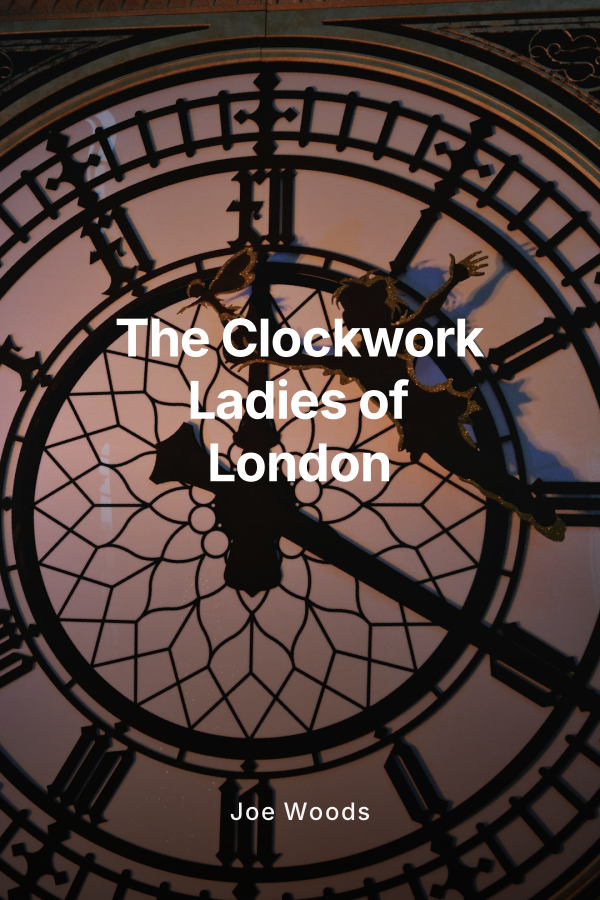
“The Clockwork Ladies of London” is a gothic‑Victorian psychological horror that traces the slow, methodical erasure of a woman’s identity under the weight of fashion, propriety, and an organised will to control. It explores how appearance, language, and routine can be weaponised until a person becomes both prisoner and proof of a system’s success. Through Enola’s divided existence, the story presents a world where the most terrifying loss is not of life, but of the self hidden behind an immaculate smile.