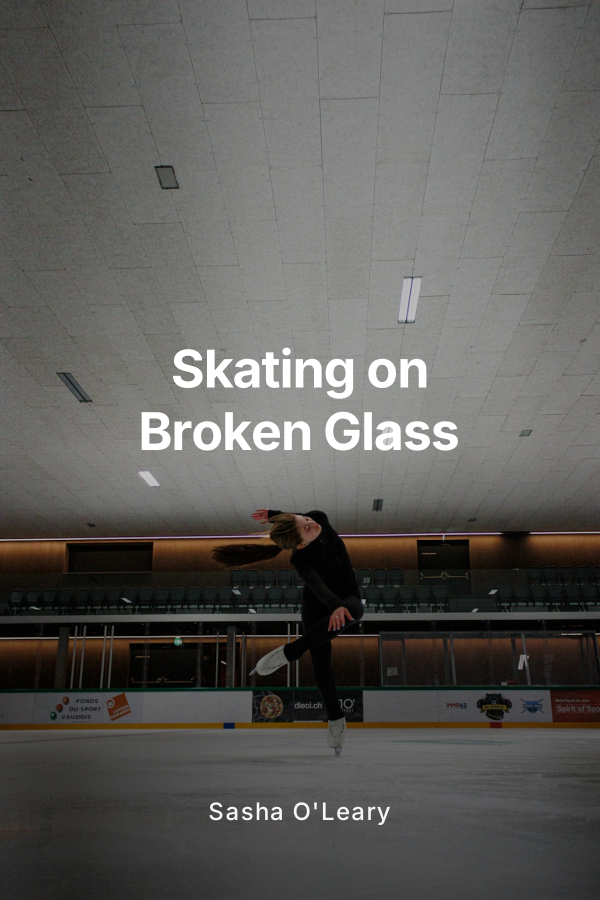
In a cold American rink that never quite feels like home, twenty three year old Leonardo Mateo Bianchi lives for the one place his mind goes quiet: the ice. An Italian center with golden retriever warmth and a deadly shot, Leo has crossed an ocean on a scholarship and seized the captain’s “C” in a single season. To his teammates he is charm, leadership, and relentless work ethic.
Only Leo knows the truth.
Four years earlier, his father died in a violent car crash. Leo was in the passenger seat, miraculously unhurt on the outside, fractured beyond recognition inside. Since that night he has woken to screams he does not remember making, relived shattering headlights and screeching metal, and learned to smile through panic so no one has to carry the weight of his pain. Hockey is not just a sport for him. It is survival. It is the last living thread that ties him to his dad.
Lilian Ella Michaelson glides across that same rink, alone in the early hours when the arena still echoes. At twenty three, she is the university’s brightest figure skating star, all sharp focus and black cat poise. Behind every perfect landing lies a brutal reality her elegant routines never show: a coach who pushes far past the edge of discipline, who grips too tight and speaks with threats and veiled cruelty.
Lilian arrives two hours early to every session, not only to polish her jumps, but to reclaim the ice before it belongs to anyone else. Out there, under the harsh white lights, she can almost pretend the pressure does not hurt. That she is staying for herself and not out of fear.
Their worlds collide in the silence before dawn.
One morning, Leo appears at the rink five hours before his team’s practice, armor on his shoulders, a puck and stick his only company. He is not the confident captain his teammates know. He is a son outrunning a memory. When Lilian steps onto the ice and catches him there, he apologizes immediately and moves to leave, only to be stopped by her calm invitation to share the rink. Half for hockey. Half for figure skating. Neutral territory on frozen ground.
A phone call from Italy pulls his mask away.
As Leo answers in fluid, musical Italian, Lilian finds herself held by the sound of his voice, by the tenderness threaded through every word to his mamma. It is the first crack in a wall he does not yet know he has built. Over the next days, she finds him there again, sitting in the stands, breathing hard, eyes red as he forces himself onto the ice and slams pucks into an empty net with rising fury. Against her better judgment, Lilian crosses the distance and offers him the smallest lifeline: a presence, a question, a simple “Are you okay?” that he cannot answer honestly.
The ice keeps pulling them together.
A college party reveals that their lives are more intertwined than either realized. Lilian’s best friend Mindy is dating Jayden, one of Leo’s closest teammates, tying the figure skater and the hockey captain into the same tight social circle. What starts as awkward introductions at crowded parties soon spills into shared laughter, late night conversations, and quiet moments in the stands as Lilian watches Leo lead his team into the season.
But the stronger the connection, the more dangerous the secrets.
Before the first game of the year, Leo cracks. Panic sinks claws into his chest in the locker room. For the first time, his teammates see the terror beneath the captain’s calm. The referees delay puck drop while he battles to breathe. To the crowd, it looks like routine pre-game chaos. To Lilian, watching from the stands with Mindy, it looks hauntingly familiar: the same strain she hides every day under the sharpened edges of a flawless routine.
When the puck finally drops, Leo plays with a ferocity that borders on rage. Yet where rage ruins some players, it sharpens him. He dominates the ice, every shift a desperate attempt to outrun the images in his head. Lilian cannot look away.
The night ends with a party and a confession on a quiet curb.
Under the soft glow of streetlights, Leo answers the question no one has dared to ask. He tells Lilian, haltingly, about the crash, his father’s death, the three years frozen in place by guilt and fear. He apologizes as if his pain is an inconvenience. She stops him with a touch and a simple truth. He does not have to carry this alone.
From there, a slow burn becomes impossible to ignore.
Early morning practices turn into shared ice. Careful small talk deepens into trust. A double date, orchestrated by meddling friends, forces Leo and Lilian to see what everyone else already does: the way their eyes find each other, the ease with which their walls lower in each other’s presence. One impulsive kiss in the quiet after a night out ignites a fire they cannot pretend away, pulling them into a night of raw tenderness that neither expected.
They fall into stolen kisses, private jokes, and growing comfort that feels too precious to name. Leo sees the steel in Lilian’s spine and the way she flinches when her coach’s name appears on her phone. Lilian sees the tightness around Leo’s smile when he talks about his father, the way certain sounds and headlines turn his gaze distant and gray.
Neither has yet learned that love cannot survive behind locked doors.
As their relationship deepens, the outside pressures sharpen. Leo shoulders the expectations of his team, the weight of the captaincy, and the fear that his trauma makes him unreliable, unworthy, dangerous to lean on. Lilian braves an increasingly volatile coach who crosses lines so often she has started to pretend the bruises on her psyche are part of the sport.
The breaking point arrives on an ordinary practice day.
From the stands, Lilian and Mindy watch the team skate drills when a drunk driving advertisement flashes across the rink’s big screen. Sudden footage of twisted metal, shattered glass, and flashing red lights sears through Leo’s vision. He tries to push through, to lead as always, but the ice warps beneath his feet. The crash is back, full color and merciless.
He explodes.
In front of teammates and girlfriends, Leo’s composure shatters. His stick slams against the boards, angry tears spill unchecked, and words he does not mean lash out at the people trying to reach him. When Lilian descends from the bleachers to help, his fear and shame twist every instinct, turning comfort into threat. They argue, both bleeding from wounds neither has ever fully named. Their hidden pains collide, bringing Lilian’s abusive coaching into the light and Leo’s terror of being seen as broken out into the open.
Hurtful words slip free that neither can take back.
In the weeks that follow, they drift apart, each convinced they are too damaged to be a safe place for the other. Leo’s game falters as he fights guilt and dread. Lilian faces her coach’s escalating aggression, trembling on the edge of quitting the sport she loves. Their friends choose not to look away, forcing them slowly, gently, toward the hard conversations they have avoided for years.
Healing begins on the ice where everything first broke.
With the quiet support of his teammates, Leo finally cracks in a different way. In a raw, vulnerable moment in the locker room, he tells the full story of the crash and the guilt that has been knotting his chest ever since. Tears and shaking hands replace slammed sticks and silence. His teammates listen, not as soldiers losing a captain, but as brothers who refuse to let him drown alone.
They decide to honor his father together.
At the next home game, a teammate secretly arranges a tribute. The announcer’s voice cuts through the pre-game noise, dedicating the match to Leo’s father, acknowledging the loss and the courage it took for their captain to stay. The team skates with small symbols on their gear, visible only to those who know the story. In the stands, Lilian watches Leo’s shoulders tense, then slowly straighten as he looks from the ice to the crowd and sees, at last, that he is not alone.
The rest of their story twists through triumphs and setbacks.
Lilian finds strength in the outrage and protection of Leo and his friends when they witness her coach’s abuse firsthand. Prompted by their unwavering support and her own exhausted anger, she finally reports him, reclaiming both her safety and her love for the sport. Leo, newly honest about his broken places, starts to heal in earnest. He leans on therapy, on his mother and little sister flying in for surprise visits, on moments of laughter with his teammates and quiet nights with Lilian’s fingers in his hair.
He learns that grief does not vanish. It softens. It makes room.
Together, Leo and Lilian navigate figure skating competitions, high stakes hockey games, injuries, campus parties, family reunions, and the terrifying vulnerability of truly letting someone in. There are jealous flashes, clumsy apologies, stolen weekends, and nights when trauma threatens to swallow them both. Yet every step, every stumble, every whispered reassurance builds something stronger than the ice beneath their blades.
They graduate not as flawless heroes, but as two scarred people who have chosen each other, again and again, through panic, anger, and fear. Years later, on the world’s brightest stage, Leo skates for his country and his team in the ultimate tournament. With a gold medal heavy around his neck and the roar of a crowd still shaking his bones, he drops to one knee and asks the woman who met him on broken ice to build a life with him off it.
Skating on Broken Glass is a slow burn college romance threaded with grief, pressure, and the healing power of love that does not flinch from the ugly parts. It follows a golden hearted hockey captain and a fiercely driven figure skater as they learn that real strength is not in never breaking, but in daring to be seen when you already have.