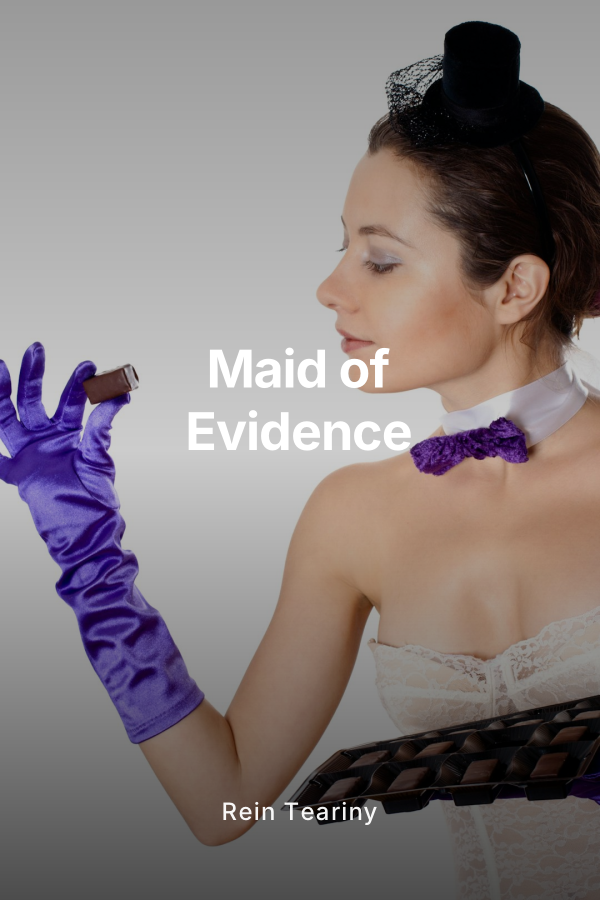
Maid of Evidence follows Maria Reyes, a hotel maid with bleach-burned hands, a city mapped in the back of her mind, and a past that never leaves her alone at night. Her job makes her invisible. Men ignore her, talk over her, undress in front of her like she is part of the lamp. But invisibility has an edge. She sees everything.
Jonah Park is the opposite of invisible. He is the FBI jacket at the door, the badge, the clipped voice on crime scenes around the city. He believes in evidence, procedure, and keeping emotion outside the tape. To him, maids change sheets and keep quiet.
Until the morning Maria walks into his hotel room, steps over his open case file, and gives him a piece of her mind. The victim was a girl from the wrong side of town, written off as “high risk.” Maria reads the way Jonah’s notes lean on that label. She calls him out. She points out a smear on the carpet, a cleaned-but-not-cleaned bathroom, a trash can that was “wiped up in a hurry.” Things his team missed. Jonah thinks she is a nuisance. Then her throwaway observations crack his case open.
That is how it starts.
Across five tightly woven chapters, each with two intense subchapters, Maid of Evidence follows Maria and Jonah as they collide, clash, and slowly become an unlikely investigative team. Together they take on five brutal cases in one unforgiving city, each one orbiting the same ugly truth: men who learned, over years of getting away with it, that women’s bodies are disposable and women’s voices do not matter.
Every case stands alone on the surface. A different victim, a different crime scene, a different corner of the city. But the pattern is always there once Maria learns to name it. A boss who thinks his power is a free pass. A “respectable” husband who hides his violence behind charity galas and church barbecues. A wannabe predator who copies what he sees in the news. An officer who “loses” evidence when a certain type of man walks in. A rich guest who treats hotel staff like they are things he bought along with the minibar.
The book never shows the violence in progress. Instead it walks readers through the aftermath, room by room, alley by alley, body by body. The victims are presented in clinical, unflinching detail, like a report written in blood and bruises. No melodrama, no horror-splatter, just cold facts that hit twice as hard because there is no place to look away. Purpled fingerprints on a wrist. A broken nail snagged on carpet. Bleach streaks where someone tried to clean in a hurry. Maria’s trained eyes catch what everyone else steps over. She knows what a properly scrubbed surface looks like. She knows what it looks like when guilt is on a timer.
Maria’s power comes from exactly what makes the world underestimate her. She is a maid, which means she has access to every floor, every hallway, every private mess. She knows the kind of stains that come out and the kind that do not. She knows which guests ask for extra towels at strange hours. She knows which cops flirt with her and which ones avoid her eyes because they are used to women disappearing quietly.
The cases trace the full spectrum of male entitlement:
- Men who lean brazenly on status and money, assuming nothing will ever stick to them.
- Men who hide behind a polished image and the trust of the community, using it as a shield every time a woman's name shows up in a whisper.
- Men who are not particularly powerful or rich but grew up marinating in the idea that they are allowed to take what they want.
Jonah has spent his career chasing monsters that fit neat profiles. Working with Maria tears those profiles apart. At first, he fights it. He calls her “helpful,” like he is tossing her a bone. He keeps trying to tuck her insights into the corner of his official files. But case after case, Maria is the one who sees the pattern that no one documented, remembers the face from a hallway camera no one bothered to rewatch, recognizes the cheap cleaning chemical a predator used in a failed attempt to erase a woman’s last fight.
Their partnership grows in the quiet spaces between crime scenes. In the car while the city blurs past their windows. At a 24-hour diner at three in the morning, when their coffee tastes like burnt rubber but neither of them can go home yet. In the narrow staff corridors behind the hotel’s polished lobby, where Maria is as confident as Jonah is in his lab.
And threaded through the horror is something surprisingly light. Their banter becomes a pressure valve neither of them wants to admit they need. Maria mocks Jonah’s perfect suit and his inability to tell one cleaning chemical from another. Jonah teases Maria for her secret stash of hotel soaps and her refusal to call him by his title. Snark becomes a shared language. In stolen glances and offhand jokes, a slow, careful tenderness begins to grow. Their feelings never hijack the story, but they sit there like a pilot light under everything, warming even the darkest pages.
As they close each case, Maria grows more confident not just in her instincts but in her right to speak them out loud. She stops apologizing before she talks. She stops flinching when a man in authority cuts her off. She starts to see, in every woman they cannot save, pieces of the girl she used to be. The one in the backseat of her mother’s car, thirteen years old, while a man climbed in with cash and teeth and patience that felt like a trap. The night her mother died in a bloody, desperate scuffle over who owned Maria’s body.
For most of the book, that story lives in shadows. We see the edges of it when Maria freezes at a certain type of crime scene, when she lashes out at a suspect who feels too familiar, when she refuses to step inside certain hotel rooms alone. Jonah notices, but he does not push. He files it away in the part of his brain where he stores unsolved things.
The final case pulls everything tight. The suspect is not a stranger. He is the man who bought that “night” with Maria all those years ago, the man who walked away while her mother bled. He has reinvented himself into one of those “good honest men” the city is proud to claim. Charitable events, respectable job, an expensive suit that fits too well. To everyone else, he is a pillar. To Maria, he is the original monster.
With Jonah on one track trying to build a case and the system once again bending itself around a man in a nice tie, Maria faces a choice. Trust the process that has failed girls like her her entire life, or take justice into her own hands.
She chooses herself.
In a climax that refuses to blink, Maria lures the man into a space she knows better than anyone. A place that belongs to the invisible. She looks him in the eyes and lets him see what he created. Not a broken victim waiting for his apology, but a woman he did not manage to finish destroying. She does what the system never would. She kills him and cleans up in a way no forensic team will ever unravel. This time, the evidence belongs to her.
Jonah feels the wrongness as a shiver down the spine of the case file. A suspect who vanishes too neatly. A trace that almost shows up, then does not. A look in Maria’s eyes that should not be calm but is. He notices. He chooses, once, to look away. Maybe justice got delivered off the books. Maybe he will spend the rest of his career pretending he does not know that.
For Maria, the result is not triumph fireworks. It is a silence that feels different. Sleep that finally comes without the old nightmare. A street she can walk down without her chest locking up. A story she can almost tell Jonah, even if the last page stays hidden. The weight she has carried since childhood does not vanish, but it stops pressing on her windpipe.
In the book’s last stretch, as the city keeps spinning and new cases wait in the dark, Maria and Jonah finally stop pretending their bond is just “professional.” There is no big speech. No candlelit confession. Instead there is a small, exhausted moment after everything goes down, when they lean into each other and neither one pulls away. A hand brushed and not snatched back. A joke that lands soft and honest. Two people who have stared at what men do to women and still choose tenderness, even if they barely have the words for it yet.
Maid of Evidence is for every reader who has ever felt invisible in their own life and wondered if anyone would notice if they disappeared. It is raw without being graphic, clinical in its crime scenes yet deeply emotional in its characters. It shows, case after case, how entitlement and power let men walk away, and how one woman who was supposed to stay silent starts changing the outcome just by refusing to look down at the floor.
At its core, this is a story about three things:
- The quiet skills and survival instincts women develop just to stay alive, and what happens when those same skills are finally valued as power.
- The rage and grief that build up after a lifetime of watching men escape consequences, and the different forms justice can take when official channels are built to ignore that pain.
- The slow, surprising way trust and love can grow in the middle of darkness, not as a neat cure for trauma, but as proof that broken does not mean ruined.
Maria is not a superhero. She is a maid with a cart and a master key and scars that ache in bad weather. Jonah is not a savior. He is a man who learns, painfully and gradually, how to shut up and listen, how to use his badge to open doors for a woman who never should have needed his permission. Together they solve murders. More importantly, they drag into the light all the little ways the world tells women their lives are worth less.
By the final page, the city has not magically healed. Men still walk the streets thinking they own them. But more women are talking. More evidence is being kept. One monster disappeared and no one will ever find his body. And somewhere behind a hotel lobby that smells of lemon and lies, Maria laughs at something Jonah says, wipes a fingerprint off a forgotten glass, and knows, for the first time, that her story belongs to her.