In the rain soaked quiet of Forks, Washington, Astrea has always looked wrong. White blond hair that almost glows in the gloom. Eyes an impossible, burning red. Parents forever absent, doctors repeating the same clinical lie about “a rare condition.” She tells herself she is ordinary enough, invisible enough, just another neglected girl waiting for graduation and escape.
Then the dreams begin to tear that illusion apart.
Night after night she sees a Quileute woman with her own face, wrapped in furs and moonlight, standing beside a silver and black wolf with the eyes of a man who loves her and condemns her in the same breath. In the dreams, the woman is drenched in blood that will not wash off. In the background, a chief falls to his knees with a wound Astrea cannot quite see.
Astrea wakes shaking, aroused, sick with terror she cannot name.
When she meets the Quileute chief’s teenage nephew, everything fractures. One accidental glance and the world narrows to him. The pull between them is instant, feral, and wrong. He tries to avoid her with the urgency of someone who has been warned, yet the more distance he puts between them, the sicker Astrea becomes. Fever, vertigo, a bone deep ache that will not stop until he is near again.
He is more than a boy from the reservation. Buried beneath his skin is something older and hungrier, a spirit that recognizes her as its lost counterpart. The wolf’s emotions crash into her body without warning. His lust becomes her heat. His rage becomes her trembling hands. When he fights to keep away, the bond only tightens, making her malady look like a simple medical mystery instead of a supernatural leash.
Sex and blood become the keys that unlock the truth.
In moments of scorching intimacy, when their mouths are red and their bodies tangled, visions rush through Astrea with almost unbearable force. She sees not the future, but a life she has lived before. She is the Quileute woman of her dreams, lover to the silver and black wolf, bound to a chief she is destined to betray. Each orgasm and each drop of blood shared peels back another layer of that former life, revealing the sin everyone insists she must atone for.
Somewhere in that past, she killed the chief.
Everyone believes it. The wolf spirit that haunts her rituals, the elders that whisper about curses, perhaps even the chief himself. Yet as the visions sharpen, details refuse to agree with the tribe’s version. The setting changes. The wound shifts. The weapon is wrong. The more she remembers, the less certain she is that the blood on her hands ever belonged to the man she was taught to mourn.
The tribe’s prophecies insist on a white haired girl with red eyes who will doom them by repeating her ancient betrayal. She will be the cause of another chief’s fall, another war, another spiral into darkness. The elders preach this warning as if it were a sacred fact. Only when Astrea stumbles on an older, hidden version of the prophecy does the lie snap into focus.
The true text does not blame her alone. It speaks of a “chosen mate” who will bear the mark of the rival spirit, who will either wield their love as a weapon or become the blade turned against the tribe. In that version, the real danger is not the girl, but the one who claims her.
The elders buried that version under threats and obedience. Ordered to hide the truth, an aging council member finally breaks and confesses to Astrea. Long ago, another chosen pair burned the tribe with their love and blood. Another mate went feral. Another chief died. The tribe chose to blame the girl and erase the complexity of what happened, building a cleaner story to control the next generation.
Astrea’s life has been arranged around a lie.
The chief’s nephew is that “chosen mate” foretold. The wolf’s rival spirit lives in him like a live wire, half of an ancient soul that once battled the silver and black wolf for her heart. The other half of that rival spirit hums in a far more dangerous body.
A new vampire family arrives in Forks, five pale predators glittering with old wealth and sun protected by dark stones and forged jewelry. To the townspeople they are simply odd new neighbors. To the Quileute tribe they are an old enemy returned, a threat wrapped in elegance and false smiles.
Among them is a teenage looking vampire boy who focuses on Astrea with predatory clarity. He recognizes her blood for what it is: potent, cursed, and uniquely intoxicating. He offers her a place at his side as his “blood concubine,” promising worship and power in exchange for submission. Unlike the nephew’s wild bond, his interest is calculated and transactional, an obsession sharpened by centuries of hunger.
Astrea recoils from him, but her refusal only fuels his need.
When one of his family members tastes her blood by accident, the truth of her curse explodes. The vampire goes feral in seconds, lost in hallucinations and animal bloodlust, tearing at his own kin in a frenzy he cannot control. It takes everything the others have to restrain him. Her blood is poison masquerading as perfection. It drives vampires insane.
The tribe seizes that chaos as leverage. The chief gives the vampire clan a stark ultimatum: leave the area or face war they cannot win. They accept the terms and vanish into the misted highways, but the boy who wants Astrea does not go with them. He lingers like a whisper at the edge of her dreams.
His new battleground is her mind.
He slips into her sleep with precision, turning her visions into nightmarish seductions. In her dreamscape, he can control the world they move through. Forests become bedrooms. Blood becomes perfume. He offers to free her from the wolf spirit’s punishments and the tribe’s demands, to cut the cords of prophecy and pain with one decisive bite.
He targets her deepest vulnerability: the terror she feels when the nephew’s blood addiction surfaces. Each time the boy defends her from threats, a darker pleasure streaks through him. He begins to savor the violence, to indulge in a cruel joy when he tastes blood. That joy floods through the bond and slams into Astrea’s nerves. It arouses her even as it horrifies her, driving her into a spiral of guilt and longing.
She both fears and craves his monstrosity.
The wolf spirit watches all of this with a lover’s jealousy and a judge’s coldness. Once, in that other life, it was chief and protector, ruling over the tribe and sharing Astrea’s bed under the same lonely moon. Now it offers a different kind of guardianship, one that demands monthly suffering in exchange for its protection.
Every month Astrea walks alone into the forest, to a place only the spirit considers sacred. There, under its invisible gaze, she submits to a ritual of pain. Lashes carve fire across her skin. The wolf does not need a physical hand to wield the whip. Its power drags every stroke deeper than flesh, forcing her to relive moments of past betrayal and present desire with merciless clarity. She accepts this agony as repentance, convinced that her suffering will keep the tribe safe and the prophecy at bay.
The whip does more than punish. It unlocks memories.
Through the blood and bruises, she sees the past chief’s face dissolve and re form as the silver and black wolf who loved her. She sees the rival spirit in another man’s eyes. She realizes her “betrayal” was bound up in a complicated tangle of love, manipulation, and political fear, not the simple treason the tribe has built into a doctrine. Truth and myth blur until she cannot trust a single teller: not the elders, not the chief, not even the wolf.
The rival’s soul, she learns, did not vanish with the past. It split. One half lies curled and restless inside the nephew, feeding his blood addiction and possessive impulses. The other half glows like embers inside the vampire boy, warping his desire for Astrea into something that mimics love and dominion at the same time.
Everything in Astrea’s present is an echo of her past life’s triangle. Two halves of one ancient rival, and the wolf that will not let her go.
To tilt the balance, Astrea chooses to act instead of drift.
Under a swollen moon, she and the nephew perform a forbidden ritual among the pines. It is part spell, part sacrament, part surrender. Their bodies and blood intertwine against the wet earth as they speak words taught in secret by the elder who broke their silence. The goal is simple and deadly: claim the nephew’s half of the rival spirit fully, anchor it to her instead of leaving it free to spiral into madness and murder.
The response is instant.
The wolf spirit howls in fury, its presence slamming through the clearing. The air thickens. The forest darkens. For a moment the wolf overlays the nephew, silver and black fur flickering where his skin should be, eyes lit with a pain that feels like betrayal and longing at once. Astrea feels something sear itself into her neck where the nephew’s teeth meet skin. His bite is not just passion. It is a claim older than language.
New power floods their shared bond. They feel each other’s senses more sharply. Wounds echo from one body to the other. Pleasure, pain, fear, hunger. There is no peace in the intensity, only an addictive completeness.
At the same time, miles away, the vampire boy shudders as if something has been taken from him. The half soul he carried is pulled, stretched, weakened. His fury sharpens into resolve.
He will not surrender his claim so easily.
Inside this tightening web, the prophecy mutates. The elders admit to Astrea that there have always been two texts, two futures. One blames the girl who looks like a ghost. The other blames the one who loves her enough to kill and die. Each generation has chosen which line to fear more and which to bury.
Now both versions seem to be coming true.
The nephew’s need for Astrea curdles into a possessive frenzy one night when he senses her drifting under the vampire boy’s influence. In the dark privacy of her bedroom he pins her with hands that tremble, eyes a luminous storm. His teeth sink deeper than they ever have before. Blood spills across her tongue, and a vision detonates so violently she cannot breathe.
She sees herself with the chief, alone and helpless as he bleeds. She sees the nephew, wild and broken, with blood up to his elbows. She sees the vampire boy smiling as the tribe burns. Then the images shatter and reform, swapping faces and settings like cards in a rigged game. No version feels solid enough to trust.
Astrea’s submission in that moment is not simple collapse. It is strategy and surrender intertwined. She uses the bond to push calm into him, even as his violent desire ignites her nerves. When his eyes finally clear and horror slams into him, she holds him as he shakes, realizing that the “chosen mate” in the prophecy may be both salvation and weapon.
She will not let any of them choose her future for her again.
Astrea begins to turn every piece of her curse into a tool. Her blood, which drives vampires into feral hallucinations, is not just a threat but a shield. Her visions, though stained by interference, carry enough fractured truth to expose the tribe’s lies. The wolf spirit’s discipline, however cruel, has honed her endurance beyond what any ordinary human or monster expects.
Caught between a tribe that wants to use and control her, a spirit that wants to own her soul, a nephew who might love her into monstrosity, and a vampire boy who wants to break her bonds and crown himself her master, Astrea stands at the center of a war written in advance.
Her past life ended with a chief on his knees and a pack in flames. This time, she holds the knife and the prophecy both.
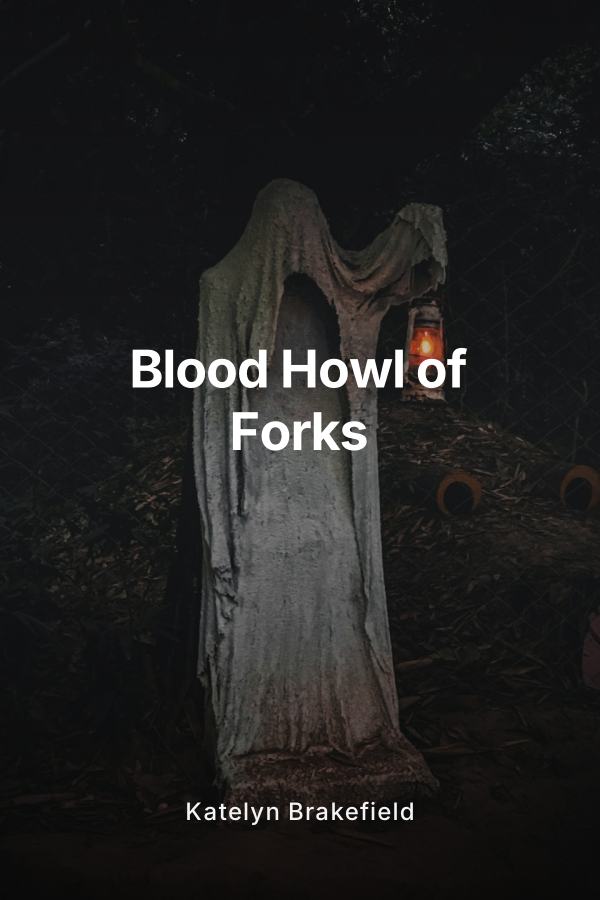
Blood Howl of Forks is an adult paranormal horror romance about reincarnation, erotic obsession, and the corrosive power of sacred lies. It follows a woman who is both cursed and necessary, a mate who might be either executioner or redeemer, and a town where every kiss, every cut, every howl in the night might be the step that tips an entire people into ruin.
In a world where sex unlocks memory, blood unlocks madness, and prophecy can be edited to suit those in power, Astrea must decide who to trust, who to betray, and whether love itself is the trap that has been killing her for lifetimes.