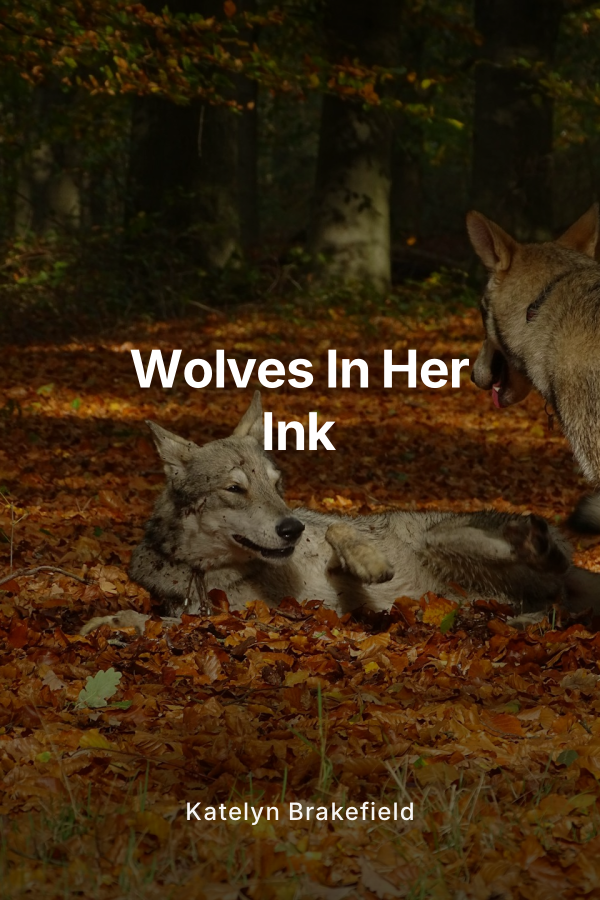
Astra has always drawn the things that should not exist. Wolves with eyes like distant stars, forests she has never walked, a boy’s silhouette crowned with teeth and shadow. She blacks out over blank pages and wakes with her fingers stained, her sketchbook filled with scenes she cannot remember creating. The doctors call it a dissociative episode. Her father calls it proof that she is broken.
On the edge of the Olympic rainforest, the Quileute reservation calls it something else.
He has spent his whole life trying to keep the wolf inside him quiet. Son of the tide and the timberline, he grew up on stories that the modern world calls myth. Still, when he looks in the mirror during his rages, he recognizes the shape of his ancestors’ monsters reflected back at him. He knows how thin the line is between protector and predator, between legend and the violence that stains his family name.
Then he sees Astra’s drawings.
Buried in her gothic spirals and haunted faces are his forests, his river, his ancestral wolves. She sketches the tribal dances she has never attended, the firelit masks she has never seen, the exact pattern of scars on his shoulder. Most terrifying of all, she draws the tribe’s wolves not as stories but as witnesses. Watching. Waiting. Choosing.
He was never supposed to show her the real stories. She was never supposed to see what lives beneath them. But a boy who carries a wolf in his blood cannot turn away from a girl who brings those wolves to life in ink.
Their bond begins with a shared secret. He recognizes his culture hidden inside her art, and she recognizes her own madness reflected in his quiet rage. In the hush of cedar trees and fluorescent-lit classrooms, their connection coils into something sharp and undeniable, a dark romance rooted in fear and fascination.
Astra is not just unstable. She is a seer. Each blackout unleashes a vision that pours through her hands. Her spirit guide, a wolf no one else can see, presses her toward the truth with a gentleness that borders on ruthless. With every sketch, the line between hallucination and prophecy grows thinner. Her drawings do not simply echo the tribe’s wolf legend. They begin to rewrite it.
The boy’s people have survived centuries of erasure by guarding what is sacred. They know what happens when outsiders touch the old power carelessly. So when Astra’s art starts predicting more than weather and shoreline, when it begins to bleed into living memory and future danger, the tribe cannot look away.
In her pages they find more than wolves. They find betrayal.
Hidden among her nocturnal sketches is the shape of a man revered as healer and spiritual anchor. The tribe’s shaman, keeper of the oldest stories, stands in Astra’s drawings wreathed not in smoke but in shadow, always near scenes of broken bodies and burning eyes. Her pencil places him at the edge of rituals that have not yet happened. At the center of threats no one has dared voice aloud.
When a confrontation on tribal land brings everything to a breaking point, the boy finally loses the control he has spent years building. A tribe member corners Astra with a threat that turns verbal menace into physical danger. The boy’s vision tunnels, the wolf inside him answering faster than his human fear. The aftermath leaves blood on the ground, sirens in the distance, and the shaman’s influence curling through the story like smoke.
To outsiders it looks like a violent outburst from a troubled native boy. To the tribe it looks like something older and more dangerous waking up.
The elders intervene, but their power is not absolute. The shaman twists the incident into proof that the old legends must be tightened like a noose. Astra becomes a convenient omen, her art recast as a curse, her presence framed as the spark that set the wolf within the boy ablaze. Under the shaman’s whisper campaign he stands at risk of being caged or worse, and she stands at risk of being offered up to whatever superstition demands.
One elder refuses to let the story end that way. Quietly, secretly, he turns against the shaman’s tightening grip. He sees patterns in Astra’s work that match fragments from forbidden history. He sees a boy whose violence has always been aimed at protection, not power. He sends them away with nothing but a handful of cash, a rusted-out car, and cryptic notes tucked between the bills.
“Trust the wolves, not the man who pretends to own them.”
“His power depends on what you do not remember.”
“Your drawings are evidence. Guard them.”
Exiled from the land that formed him and cut off from the thin lifeline of structure that kept her from shattering, the boy and Astra become bound by more than love. They become mutually dependent. She leans on him as anchor during the blackouts that drain her, leaving her exhausted and frightened of her own mind. He leans on her as witness, the only person who has ever seen the thing he becomes and not recoiled.
Their romance grows in the shadows of cheap motels and bus stations, tender and toxic in equal measure. He teaches her the real names of the stars over the highway. She draws his hands until sleep drags her under. Between them rests a sketchbook that holds futures they may not survive.
Each new blackout brings a torrent of images. Astra’s eyes glaze; her hand moves. Wolves on cliffs, the shaman in the distance, a circle of masked dancers whose faces she blurs instinctively. She draws the inside of a building she has never entered, marked with tribal symbols that only he can name. She draws the elder’s face, marked with a slash of crimson that makes his stomach drop.
The wolf spirit at her shoulder remains kind, but its kindness no longer feels gentle. It guides her toward truths that splinter any hope of pretending their love exists apart from the legend. Her visions insist that the shaman’s betrayal goes deeper than personal power plays. He is feeding something. Or someone. And the tribe Astra left behind may be marching toward a night none of them will walk back from.
The elder’s messages grow more urgent. Scrawled phrases reference old sayings about the wolf that turns on its own pack. Warnings hint that the violent incident which pushed them out was not an accident but a pressure point deliberately struck. One note carries only a date and a single word that translates roughly to “awakening.”
They face an impossible choice.
They can stay gone, cocooned in a fragile life sewn from late shifts and shared nightmares, pretending that love can smother prophecy. Or they can return to the river and the forest and the bones of stories that never belonged to them equally, knowing that walking back onto that land might cost them their freedom, their minds, possibly their lives.
They choose each other, and because of that they choose to face what hunts his people from within. Not as saviors, but as the only ones carrying both the wolf’s blood and the seer’s visions in the same fragile, flawed partnership.
“Wolves In Her Ink” follows two damaged teenagers as they navigate a love affair stitched through with spiritual legacy, mental illness, and cultural fracture. It is a dark romance that refuses clean lines between sacred and sick, between supernatural and psychological. Astra’s hallucinations are not neat metaphors. They are invasive, disorienting, and physically punishing. The boy’s violence is not romanticized. It is terrifying even to him, and its consequences exile them from home.
Yet beneath the darkness, the story holds a vein of stubborn hope.
Their relationship is twisted but never pointless. They lean on each other too hard, feeding a mutual dependency that both sustains and warps them. At the same time, they are the only ones who truly see each other whole. He reminds Astra that she is more than her diagnosis, more than a vessel for prophecies that others wish to harness or fear. She reminds him that his heritage is not a curse, that the wolf inside him existed long before the shaman tried to weaponize the legend.
The novel confronts:
• How far a community will go to protect itself, even if it means sacrificing its own vulnerable members.
• How a girl branded as mentally unstable can become the most accurate historian of things no one wants recorded.
• How love can both soothe and sharpen the edges of inner monsters.
• How ancestral stories can be corrupted by those who crave control, and reclaimed by those willing to face what those stories actually demand.
In the end, Astra and the boy do not emerge healed or whole. The confrontation with the shaman and the truths inside Astra’s drawings leaves scars that will not fully close. Allies are lost. Trust in institutions cracks. Some of the ghosts they raise cannot be put back to rest.
But they stay together.
Not as a fairy tale couple who have solved each other, but as two battered souls who have chosen to keep holding on anyway. They walk away from the final reckoning scarred, more aware of their own damage and the harm they could do to each other. Yet they also walk away with something unshakable: the knowledge that they faced the darkest parts of themselves and their shared history and did not look away.
Astra keeps drawing. The visions are less frequent, no longer ripping her out of herself without warning, but they never disappear completely. Her wolf spirit remains at her side, not as an omniscient puppeteer, but as a reminder that some connections between flesh and story cannot be severed. The boy continues to war with the temper that nearly destroyed them, but now he does it with tools, not just shame, and with a partner who refuses to let him pretend that he is either monster or martyr.
“Wolves In Her Ink” is a story for readers who crave romance that tastes like iron and midnight, who are drawn to narratives where the supernatural feels tangled with mental health rather than neatly separate, and who are willing to sit with a love that survives not because it is pure, but because it is fiercely, vulnerably chosen.
The hope at its heart is not soft. It is the kind that limps, that flinches at loud noises, that wakes up sweating from dreams of forests and teeth. It is also the kind that refuses to let a shaman’s betrayal, a tribe’s fear, or a lifetime of being told “broken” be the final word written over two lives.
In Astra’s hands, the wolf legend stops belonging solely to those who would hoard it. It becomes something new, something inked with her instability and brilliance, with his rage and loyalty. In his arms, she is not a cursed seer or a fragile Gothic archetype, but a girl who has every right to exist even when her mind terrifies her.
Their love story is not safe. It is not clean. It is, however, still standing when the last page turns.