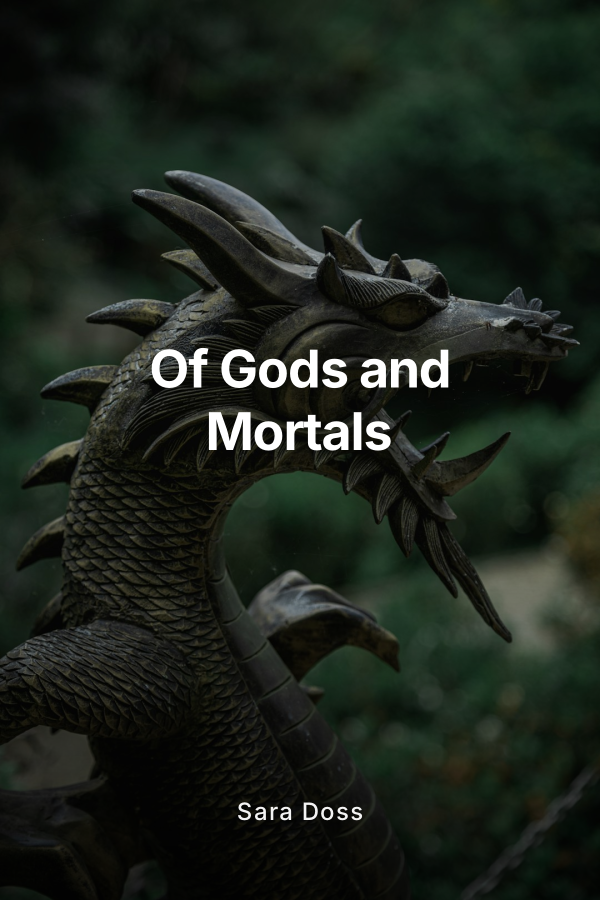
In the fractured world of Ilaria, cities of glass and spellsteel rise beside haunted ruins where time itself forgets how to behave. Elemental metropolises glitter against horizons torn open by ancient magic, and between them stretch farmlands, lava plains, and oceans that whisper with the voices of forgotten gods. Above it all hangs the Riftlands, a festering wound where reality unravels and something old and hungry dreams of dominion.
Elijah Vashanti wants none of it.
Once a weapon in someone else’s holy war, he has carved out a quiet life with his wife Misha Novac in the peaceful farming nation of Gulden. His days are spent mending fences, teaching children small tricks of mana, sharing drinks with the earth mage Grendel, and pretending the gods that live within his soul are nothing more than echoes. Yet inside him dwell Ohius and Ula, the forsaken twins of dark matter and light, forever bound to the man who carries their power as living vessel and reluctant heir.
When a surge of unstable magic spills from the Riftlands and tears through Gulden’s farmlands, the façade of peace shatters. Crops wither in a heartbeat, elemental beasts scream at the sky, and something twisted prowls the night. The Corrupted arrive first as scattered horrors, then as hunting packs guided by an unseen will. In their wake moves Kagne Gathnu, a near myth whose name is spoken only in terrified whispers.
Kagne was once a man. Now he is a sculpted engine of corrupted divinity, a being whose flesh has become a canvas for the most perverse evolutions of matter. He births weapons from raw distortion and commands an empire of warped souls. More than conquest drives him. He is obsessed with Elijah, with the twin lights nested in the mortal’s heart, and with the possibility of claiming them for himself.
Bound by love and weary duty, Elijah returns to Chuso, the land of volcanoes and sky-tangled mana wires, where Misha’s family rules half a kingdom stained by its own ancient sins. In Solaris Reach, capital of fire and glass, Elijah must confront his past as a reluctant weapon and his present as a man who only ever wished to be a husband and friend. King Hiram Novac, Misha’s hardened father and sovereign of Gulden, sees in Elijah both a threat and a last, fragile hope.
As political tensions flare between the Novac and Tillès territories and the Riftlands churn louder with each passing moon, old faiths stir beneath the surface. The forgotten gods of dark and light, long reduced to rumor, scent the rise of a rival divinity in Kagne. Ohius counsels harsh balance and necessary cruelty, while Ula demands mercy and the preservation of what can still be saved. Elijah is their battlefield as much as their champion, torn between power and the fear of becoming the very monstrosity he must face.
Into this crucible strides Sona, the Slayer of Sin, a towering hunter etched in runes of sun and moon. She serves her twin deities with ruthless devotion, tracking the Corrupted across continents with her demon wolf companion, Kronos, at her side. To her, Elijah is at first a threat tethered to dangerous gods, a walking fracture in the moral order she clings to. Yet the more she travels with Elijah and Misha, the more she witnesses the painful humanity under his divine weight. Attraction flickers where suspicion once lived, even as Sona grapples with sins of her own and the debts she believes only blood can pay.
Together this unlikely fellowship stands at the confluence of collapsing realities. The tranquil hills of Gulden, the molten plains and gleaming towers of Chuso, the unstable mirages of the Riftlands, and the storm-swathed sanctuaries of the Blaintawa Isles all become stages in a single, spiraling conflict. On the unconquered Isles, where elemental gods of sea, flame, wind, and earth still walk in beast and storm, Elijah and Misha seek answers from divine beings who consider mortals both cherished children and passing curiosities. The gods of the Pantheon speak not in prophecy, but in tides, earthquakes, and searing winds, demanding that mortals finally decide what world they wish to build from the ashes of the last.
Kagne’s reach grows. He warps the Riftlands into a breeding ground for abominations, then extends his influence outward, wrapping tendrils of warped matter around entire cities. Where he passes, elementals are twisted, elemental beasts become nightmares, and the air itself tastes of rust and grief. His greatest creation, the colossal Basilisk, prowls as his herald, a monument of living corruption that reduces armies to whispers in the dirt. Through it he seeks what he desires most: Elijah’s submission and the unmaking of the old divine order.
As the Corrupted march toward Solaris Reach, Elijah must decide whether to yield fully to Ohius and Ula, becoming something more god than man, or to remain bound by his fragile mortality and the love he holds for Misha and the fragile peace he has built. Misha herself must balance duty and affection, torn between her loyalty to her kingdom, her father’s stern expectations, and her determination to stand beside Elijah not as his anchor alone, but as an equal force of devastation and hope. Her flames become more than weapons; they are the firelight that defines the edges of who they are allowed to be.
Sona, caught between the sun’s unforgiving glare and the moon’s quiet judgment, must confront the truth that not all sin deserves the same blade. As she hunts Kagne’s agents, her own rigid codes are tested. The more she fights beside Elijah, the more she realizes that redemption is not a straight path and that love, in all its inconvenient forms, is as dangerous as any battlefield.
Across five sweeping movements, Of Gods and Mortals traces a rising storm. Each chapter delves deeper into the geography of Ilaria and the hearts of those who defend it. From Gulden’s threatened calm to the heated intrigues of Chuso, from fractured time-streams in the Riftlands to solemn pilgrimages on the Blaintawa Isles, the story unfolds as a tapestry woven from elemental fury, divine politics, mortal fears, and fragile hopes.
Old myths awaken. The Forgotten Gods test their chosen vessel. Elemental deities watch from storm, forest, sea, and magma, uninterested in mortal debates yet keenly aware that something in Kagne’s ascension threatens the equilibrium even they require. Everywhere, the same question surfaces in whispers, prayers, and the silent glances between allies on the eve of war.
What does it mean to be mortal in a world where gods bleed through human veins?
At its core, this is a tale of boundaries challenged and remade. Elijah wrestles with the line between protector and destroyer. Misha confronts the divide between royal duty and personal desire. Sona faces the chasm between justice and mercy. Grendel stands between quiet farmer and earthshaker. King Hiram wavers between sovereign and father. Ohius and Ula themselves must decide whether they truly wish to guide Elijah toward balance, or if their ancient rivalry will doom the world they claim to cherish.
Kagne believes that the age of balanced gods and trembling mortals is over. In his vision there is only one law: power without restraint, reshaping existence in his image. To steal Elijah’s inner cosmos is not only to cripple a rival, but to seize the twin fires of creation and oblivion and remake Ilaria into a single, endless kingdom of Corrupted worshipers who feel no pain, no doubt, and no choice.
Of Gods and Mortals invites readers into an epic where magic is threaded through metal rails and volcanic rivers, where gods wear the skins of wolves and stags, where time bends and snaps over scarred horizons. It is a saga of lovers and hunters, of kings and farmers, of gods who learned too late that they need their mortals as much as mortals ever needed them.
As Kagne’s shadow lengthens and the final confrontation approaches, every bond is tested. Found family is not a soft refuge, but a responsibility. Romance is not a distraction from war, but the reason anyone dares to wage it at all. Somewhere between the first flicker of dawn over Gulden’s fields and the last scream over the Riftlands, Elijah must answer the question that will shape the fate of Ilaria.
Will he remain a man who carries gods, or become a god who remembers what it meant to be mortal?
In shining cities and ruin-choked wilderness, under twin moons and cracking skies, the answer will be written in light, in shadow, and in the ashes left behind when gods and mortals stand together, or fall alone.