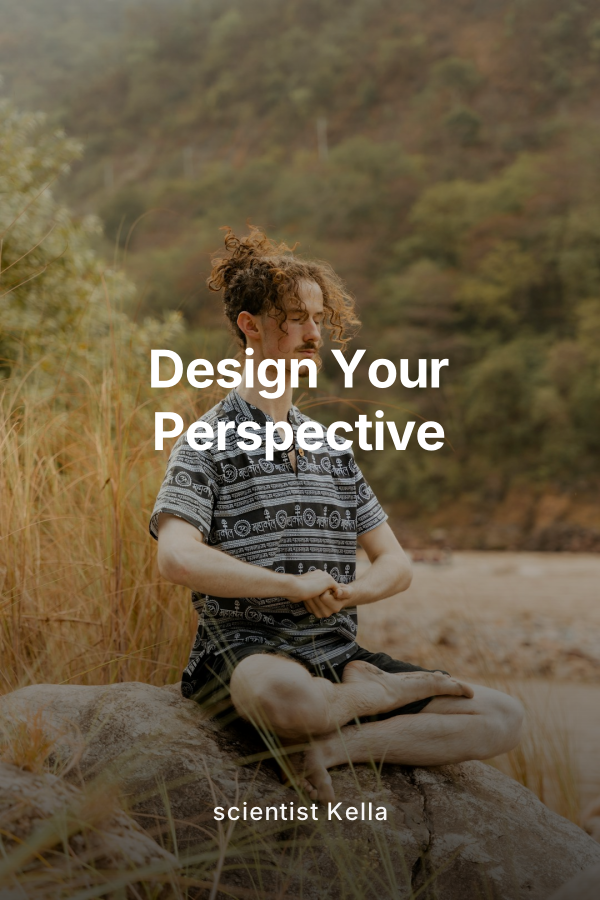
This book is a guided journey into one of the most powerful, underrated forces shaping your life: your perspective. It shows you how the way you see the world quietly scripts what you believe, how you feel, and what you dare to attempt. Instead of trying to control every external circumstance, you will learn to redesign the inner lens through which you experience everything.
Written for a general audience in an accessible, conversational style, “Design Your Perspective” blends personal stories, Indian village wisdom, simple psychology, and practical exercises into a unified, interactive path of change. It does not ask you to become someone else. It invites you to look again at who you are, what you have lived through, and what you want next, then consciously reshape the way you think about all of it.
The book opens by answering a simple but profound question: What is perspective, really? Using an easy formula of perception and interpretation, it shows how two people can live through the same event and walk away with completely different stories about what it meant. From there, you begin to see that you are not trapped by your circumstances as much as you are trapped by the meaning you have been giving them. This realization becomes the foundation for the rest of the journey.
To make this idea concrete, the book introduces artistic concepts like the XYZ axes, the horizon line, and the vanishing point, and then translates them into tools for life. Your goals become the X-axis, your values the Y-axis, and your daily actions the Z-axis. The horizon line represents what you currently believe is possible for you. The vanishing point becomes your ultimate direction in life, the long view that keeps you centered even when the road feels messy or unclear . Through stories and guided reflections, you discover where your current “drawing” of life is distorted and how to realign it.
At the heart of the book runs a narrative about a boy named Arjun, who grows up feeling crushed under academic pressure and social expectations. A journey to a village and an encounter with an elder named Raghav completely change the way he sees his life. Sitting around a fire, listening to a story about a wise sage and a young prince, Arjun realizes he has been looking at his entire future through a tiny peephole, focused only on marks and approval. As he immerses himself in village life, traditional crafts, and sustainable living, his horizon line rises, his vanishing point shifts, and his sense of purpose expands far beyond grades. This story serves as a living thread that connects the abstract ideas of perspective to real human choice and change .
From there, the book moves into one of its core contrasts: creative thinking versus competitive thinking. You are invited to question how deeply comparison has infiltrated your mind. Have you been measuring your worth only against others, their salaries, their achievements, their timelines? The book shows how a purely competitive mindset narrows your view, fuels anxiety, and pushes you into chasing goals that never really belonged to you. In contrast, a creative mindset respects your uniqueness, encourages experimentation, and allows you to design paths that match your values and strengths, not just society’s scoreboard.
Next, “Design Your Perspective” takes you beyond the boundaries of your own town, country, and even your era, introducing what it calls the Universe Point of View. Here, you learn to zoom out and see yourself as part of a much larger human story. Through reflections on grassroots innovation, village ingenuity, and the wisdom found in unexpected places, you realize that true advancement is not just about being “modern” but about staying connected to creativity, resilience, and community. The book challenges fast judgments about who is “advanced” and who is “behind,” offering portraits of rural problem solvers and mentors who changed the author’s understanding of progress and success .
Midway, the focus shifts inward to the building blocks of a strong inner foundation: confidence, fear, courage, and acceptance. Confidence is reframed not as loudness or arrogance, but as the quiet trust that you can learn, adapt, and grow. You explore how self-talk, past failures, and labels given by others have shaped the story you tell about your capabilities. Then you are given specific practices to gently but consistently rewrite that story: small challenges, honest acknowledgments of your progress, and visible proof of your own ability to handle discomfort.
Fear is treated not as an enemy to be eradicated, but as an alarm system that often fires too early and too loud. You learn how fear exaggerates risks and hides possibilities, and how courage is not the absence of fear but the decision to move while your heart is still racing. Simple tools like graded exposure, visualization, and breathing techniques become practical companions for real situations, whether it is public speaking, exams, career changes, or difficult conversations . Alongside these are stories of people who redefined what was possible for them despite fear, subtly nudging you to see yourself in their journeys.
The art of acceptance is then introduced as the missing balance. Where confidence and courage push you forward, acceptance keeps you grounded. You are encouraged to face realities you cannot change, events you wish had gone differently, and traits you might never fully erase. Instead of fighting everything, you learn to separate what can be changed from what must be accepted, and to see acceptance not as surrender but as a starting point for wiser action. This shift releases energy that was previously trapped in resistance and regret.
The book also traces how human thoughts and beliefs have evolved over time, placing your own struggles in a much bigger context. You see that confusion, uncertainty, and inner conflict are not personal defects; they are part of what it means to be human in a rapidly changing world. Understanding this evolution helps you feel less alone and less “broken” for not having everything figured out.
From this more compassionate place, the book guides you toward two crucial outer supports: mentors and self-definition. You learn what a true mentor is, how to recognize them, and why a single conversation can sometimes expand your horizon line more than years of routine. At the same time, you are challenged to answer a question many people avoid: Who are you, beyond the roles and expectations others have placed on you? Through reflective prompts, you begin to design a personal definition that is flexible, honest, and rooted in your own values, not in external pressure .
In the final part, the book introduces a practical, science-informed layer to your inner work: designing your dopamine. You explore how your brain’s reward system influences motivation, habits, and the pull of distractions. Instead of chasing endless instant hits of pleasure, you learn to build sustainable sources of satisfaction through meaningful work, creativity, learning, movement, relationships, and service. The book explains, in simple language, how small daily actions can gradually rewire what your brain finds rewarding, making it easier to move toward long-term goals without constant self-battle .
Throughout the journey, “Design Your Perspective” is intentionally interactive. Each chapter includes exercises such as perspective journaling, visualization, fear journaling, gratitude lists, and perspective-taking activities. You are repeatedly invited to pause, write, question, and experiment. The aim is not for you to just “understand” perspective but to experience it shifting in real time. By the final pages, you are not handed a perfect formula for life but a set of tools, images, and stories that you can return to whenever you feel stuck, confused, or overwhelmed.
Ultimately, this book is a companion for anyone who has been crushed by expectations, numbed by comparison, or trapped in a story about themselves that no longer fits. It does not promise that life will become easy. It promises something more honest and more powerful: that you can learn to see differently, choose differently, and slowly design a perspective that supports a life richer in meaning, creativity, courage, and connection.
Your circumstances will not always be yours to choose. Your perspective, however, is. This book shows you how to claim it, shape it, and let it guide you toward a life that finally feels like your own.