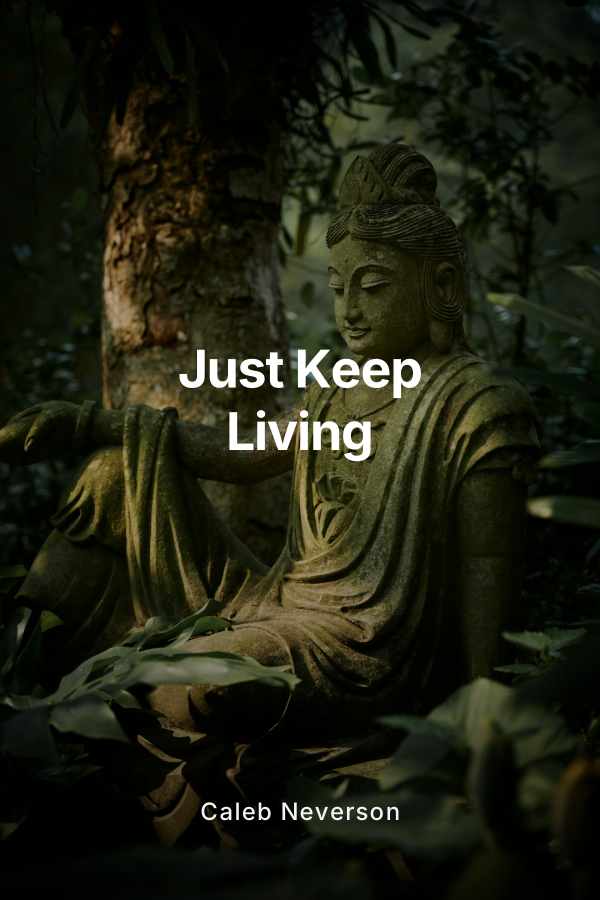
This book is a spiritual, motivational roadmap for people from sixteen to twenty four who feel like life hit a little harder and earlier than they were ready for. Drawing from the real, raw journey captured in your existing chapters, it walks readers through the hidden weight of potential, the sting of failure, the quiet battles of anxiety and self doubt, and the slow, honest process of building a life with God when nothing feels clear yet.
At its core, Just Keep Living is a testimony. It tells the story of a young man who grew up labeled as “gifted,” praised as “going places,” and constantly reminded that he was “wise beyond his years,” yet still felt lost inside. People saw greatness, but they did not always hand him a map. The result was a deep tension between who everyone said he would become and who he actually felt like in the late nights, in the counselor’s office, in the locked online courses, and on the lonely trail where his lungs burned and his legs wanted to give out.
In this book, that private tension becomes a public invitation for young readers who feel the same pressure. Sixteen becomes more than an age; it is an internal mountain, a climb toward identity that feels like you are expected to carry greatness before you even know who you are. The book shows how potential can feel like pressure, how being the “strong one” can feel like a prison, and how God quietly shapes character in the shadows long before He ever reveals someone in the spotlight.
From there, the story moves into seasons of apparent failure and falling behind. The reader follows you into the reality of failing grades, locked screens, and the fear of not graduating on time, all while the world assumes you are “too smart” or “too focused” to ever struggle like that. The book does not skip the shame, the anxiety, or the tears. It does not pretend perseverance feels glamorous in the moment. Instead, it paints a true picture of success as it really is for a young believer: exhausting, repetitive, made up of small, hidden steps that do not even look like progress until you look back and see how far God has carried you.
In the middle of that struggle, the book keeps pointing back to faith. Not the polished, churchy kind that only exists on Sundays, but the whispered prayers in dark rooms when your GPA is collapsing and your hope feels thin. It explores how Scripture about strength in Christ moves from being “just words” into oxygen when your future feels like it is closing in. While specific verses will be properly attributed in the full manuscript, the summary hints at that shift: from inherited faith to personal dependence, from religious routine to desperate trust.
Graduation day becomes a powerful turning point in the narrative, not as a neat, picture perfect ending, but as proof that perseverance is possible even when the odds say otherwise. The encouragement from a principal, the support of a praying mother and grandmother, and the presence of a pastor who did not just preach perseverance but lived it alongside you all reveal something vital for young readers. They show that independence does not mean isolation. Real maturity is not just about being free to make choices; it is about learning to steward freedom, ask for help, and refuse to let shame write the ending.
But the story does not stop at graduation. It pushes into the pressure that comes when opportunity finally opens. At twenty, the question shifts from “Can you get back on track?” to “What are you going to build?” With more access than most your age, more relationships, and a deeper understanding of how systems and power work, you step into rooms you once only heard about. Yet the loudest opposition is no longer from the outside; it is from within. The book exposes this inner war with brutal honesty: the voice that asks, “Who do you think you are?” “What if you fail publicly?” “What if you never live up to what people spoke over you?”
In these chapters, readers see that sometimes the greatest enemy of purpose is not external resistance but internal hesitation. The same expectations that once inspired you now test your courage. The story walks through the moment where God’s whisper, “You are too close to turn around now,” settles your spirit and shifts you from fear to faithful persistence. This moment becomes a model for every young adult at the edge of a big decision. It shows that courage is not the absence of doubt, but the decision to keep moving even when you are unsure, to treat faith not as a safety net beneath you but as a compass in front of you.
Running and climbing Red Mountain becomes one of the primary metaphors that holds the whole book together. What started as a frustrating jog, exposing your lack of conditioning, discipline, and pace, turns into a spiritual classroom. Jogging teaches that you cannot pray for endurance while avoiding the process that builds it, you cannot sprint through life and expect to last, and you cannot start and stop without breaking your own momentum. It reveals patterns that many young adults will recognize in themselves: starting things with passion, quitting quietly, doubting themselves out of opportunities, and mistaking fear for wisdom.
As the story follows you back to Red Mountain as an adult, the climb takes on even more meaning. Each trail entrance, each hill, and each decision point between the smooth path and the steep incline becomes a picture of the choices young adults must make between comfort and calling. The chapter where you reach the top again, looking out over the cities that once felt so big, demonstrates how elevation changes perspective. Problems that once seemed overwhelming now look different from higher ground. God’s quiet reminder, that if you can conquer this mountain there is no mountain He cannot carry you over, unlocks a revelation that the reader can share: their current obstacle is not the end of the story, only a chapter in a much bigger climb.
Throughout the book, every chapter title is framed by a Scripture, giving young readers a clear anchor before they enter each season of your story. These verses about strength, perseverance, identity, wisdom, and calling are not used as decoration; they are treated as lifelines. The structure is intentionally simple and repeatable for a generation that is busy, distracted, and often exhausted. Each chapter opens with a verse to set the tone, then unfolds a real story from your life at a specific age or stage, then closes with a short “Just Keep Living” section that offers three simple things: one sentence of encouragement, one reflection question, and one practical step readers can take in their own journey with God that week.
The summary of the book’s heart can be distilled into a few core truths that echo across your draft:
- You are not just potential; you are a person that God is shaping in real time, in your fears, questions, and imperfections.
- You are not your report card, your failures, or your what ifs. Perseverance, guided by faith, can rewrite any ending.
- Independence is not isolation. God often carries you through people, mentorship, and community that refuse to give up on you.
- The loudest opposition is often internal. Learning to confront hesitation and keep moving with God is part of becoming who you are called to be.
- Mountains do not always move instantly. Sometimes God does not remove the climb; He strengthens you in it, step by step, breath by breath, until you realize you are not drowning anymore; you are learning to swim.
By the end of Just Keep Living, the reader is not left with a polished fairy tale, but with a real, practical hope. They see a young man who did not have all the answers, who questioned himself, who almost failed, who dealt with silent anxiety and heavy expectations, yet discovered that with God, no obstacle is final. Your life becomes more than a story to admire; it becomes a mirror and a map. The reader can look at their own pressure filled sixteen, their confusing eighteen, their opportunity filled but terrifying twenty, their rebuilding twenty four, and realize they are not behind, not disqualified, and not forgotten.
They are simply in the middle of it.
And with every chapter, with every Scripture, with every honest scene and every small action step, this book will keep repeating one unshakable message to a generation that needs to hear it over and over: no matter what you face, you can overcome it with God’s help. All you have to do is make a decision in the middle of the mountain, in the middle of the mess, in the middle of the doubt.
Just keep living.