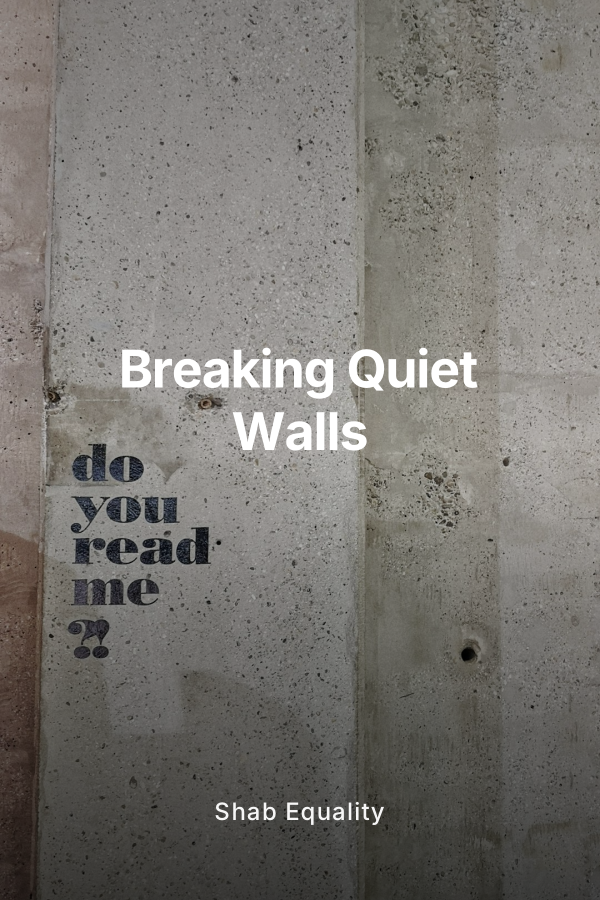
This book follows a boy from age ten to twenty one as he grows up on a deprived estate, moves through grief and self doubt, and finds his voice in healthcare and local politics. Told as a close, character driven story, it traces how a quiet child of diverse heritage becomes one of the youngest councillors in his town, while never forgetting the streets that shaped him.
At ten years old, he lives in a cramped flat with his mum and older sister, surrounded by the daily reality of poverty. The estate carries a weight of unspoken rules, low expectations, and subtle racism. He watches his mum juggle shifts and bills, feels the absence of his dad, and learns to keep his head down. His sister, however, refuses to accept silence. She argues with the TV, marches in protests, brings home leaflets and petitions. Through her, politics arrives in their living room long before he knows the word for it.
By twelve, she drags him to his first protest. He is small, nervous, and almost swallowed by the crowd, but something in the chanting, the home made signs, and the stories people share cracks his quiet shell. At secondary school, a single supportive teacher spots his sharp mind behind the lowered eyes. In classrooms that often feel hostile or indifferent, this teacher pushes him to speak, to write, and to see that his story and his estate matter. That early encouragement, combined with his sister’s stubborn activism, plants the idea that politics is not just for people on television.
Through his teenage years, he slowly tests his voice. He joins school debates, helps organise small campaigns, and begins to name the injustices he sees every day: families queuing at food banks, friends leaving school with no real options, neighbours treated like numbers by distant systems. He wrestles with his own shyness and insecurity, haunted by the quiet message that boys like him do not belong in positions of power. Yet each conversation with his mum, each argument with his sister, each moment of being listened to nudges him forward.
At seventeen, he takes a job in local healthcare, working on the frontline of an underfunded system that holds together the most vulnerable people in his community. The work is exhausting and underpaid, but it gives him a clear, unfiltered view of how policy decisions land in real lives. He meets elderly patients alone in freezing flats, parents skipping meals so their children can eat, and colleagues burnt out from doing too much with too little. When staff organise a strike for fair conditions, he joins the picket line and feels a new kind of solidarity. Standing with others, he realises that collective action is not abstract theory but something he can touch and feel.
Then the Covid 19 pandemic hits. The estate falls eerily quiet, sirens become a nightly soundtrack, and fear seeps into every visit and shift. While he tries to hold things together at work, his own family life shatters. His dad, already distant but still a presence in his thoughts, becomes a victim of the virus. Losing him during a time of isolation, confusion, and public arguments about whose lives matter most, tears open old wounds and raises new questions. He is left to negotiate grief, anger, and guilt while still showing up for others.
That loss becomes a turning point. Instead of retreating fully into silence, he throws himself deeper into political engagement. He starts asking harder questions about why certain communities were hit so fiercely, why services had been so thinly stretched for so long, and why people like his dad seemed almost invisible in official responses. Encouraged by his mum’s quiet belief and his sister’s refusal to back down, he steps into more visible roles. He helps run online meetings, speaks at local forums, and becomes known as a young voice unafraid to challenge the status quo.
By his late teens, people in the community begin to nudge him toward standing for local office. The idea terrifies him. He has never seen anyone who looks like him, with his background and his postcode, sit at those long tables where decisions are made. Impostor syndrome grips him, and bias soon proves to be more than a private fear. During the selection process to become a council candidate, he encounters subtle and open prejudice: questions about his age, his accent, his loyalties, and even his right to speak on behalf of the community he grew up in.
The book does not shy away from these barriers. Party meetings, interviews, and selection stages expose how institutions can mirror the same inequalities they claim to challenge. He faces being talked over, underestimated, and treated as a token rather than a serious contender. Yet every attempt to sideline him strengthens his resolve. He learns to build alliances with older community members, to stand his ground when rules are quietly bent against him, and to turn his lived experience into political strength instead of shame.
When he finally wins selection as a candidate, a new test begins. Campaigning on the doorstep, he has to convince neighbours who remember him as a shy boy that he can now represent them. He listens more than he speaks, gathering stories of overcrowded flats, rising bills, patchy youth services, and fraying trust in institutions. The election campaign becomes more than a contest for votes; it is a reckoning with his own journey from background noise to public voice. At times he doubts every step, overwhelmed by responsibility and the weight of expectation.
Election night at twenty one forms the emotional climax of the story. Surrounded by family, friends, and the people who saw him grow up, he waits for the results that will decide whether all the sacrifice, late nights, and battles against bias have made a difference. The tension of that night carries within it every earlier moment: the ten year old boy watching his mum count coins, the twelve year old on his first protest, the healthcare worker on a picket line, the son mourning a father lost to a pandemic.
When the result comes, the victory is not clean or simple. Winning a seat on the council does not magically erase the deprivation of his estate or the grief that sits quietly in his chest. Instead, the book’s final scenes focus on the complex reality of breaking into power while still feeling its weight. He sits in the council chamber for the first time, listening to formal language and rituals that feel far from the estate stairwells of his childhood, and promises himself that he will be a bridge rather than a convert.
Breaking Quiet Walls is not just a story of individual success. It is an exploration of how class, race, grief, and courage intersect in the life of one young man who chooses to step into public life without forgetting where he started. It offers a vivid portrait of council estates, school corridors, hospital wards, and political backrooms, all seen through the eyes of someone often told he does not belong. His journey shows how quiet can turn into conviction, how loss can become a source of purpose, and how a young councillor of diverse heritage can begin to reshape the walls that once confined him.