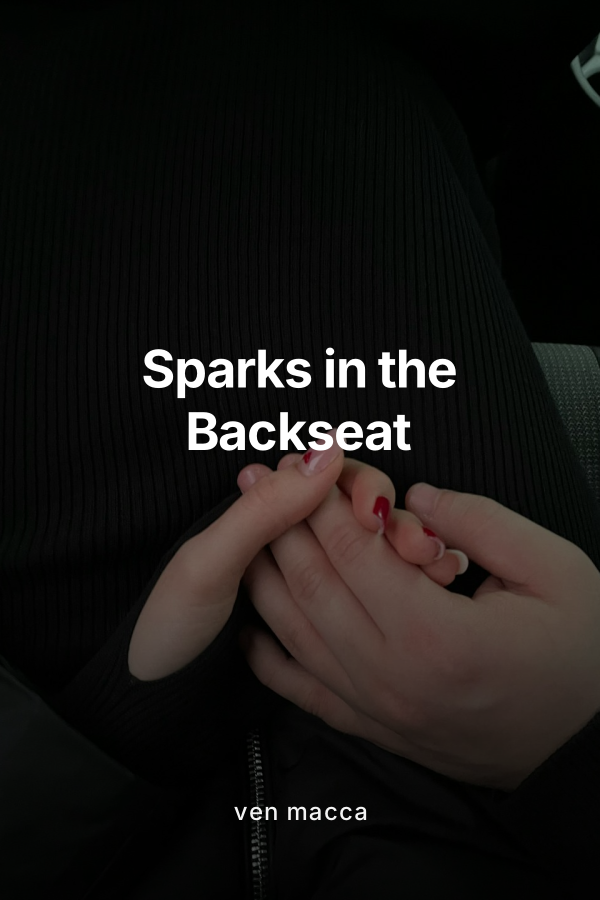
This book is a tight, focused vignette of tension where two people who pretend to hate each other finally stop pretending. It takes place in a single charged scenario rather than across a sprawling plot. The heart of the story is not a long romance arc, but the exact moment when snark, mockery, and mutual annoyance turn into something undeniably physical.
At its center is Chetty, a sharp tongued girl with long black hair and glasses, who uses attitude as armor. She rolls her eyes, weaponizes sarcasm, and never lets anyone see how deeply she feels anything. She especially refuses to show any softness around Enzo. His existence is her favorite insult. Her cool, distant intelligence pairs with a talent for pushing the right buttons. She knows precisely what to say to cut him down, but also how to lean closer and make every dig sound almost like a dare.
Opposite her stands Enzo, the red haired problem everyone loves to hate. Loud, reckless, and annoyingly hard to ignore, he is the boy who never knows when to stop talking. His reputation is a mess, his self image is complicated, and he acts like he is made of pure bravado. People say they cannot stand him, yet he never quite fades into the background. Chetty calls him an idiot, a walking disaster, and still his presence lingers under her skin.
Instead of a traditional love story, this book captures a single night when both of them get trapped alone together in the back of a truck that should probably belong to someone very rich and very far away. The truck itself is ridiculous, over the top, and symbolic. It is a stolen moment in someone else’s world, a space where they are out of bounds and off the record. Inside that stolen space, nothing has to be admitted out loud, but everything becomes obvious.
The story belongs firmly in the contemporary romance genre with strong enemies to lovers flavor, but it narrows the focus to raw chemistry rather than long term commitment. It is written for readers who enjoy sharp banter, slow circling tension, and that particular kind of scene where two people keep pretending they are only arguing even as the distance between their bodies shrinks. The tone is modern, irreverent, and slightly chaotic, meant for an audience comfortable with suggestive content and heavy flirting, but not looking for fully explicit detail.
The main draw of the book is how it lingers on the micro shifts between cruelty and care. Chetty calling Enzo annoying feels like a reflex, yet as the scene heats, the same mouth that throws insults starts to stumble. Enzo’s habit of talking over everyone turns into breathless pauses when Chetty moves too close. Neither of them knows how to behave tenderly, so they keep using mockery as a shield while their actions betray them.
In the first half, the summary of their situation sets the context. We learn how Chetty and Enzo orbit each other in public spaces. Their friends cannot understand why they are always in each other’s faces, why Chetty spends so much energy hating someone she claims is beneath her, or why Enzo lights up the second she walks into a room. Their reputations are opposites, both messy in different ways. The lead up hints that something between them has been simmering for a while, even if they refuse to name it.
The second half focuses on the night that brings them to the back of the truck. A party, a dare, or a terrible idea turns into an opportunity. Someone leaves a door unlocked where it should not be. Enzo, desperate to impress or simply too curious to behave, finds himself pulling the handle of a very high profile vehicle. Chetty follows out of boredom, irritation, or the sheer thrill of having something new to mock. The truck becomes a private cocoon in the middle of chaos.
Once the doors close, the tone shifts from public performance to private tension. Their voices lower. Every sarcastic comment hits harder because there is no audience to distract from the undercurrent. Chetty teases Enzo for his recklessness, his ego, his ridiculous hair. Enzo fires back about her glasses, her attitude, how she clearly loves to watch him. The banter snaps and cracks until it starts to feel less like combat and more like foreplay.
The intimacy builds through small physical choices. They sit too close on the leather seats. Their knees bump. One of them reaches over to steady the other when the truck rocks slightly and does not pull back fast enough. The heat is not described in explicit detail, but the atmosphere makes their intentions unmistakable. Hands hover too long, glances drag over lips instead of eyes, and breathing becomes shallow.
What makes the scenario compelling is the tension between what they say and what they do. Chetty keeps calling him insufferable while tilting her chin higher so he has to lean in closer to argue. Enzo makes offhand jabs about her being uptight while watching the way her mouth curves when she smirks. Both of them are fully aware that something is shifting, yet neither wants to be the first to admit it out loud.
The book uses the confined setting to amplify everything. There is nowhere to run, nowhere to redirect attention, nowhere to hide behind friends or noise. The glow of the dashboard, the fogging windows, and the muted sounds outside create a bubble that belongs only to them. Within that small space, a years long pattern of mutual provocation condenses into a single electric encounter.
The spice level stays implicative, relying on suggestive framing instead of graphic detail. Kisses are described through sensation and reaction rather than anatomy. Touch lingers on edges, hints at more, and then pulls away, leaving the rest for the reader’s imagination. The focus remains on how the physical contact exposes emotional vulnerability they are not ready to name. A hand sliding under the hem of a shirt matters less for the skin involved and more for the fact that neither of them says stop.
Consent is woven through tone and response. Every moment that escalates is matched with a beat of hesitation or verbal check in, even if it is wrapped in banter. Chetty pushes Enzo back with a sharp comment, but does not actually ask him to move away. Enzo pauses just long enough to let her either shove him off or use the pause to pull him closer. Their insults become a coded language of invitation and permission.
This book is crafted for readers who crave that knife edge where two characters keep pretending it is all a joke even as they cross boundary after boundary. It is not about grand declarations or romantic promises. It is about one stolen night in a stolen truck where two people stop lying to their bodies even while their mouths keep trying to lie to each other.
Ultimately, the story suggests that sometimes the most honest things we say are never spoken. The arc does not resolve into a neat relationship label. It leaves room for uncertainty and possibility. Will they go back to pretending they hate each other once the truck doors open, or has the line between enemy and lover already blurred beyond repair? The answer is left intentionally open, inviting readers to linger in that breathless place where nothing is certain but the memory of heat.
By the end, readers will not have a full timeline of Chetty and Enzo’s love story. Instead, they will have something sharper and more immediate: a vivid snapshot of the moment it truly begins, hidden in the back of a powerful stranger’s truck, while the world outside carries on without any idea what just changed between two people who were never meant to be soft with each other at all.