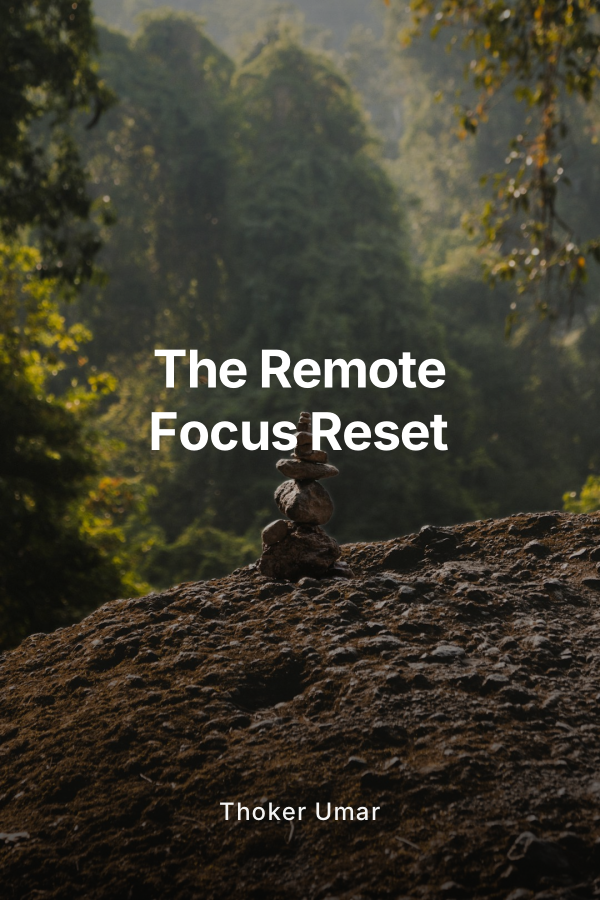
This book is a short, practical guide for remote knowledge workers who feel worn out by constant context switching, yet still end most days with the uneasy sense that nothing important got finished. It is written for individual contributors in async friendly, fully remote companies who do not control the calendar, cannot rewrite company policy, and are tired of productivity advice that simply adds more to their plate.
The Remote Focus Reset offers a calm, anti hustle alternative. Instead of pushing readers to work harder or adopt extreme routines, it introduces a cognitive load reduction system created specifically for remote roles like product management, design, development, marketing, and operations. The goal is not to maximize output at all costs. The goal is to protect attention, simplify decisions, and make deep work possible within the messy realities of distributed work.
Across five sections, the book explains why remote work quietly breaks focus, then walks the reader through a lightweight, 14 day reset that fits around their existing tools and obligations. The reset does not require new apps, elaborate tracking, or strict schedules. It uses simple structural shifts, a small set of repeatable routines, and a focus on fewer decisions each day.
Section 1, “Why Remote Work Breaks Focus,” helps readers understand what is actually draining them. It explains the hidden cost of constant context switching that happens when Slack, email, and project tools are always open and always nudging attention. It shows how the flexibility of remote work often doubles as an invisible workload, creating a pressure to always be available and always be catching up. It also breaks down why multitasking in remote environments is especially punishing for the brain and how that leads to longer days, scattered progress, and difficulty “clocking out” mentally.
Section 2, “The Remote Focus System,” introduces the core mechanics of the approach. The system centers on the 3 List Method: Now, Next, and Parked. Instead of juggling dozens of tasks in one endless list, readers learn to keep only a very small number of active tasks visible while parking everything else in a clear, low friction holding space. The section also shows how to design a default focus day, a gentle template that repeats across the week so decisions about “what kind of work fits where” are made once instead of every morning. Finally, it explains how to create async buffers for Slack and email, so communication gets batched into predictable windows without pretending that messages can be ignored entirely.
Section 3, “Meetings Without Burnout,” deals with the biggest obstacle most readers cannot control: other people’s calendars. Without assuming any formal authority, this section shows how to quietly reclaim peak mental hours by nudging recurring meetings out of the most valuable focus windows where possible. It offers realistic strategies for filtering which meetings truly require live attendance and which can be handled via async updates or recordings. The section closes with specific, polite scripts that individual contributors can use to set boundaries, delay low priority requests, and negotiate timing without sounding uncooperative.
Section 4, “Mental Shutdown Rituals,” tackles the problem of never really leaving work. Remote workers often close their laptop but keep working in their head, which slowly erodes evenings and weekends. This section offers simple, low effort shutdown rituals that separate work from home psychologically, even when both happen in the same room. Readers learn how to end the workday without guilt by using small, repeatable actions that signal “done for today” to the brain. The section includes strategies to prevent evening mental fatigue, like externalizing unfinished tasks, closing loops that cause mental rumination, and using short reflection prompts that require only a few minutes.
Section 5, “The 14 Day Reset Plan,” ties everything into a clear, time boxed experiment. Instead of asking readers to overhaul their life, it asks for 14 days of small, daily actions that take 15 to 30 minutes. Each day focuses on one simple adjustment that reduces mental friction: setting up the 3 List Method in the tool they already use, defining a default focus day template, picking two small Slack or email changes, choosing one shutdown ritual, and gradually practicing boundary scripts. Habit stacking is used throughout, so new behaviors attach to what already exists instead of creating isolated, fragile routines. The section ends with guidance on what to keep, discard, or automate after Day 14, so the reset becomes a sustainable way of working rather than another abandoned system.
The entire book is built to pass a single test: “Does this reduce mental effort tomorrow?” If a tactic increases complexity or demands more willpower, it is either simplified or removed. Readers will never be asked to wake up at extreme hours, adopt rigid morning routines, or maintain complex dashboards. The emphasis stays on fewer decisions, fewer context switches, and a clearer boundary between work time and life.
By the end of The Remote Focus Reset, readers can expect three concrete outcomes. First, they will work fewer hours without quietly falling behind, by putting their best focus where it matters most and letting go of busywork that only looks productive. Second, they will complete meaningful work more consistently, as deep work sessions become a protected, predictable part of their week instead of rare accidents. Third, they will feel mentally clear at the end of the day, with a realistic sense of “enough” and solid shutdown rituals that allow them to leave work at work.
Instead of more hustle, this book offers a quieter, more structured way to do remote work. It respects the limits of attention, assumes messy calendars and demanding teams, and shows remote workers how to get their brain back without fighting their company every step of the way.