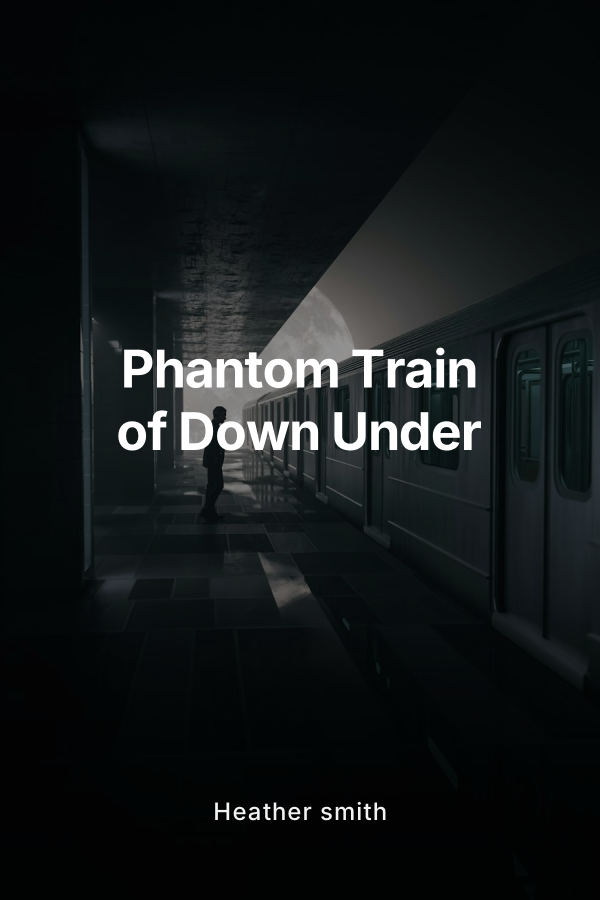
In the baking Australian afternoon, where cicadas drone like distant engines, Grandpa Ray is famous for two things: being the sleepiest train driver in the country and having the sharpest mind on the line whenever he finally wakes up. One lazy nap in his battered armchair becomes something else entirely when he opens his eyes to find himself aboard a rattling, impossible locomotive that should not exist: the Phantom Train of Down Under.
This book is a playful, slightly spooky mystery for adults who enjoy a blend of humor, heart, and a touch of the uncanny. It invites readers into a world where the line between dream and reality keeps wobbling, where the outback stretches on outside the windows of a ghostly carriage, and where a dozing old train man has to outthink the dead before morning.
Grandpa Ray’s journey begins in calm domestic quiet. The first chapter, “Afternoon Reverie,” settles readers into his life, his quirks, and his family. Ray is a man gently worn down by years on the rails, a lifelong worker whose body has slowed but whose inner world is vivid and sly. “Whispers on the Wind” shifts the mood as a spectral train groans into existence, its headlamp a smudged star over the red dirt plains. Inside, the passengers look ordinary at first glance, but something is wrong with their voices, wrong with the way they remember, wrong with the way time loops around them like a track that never ends.
Each chapter of the Phantom Train sequence deepens the eerie comedy of the situation while sharpening the mystery. “Question of the Phantom” challenges Ray’s sense of reason. Is he dreaming his own past, retold with peculiar passengers and changing stories, or has he slipped sideways into a threshold where the dead ride until someone can make sense of their unfinished business? His habit of nodding off at odd moments becomes oddly useful as he keeps “waking up” to new fragments of the same journey, just slightly altered.
In “Silent Observations,” Ray turns his sleepy façade into an advantage. He poses as an absent-minded old codger while quietly studying everyone on board. The passengers spin tales that do not quite match. A shy woman insists she died in a flood. Minutes later, she claims it was a fire. A swaggering stockman insists the train is taking him home, despite having no idea where home is. Details flicker and change as if their memories are being edited on the fly. The more Ray listens, the more he realizes that confusion itself might be the key to their imprisonment.
“Echoes of the Past” sends murmurs through the carriages. Snatches of song, the metallic clank of old equipment, the distant cry of a whistle from another era begin to surface. These echoes hint at a tragic incident nobody can cleanly recall. The train appears both ancient and timeless, its walls holding stories that refuse to stay fixed. Ray feels fleeting jolts of recognition, as if the accident that cursed this line is tangled with earlier points in his own life. Yet nothing is clear enough to trust.
As tensions rise in “Shadows in the Carriage,” the laughs and the scares start to overlap. The ghosts are not malevolent horror figures, but rather frayed, frustrated souls who have been circling for too long. Their fears leak out sideways as petty arguments, absurd logic, and debates over who actually died and when. The humor comes from their bumbling attempts to make sense of their own confusions, while the darkness seeps in from the underlying possibility that they are stuck here forever.
“Looping Tracks” reveals one critical piece of the puzzle: the Phantom Train is not heading toward any station. It is endlessly repeating a broken loop through the outback night, revisiting the same desolate stretches of land, never quite arriving or departing. Ray realizes that the train seems to respond to attention. When he questions its route, new scenery flickers past. When he grows tired and looks away, the windows slip back to the familiar scrub and stars. It is as if the train is feeding on narrative itself, reshaping reality according to what its passengers believe.
This brings him to the heart of the haunting in “Confronting the Conductor.” The spectral conductor is not merely a caretaker; he is a kind of stubborn custodian of unfinished stories. Polite but unnerving, he guards the details of the past with bureaucratic zeal. Ray’s gentle yet dogged questioning turns their exchanges into a battle of wits wrapped in dry humor. The conductor insists everything is under control. The tremor in his voice and the flicker in his eyes say otherwise.
As the night accelerates, “Fading Memories” and “Tunnel of Flames” pull the narrative tight. The train picks up impossible speed. The scenery streaks, faces blur, and memories shudder like failing film. The passengers struggle to cling to their identities, shouting fragments of who they were. Then the ultimate nightmare strikes: a spectral derailment, the carriages plunging into a tunnel of roaring flame that might belong to the original tragedy or might be a shared hallucination born from collective guilt.
Out of those ashes, the book’s tone shifts from predominantly comedic mystery to something more quietly moving. “Fragments in the Ashes” presents Ray on the other side of the disaster, standing amid smoking ruins that may only exist inside his head. In that stillness he understands that the curse is woven less from horror and more from regret. The train, the loop, the confusion; all are bound together by people who could never accept what happened or forgive themselves and each other.
“Healing Words” shows Ray putting his true gift to work. Not his ability to nap anywhere, nor his old mechanical savvy, but the gentle patience he honed over years of listening to rambling passengers on long routes. He begins to speak to the spirits one by one, not as an expert exorcist, but as a tired, kind grandfather who knows how fragile a person can feel. Through simple, grounded conversation he offers them a chance to say what they never managed to say in life: apologies, confessions, acknowledgments that no one moment defines a whole existence.
“Bridging Divides” extends this work through conflict. Old grievances rise up between passengers who only barely recall their shared histories. Even here the book keeps its playful tone: arguments over trivial train etiquette slip into fierce condemnations, then, gradually, into reluctant honesty. Ray stands between them as a mediator whose own family experience has taught him that loyalty is not blind agreement but a stubborn willingness to stand beside someone while they face painful truths.
In “The Last Journey,” the Phantom Train accepts the changes. Its carriages grow quiet rather than eerie. The outback outside the windows seems less endless and more like a path. The conductor loosens his grip on protocol. The passengers, finally certain about who they were and what they did, are ready to move on. Whether the train is crossing into another world, slipping out of existence, or simply leaving Ray’s dream is left deliberately hazy. What matters is that its loop has broken. The curse that trapped the lost souls in repetition has given way to movement.
“Awakening Truth” brings Ray back to his armchair and the first light of dawn over the real Australian landscape. He wakes with a start to the smell of brewing tea and the sound of his granddaughter Jill moving through the kitchen. It would be easy to shrug off everything he has seen as an unusually vivid dream. Yet small details refuse to let him do that entirely: the faint echo of a whistle in the distance, the taste of smoke, the particular phrase of an old tune still humming in his ears.
The second part of the book explores the impact of the dream on Ray’s waking life and on his family. “Morning Reflections” has Ray sharing fragments of the experience with Jill, a practical woman with a soft spot for her grandfather’s oddities. Their conversation is warm, skeptical, and curious all at once. She gently challenges his more dramatic interpretations while secretly taking mental notes on the recurring names and places he mentions.
“Curious Questions” introduces Benjamin, Ray’s grandson, whose fascination with ghost stories nudges the plot in new directions. To him, Grandpa’s wild tale is not a sign of age or confusion but a potential adventure. As he digs playfully into the details, he stumbles across surprising overlaps between Ray’s Phantom Train and scraps of old local history he finds online and in town records. The book keeps the tone light and teasing, letting the reader wonder how far coincidence can stretch before it becomes corroboration.
In “Skeptical Eyes,” Heather, another family member with a more rational streak, challenges the entire premise. She worries that Ray’s fixation might signal something more serious. Her skepticism is not cruel, but it brings tension to the family as they navigate the line between respecting Ray’s experience and protecting him from the assumptions of others. Conversations about his dream become a quiet test of loyalty: do they laugh it off, shut it down, or allow it into their shared reality, at least around the kitchen table?
“Silent Support” shines through Jill again, who offers comfort rather than conclusions. She recognizes that the dream, whether supernatural or not, has left Ray a little shaken and a little lighter at the same time. The idea that he helped someone, somehow, sits with him. Jill becomes his steady anchor, the one who listens without demanding a verdict on what exactly is true. Her presence keeps the story grounded in everyday tenderness even as strange coincidences continue to pop up.
The final chapter, “Family Bonds,” pulls together these scattered threads. The family gradually shifts from treating the Phantom Train as a private oddity to treating it as a shared inquiry. Benjamin’s playful digging, Heather’s wary intellect, Jill’s emotional intuition, and Ray’s own instinctive understanding of rail lore and human nature combine into a loose investigation. They trace certain names, visit old tracks, and hear half-forgotten stories from older locals that eerily echo the “fiction” Ray described.
The book never fully declares whether Grandpa Ray truly boarded a supernatural train or simply dreamed an elaborate parable built from things he already knew. Instead, it leans into that uncertainty with a playful, inviting wink. Objects seem to appear where they should not. A newspaper clipping matches a passenger’s confused account from the dream. A tune Ray heard in the spectral carriage drifts from a stranger’s radio in the supermarket.
What grows absolutely clear, though, is the bond between Ray and his family. At first they stand at different angles to his experience: amused, skeptical, intrigued, protective. Over time they settle into a united front. When outsiders dismiss Ray as a doddering old-timer with “stories,” his family closes ranks around him. They might not sign off on every ghostly detail, but they choose to trust his sincerity and honor the meaning the dream holds for him.
Phantom Train of Down Under is ultimately less about proving or disproving a haunting and more about how a single strange night can shift the tracks of a family’s life. It asks what happens when one person’s dream nudges everyone else toward seeing their own world a little differently. The mystery of the Phantom Train, with its looping tracks and restless souls, serves as a mirror for the ways people repeat the same emotional journeys, hold onto old hurts, and struggle to forgive themselves.
By the end, readers are left with the memory of a sleepy old man standing in the aisle of a ghost train, cracking mild jokes while coaxing lost passengers toward peace, and of that same man at the breakfast table, watched by a family that has quietly chosen to stand with him no matter how strange his tales become. The laughter, the spectral puzzles, and the warm, stubborn loyalty at the story’s heart combine into a lighthearted yet resonant ride that lingers long after the last whistle fades into the dawn.