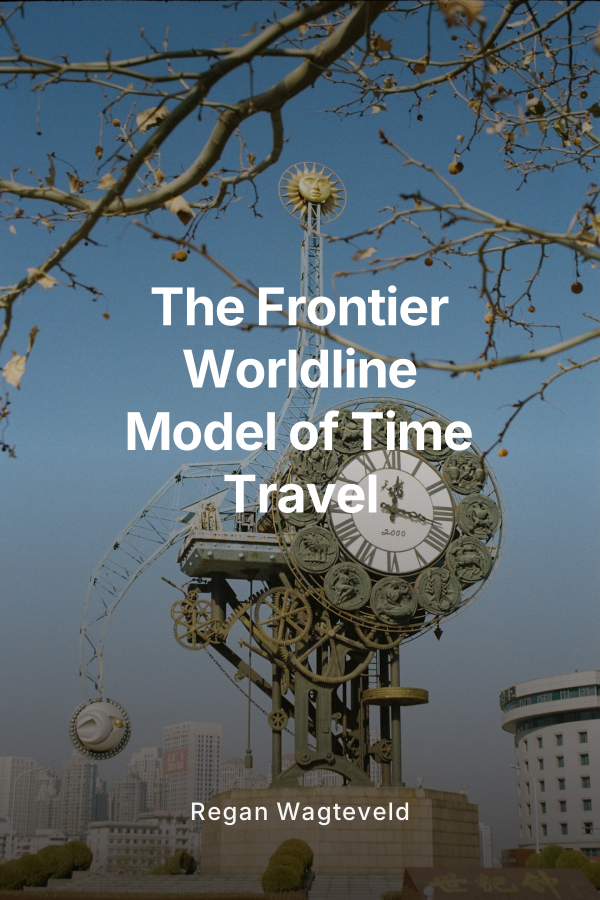
This book presents a rigorous, single timeline framework for time travel that refuses all the usual narrative conveniences. There are no duplicated selves, no branching universes, no hidden backups of reality quietly waiting to be restored. Instead, The Frontier Worldline Model of Time Travel treats time as a continuous process that never pauses, never rewinds, and never bends to protect a traveler from the consequences of their choices. The core claim is stark: existence, once achieved, is conserved. The universe does not erase lives that have been lived, even when causality is later disrupted.
At the heart of the model is the idea of a “present frontier” that advances steadily as events become fixed. Every entity carries its own “personal frontier” that measures how long it has actually existed, tracking age, memory, and wear. Time travel is defined with surgical precision as worldline relocation: the act of moving a single continuous life to an earlier calendar date without rewinding the universe behind it. The traveler does not split into copies, does not meet a past version of themselves, and does not overwrite what they have already lived. Their worldline simply continues, now embedded earlier in history.
This framework rejects the familiar fantasy that past mistakes can be undone. It draws a sharp line between open time and closed time. Open time is any future that has not yet crossed anyone’s frontier and remains fully malleable. Closed time consists of lived intervals that are now locked. You can arrive early enough to reshape an event before it crystallizes into reality, but you can never arrive late and retroactively participate in what already happened. Absence is treated as real and permanent. If you are gone while others continue living, that gap cannot be filled in later.
The book confronts classic paradoxes head on without resorting to multiverses or destiny. In the reinterpreted “grandfather scenario,” killing an ancestor in the past does not erase descendants who have already lived. Their experiences have already crossed the frontier and are therefore conserved. The result is not a logical explosion but a landscape of “causal scars,” where memories, records, and histories no longer match the clean causal chains that once produced them. People can remember events that the final history no longer supports. Documents can testify to outcomes that never technically occurred. The universe tolerates these fractures rather than sanitizing them.
From this starting point, the book explores the ethical and practical consequences of a reality that remembers everything. It examines why grief cannot be erased once felt, why some disasters can be prevented while others become unalterable, and why time travel offers power without forgiveness. The model rules out neat narrative fixes. You cannot retroactively be present at someone’s deathbed. You cannot reclaim years you chose to skip. You cannot step out of the flow of time and expect the universe to hold your place.
Later chapters expand the framework into a lived setting. Institutions emerge to manage the dangerous leverage of temporal access, including specialized investigators sometimes called timeline police, who relocate themselves to key moments after crimes have occurred in order to reconstruct what truly happened. Bound by the same causal limits as everyone else, they are forbidden from preempting crimes that have not yet taken place and cannot rely on foreknowledge of events ahead of the frontier. Their work depends on understanding causal scars, tracking conflicting memories, and distinguishing between what people remember and what the universe now supports.
Throughout, the tone remains deliberately unsentimental. The model rejects observer privilege and any notion of destiny enforcement. Time is not a puzzle designed around protagonists but an indifferent ledger that records whatever is allowed to happen, then refuses to forget. The book presses readers to confront what it would really mean to move through such a universe with the ability to step out of sequence. It argues that the true cost of time travel is not paradox but responsibility: the weight of lives that will never be lived because a future was prevented, and the unhealed gaps left in the lives of those you abandon when you leave your rightful place in time.
The Frontier Worldline Model of Time Travel ultimately offers a coherent alternative to branching timelines and self-erasing histories. It replaces reassuring myths about fixing the past with a stricter, more morally charged picture. You cannot repair time by tidying its contradictions; you can only choose where you stand while it keeps moving, and accept that every choice you make will be remembered, even when causality itself has been scarred beyond recognition.