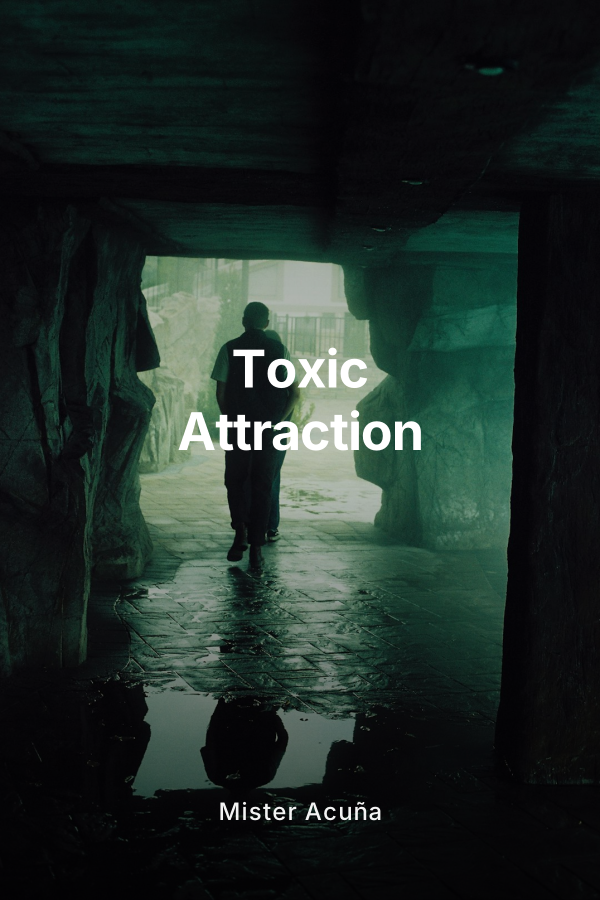
Toxic Attraction is a very dark, R rated, psychological high school drama about two people who should never have met, yet cannot stop colliding until everything around them stinks of the damage they cause.
Rushford High looks like every other wealthy suburban fortress of polished hallways and glittering reputations. Beneath the trophies and curated smiles, though, seethes a vicious ecosystem of status, cruelty, and fear. Into this stratified world walks Matthew Darkshine, a strange, bitter boy who refuses to play along, and Lexi Van Doren, the golden girl who rules it.
He is the school’s outcast, sloppy and pale, hiding behind an old black cap and a crust of sarcasm. Online, he loses himself in fantasies and theories about how human relationships are hollow, useless games. In real life, he is mocked, feared, and shunned. Matthew has learned to survive by feeling nothing and expecting even less.
She is the queen of Rushford, a perfect body wrapped in designer fabrics, carried by a crowd that never questions her. Lexi is cheer captain, social tyrant, and reigning goddess of envy. With her handsome football star boyfriend Calvin Spark on her arm and a loyal squad at her back, she appears invincible. Yet under the polished exterior lies a calculating mind, a hunger for control, and a secret terror of irrelevance.
Their lives should have remained parallel lines, never touching. They do not.
One day, in front of the class, Lexi does what she has always done. She flirts, she toys, she assumes the entire room revolves around her magnetism. Except Matthew does not take the bait. Instead, he cuts through the illusion with a blunt, philosophical contempt that slices straight into her carefully crafted identity. He does not want her. He does not fear her. He barely finds her real.
That single moment is the spark.
For Matthew, confronting Lexi is a way to confirm what he has already concluded. Power is a lie, beauty is a mask, and everyone is just as empty as he feels. By refusing her, he sees himself as finally above the petty hierarchy that despises him.
For Lexi, being dismissed by the most disposable boy in school is unthinkable. Shock curdles into obsession. She finds herself thinking about him, watching him, baiting him, needing him to react. At first she wants to break him, prove that no one resists Lexi Van Doren. Yet the more they clash, the more her fascination turns inward and downward.
Toxic Attraction follows the slow fusion of these two damaged people into a single, spiraling catastrophe. Their lives twist together in ways that neither understands and both refuse to stop.
Lexi, used to dominating others through charm and cruelty, discovers in Matthew a kind of emotional dead zone that both terrifies and excites her. She begins engineering situations to push him, to hear his brutal honesty, to feel the only kind of authenticity she has ever experienced in Rushford’s suffocating surface life. She weaponizes her status to drag him into her orbit: rumors, invitations, pointed humiliations that always have a second, more intimate target hidden underneath.
Matthew responds with his own brand of sabotage. Cynical and alienated, he starts experimenting with honesty as a weapon rather than a shield. He insults, provokes, and dismantles the people who mock him, armed with the cutting insight of someone who has spent years watching others from the outside. When Lexi keeps coming back for more, he becomes fascinated with just how far he can push her before she breaks. In trying to disprove the value of human connection, he grudgingly forms the most intense one of his life.
Around them, the school begins to rot.
Calvin Spark, star quarterback and Lexi’s golden trophy boyfriend, senses something shifting. He has always been arrogant, bullying weaker students for sport, certain his charm and talent place him above consequence. At first, Matthew is simply a new toy to terrorize, a freak to laugh at over locker room jokes. But Calvin is not stupid. He sees the way Lexi’s eyes drift to the back of the room, the way her jokes sharpen at the mention of Matthew’s name. His own insecurities and secret hypocrisies deepen his need to reassert control, to crush the outsider who has dented his image.
Irene Lutz enters this tangled web as the last sincere person still trying to hold the school’s fragile moral center. A quiet member of the literature club, she is thoughtful, idealistic, and uncompromisingly honest in her own way. Irene notices Matthew long before Lexi’s games draw everyone’s attention to him. She sees through his cynicism to the bruised humanity beneath. She offers him a different kind of honesty, one not sharpened into a blade.
Irene’s friendship complicates everything. Matthew, unaccustomed to real kindness, reacts with confusion and clumsy hostility. Lexi, sensing a rival for the one person she cannot control, tightens her grip through jealousy and manipulation. Calvin, secretly drawn to Irene’s integrity and depth, finds his loyalties and desires knotted together in toxic contradictions. The four of them become the eye of a storm that spreads through the hallways and screens of Rushford.
Social media turns into a battlefield. Anonymous accounts leak secrets, doctored photos circulate, private conversations are twisted and broadcast. What began as Lexi and Matthew testing each other mutates into a culture of deliberate cruelty. People pick sides based on fear or opportunity. New games emerge around public humiliation and emotional torment. Teachers grow wary, then complicit, then numb, unwilling or unable to trace the rot back to its source.
Matthew, once a target, discovers the dark thrill of being feared. Backed by a growing circle of disaffected misfits, he learns how to steer narratives and light fires under the popular crowd. Lexi, unable to tolerate even the hint of losing control, escalates her tactics. She digs for vulnerabilities, exploits authority figures, and uses her beauty as both bait and shield. Their battle is also a love story of the worst possible kind: two people mirroring each other’s wounds, each trying to use the other to prove that their own broken view of the world is the only true one.
Irene watches the school she cares about descend into open psychological warfare. She fights back in her own quiet ways, confronting cruelty, defending the weakest, refusing to play along with the spectacle. Her growing concern for Matthew and disgust with Calvin’s behavior pull her deeper into the conflict than she ever wanted to go. She becomes both target and symbol, a measure of how far everyone is willing to fall.
As the year grinds on, the pressure mounts. Secrets, betrayals, and cruel experiments in manipulation leave real scars on students who were never supposed to be involved. Friendships shatter. Reputations burn. The line between victim and perpetrator blurs until no one is innocent and no one is safe.
The real horror of Toxic Attraction is not in sudden bursts of violence or dramatic explosions, but in the slow, methodical unraveling of people who might have lived ordinary lives if not for a few key, poisoned encounters. Matthew’s cynicism curdles into a self fulfilling prophecy. Retribution becomes his default mode of existence, even when it hurts the one or two people who actually care about him. Lexi, determined to stay queen, becomes a prisoner of her own persona, sacrificing parts of herself she did not know she valued until they are already gone.
By the end, there are no heroes. No one emerges purified.
Calvin’s illusions crumble, his career, relationships, and self image fractured by his own choices as much as by Lexi and Matthew’s influence. Irene, despite her courage and empathy, carries the trauma of everything she has seen and endured. Her idealism is scarred, her sense of safety annihilated. Matthew, who wanted proof that the world was irredeemable, has helped make it so, and cannot find a way back from the very emptiness he thought he understood.
Lexi Van Doren remains, at least on the surface, exactly what she always was. She wins the crown. She poses for photos in her perfect uniform, surrounded by girls who still worship her and boys who still want her. The rumors fade, the scandals are buried, and Rushford High returns to its polished normal. In public, Lexi smiles, lips glossed, eyes bright, every angle flawless.
Inside, she is ruined.
Her status has been preserved at the cost of her friendships, her capacity for trust, and her last fragile connection to anything real. The obsession with Matthew that once felt like a thrilling secret has become a private cage. He haunts her thoughts long after he has vanished from those halls. She lingers by the places where they clashed, replaying every word, every look, trying to recapture the rawness she found only with him.
The final image of Toxic Attraction is not an explosion, but an echo. Lexi stands in the center of a crowd, laughing on cue for a photo that will decorate the school’s trophy case for years. Around her, everyone cheers. She is the undisputed queen. Yet her gaze drifts past the camera, past the present, into a private void where the boy who refused to fear her still exists, uninvited and immovable. Her smile never falters. Her eyes, though, are fixed on something only she can see.
In this story, no one wins. The game of power and humiliation that began as a flirtation and a rejection spreads like a stain, leaving behind a school that looks unchanged on the outside and a generation of students carrying invisible scars. Toxic Attraction is a brutal portrait of what happens when attraction grows in poisoned soil, when two damaged people become each other’s favorite weapon, and when a whole community chooses to look away until it is far too late.