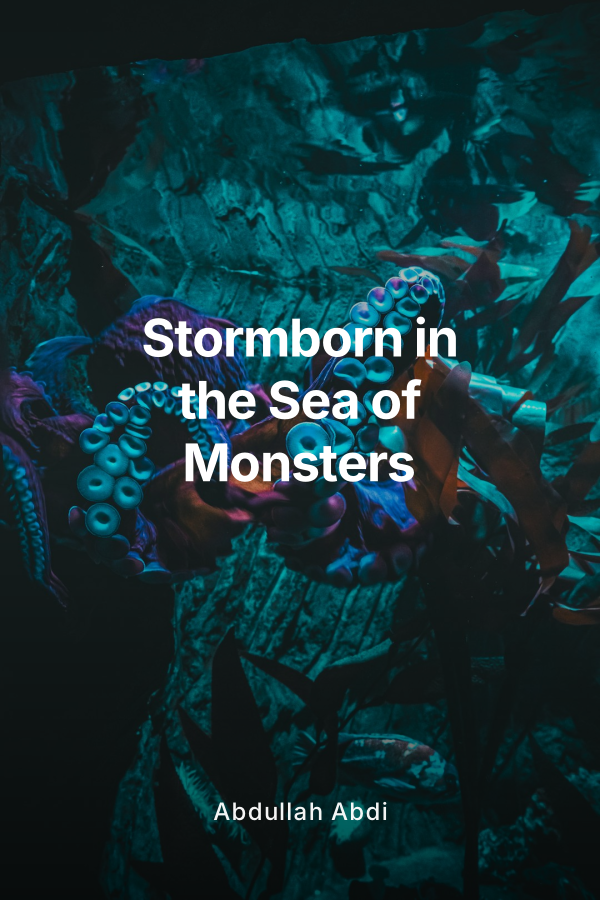
This sequel follows Malik one year after his first summer at Camp Half Blood, aligning with the canon events of Percy Jackson and the Sea of Monsters while reframing the adventure through Malik’s more mature, watchful eyes. The heart of the story is not just the quest for the Golden Fleece, but Malik’s quiet evolution from a sharp-tongued outsider into a serious, dangerously handsome son of Artemis who knows what it means to choose his own fate, even when the gods and prophecies are playing against him.
Malik begins the summer in Queens at his oldest stepsister’s graduation party, a chaotic, very mortal celebration that feels worlds away from monsters and gods. The newly renovated pool, the smell of barbecue, and the warmth of his blended family should make the night perfect. Instead, Malik watches the cracks appear as alcohol loosens tongues and old wounds rip open. Accusations explode across the yard, secrets about infidelity and betrayal surface, and what should have been his sister’s moment dissolves into a brawl that ends with cousins smashing through the graduation cake. Malik, taller, stronger, and suddenly striking in a way that catches every eye in the backyard, feels more like a stranger moving through someone else’s life. Only his father and Nicole know the truth about him, and even in this loud, messy crowd he has never felt more alone or more aware that one bad twist of fate could obliterate everyone he loves.
At dawn, while hungover relatives sleep on couches and air mattresses, Malik quietly packs for camp. This is the first day of summer, his thirteenth year, and there is a calm determination in him that did not exist the summer before. His father’s drive to the bus terminal is not full of sarcastic banter anymore. It is quieter, heavier, a conversation about responsibility, fear, and what it means for a mortal father to let his son walk willingly into danger he cannot protect him from. When Malik jogs for the bus, Frostbite’s voice hums at the back of his mind, chattering, complaining, teasing, a constant icy commentary only Malik can hear. The sword’s endless stream of remarks is both comforting and irritating, a reminder that no matter how serious he wants to be, there is still something chaotic and unpredictable curled into his spine.
The bus ride to Camp Half Blood is threaded with Frostbite’s running monologue and Malik’s careful watching of the mortal world, how close it always is to disaster without ever noticing. When he finally climbs Half Blood Hill, he expects the usual reunion. Instead he walks straight into a battlefield. Percy, Annabeth, Tyson, Clarisse, and her siblings are already locked in combat with bronze bulls tearing the camp apart, just as the canon chronicles the Colchis bulls’ attack and Tyson’s crucial role in defending the borders. Frostbite shouts a warning, tells Malik to step aside, but his reflexes are a fraction too slow. A bull slams into his back and launches him across the hill. Bruised, breathless, and furious at himself, Malik rises and fights alongside Tyson, learning the rhythm of the bulls’ movements, the hot shimmer of their breath, and the terrifying joy of perfect timing when blade and brute force bring the metal beast down.
From there, Malik becomes a shadow woven into the familiar story of the Sea of Monsters. He witnesses the aftermath of Thalia’s poisoned tree and the fear choking the camp as its magical borders weaken, exactly as the original narrative describes the crisis that threatens Camp Half Blood’s existence. He is there when Percy and Annabeth track Chiron to the Big House, only to find him packing his things, fired by the gods and replaced by the cruelly amused Tantalus, whose presence sours every tradition at camp and revives the deadly chariot races. Malik’s more serious temperament makes him an observer who sees what Percy’s anger nearly misses: Chiron’s quiet grief, the way Dionysus watches everything yet pretends not to care, and how Tantalus studies every camper like a future sacrifice.
While Percy’s canon conversations with Annabeth, Grover, and the gods drive the official plot, Malik spends the quiet corners of those days wrestling with a different war. His new looks have spread through camp gossip faster than any prophecy. Girls from multiple cabins circle him, drawn to his height, the sharpness of his features that echo Artemis in a male form, and the haunted focus in his gray eyes. Clarisse mocks him in front of others but lingers a little too close during training. Nymphs who used to ignore him now watch him from the tree line. Maya, who knew the old Malik before this sudden bloom of beauty, shifts between prickly and distant, then suddenly tender, her jealousy flashing every time another girl laughs too hard at something Malik barely said.
Malik, determined to be more composed and less sarcastic, speaks less and thinks more. He becomes the one who hears what others do not say. Ethan confides his own insecurities about being overshadowed, Maya half-admits that all the attention Malik gets makes her feel invisible, and Malik discovers that it is hard to be both wanted and truly seen. His slow-burn feelings for Maya unfold not through grand gestures, but through small, painful details: the way she snatches her hand away when someone walks past, the way her eyes follow Clarisse when she claps Malik on the back, the way she pretends not to care when other girls stare at him like he is a prize instead of a person.
Tantalus’s decision to reinstate the chariot races reshapes camp life, precisely as in the original book, where he announces the deadly contests and offers freedom from chores as the prize. Malik and Percy prepare for the race, Tyson brings his own earnest enthusiasm to the forges, and the entire camp divides between reckless excitement and remembered fear of past mutilations. The day of the race is a chaotic spectacle: wheels spinning, monsters attacking, sabotage from rival cabins, and that sickening, helpless moment when everything collapses into disaster. It is after this spectacle that Percy, desperate to save both Grover and the camp, reveals the coordinates of the Golden Fleece, echoing the moment he shares the Gray Sisters’ numbers and proves that the Fleece lies in the Sea of Monsters.
When the campfire roars and the crowd chants for a quest, Malik feels the fire inside him answer. He watches the flames shift, hears the campers cry out for a hero, and then hears Tantalus twist the moment by awarding the official quest not to Percy, but to Clarisse, sending her to retrieve the Fleece for the glory of Ares. Malik marks Percy’s hurt, Annabeth’s outrage, and Clarisse’s pride, and quietly understands something crucial: in this war between gods and prophecy, the right person does not always get chosen, and the world is not interested in fairness.
Two nights later, when the camp is quiet and the harpies begin their nightly prowl, Malik cannot sleep. Frostbite murmurs about movement in the dunes. Pulling on his jacket, Malik slips out of Cabin Eight and follows the sound of the sea. There he finds Percy, Annabeth, and Tyson with four yellow duffel bags, the guilt on their faces giving away their secret. Percy admits they plan to defy Tantalus, steal a ride, and rescue Grover themselves. Malik does not even hesitate. Without telling Ethan or Maya, he chooses to join them.
Their midnight escape on hippocampi toward the Princess Andromeda pulls Malik into the beating heart of the original quest. Creeping aboard the cursed cruise ship, the group explores its luxurious yet eerily empty cabins and its hidden secrets, mirroring the canon’s rich description of the vessel and Luke’s headquarters, complete with the golden sarcophagus that houses Kronos’s dismembered form. Malik’s presence shifts the dynamics: he is less talkative than Percy, more attuned to silences and sidelong glances. He notices Luke’s eyes linger on him with something like regret, some unspoken history tied to Artemis and the Hunters and the twisted fate of Agrius and Oreius, whose origin story Luke smugly recounts to justify his hatred of Olympus.
That night, instead of sharing Percy’s canonical dream sequence, Malik is dragged into his own nightmare. He relives his sister’s graduation party, but this time the laughter sours into screams. A huntress with a bow stalks through his Queens backyard, loosing arrows into the people he loves. Malik watches his entire family crumple, one by one, in a grotesque echo of Artemis’s own hunters. The dream leaves him shaking and soaking the pillow with sweat. When he wakes before dawn, Tyson is snoring half off the couch, Percy and Annabeth are still asleep, and Malik steps into the hallway to clear his head. He never gets the chance to right himself. A sharp blow to the skull and the last thing he registers is Chris Rodriguez’s face before he is hurled from the ship into the endless dark of the ocean.
From here the story diverges into Malik’s improvisation-filled struggle. While Percy, Annabeth, and Tyson’s canon path continues unseen for a while, Malik fights to stay alive in the sea, clings to driftwood, argues uselessly with Frostbite, and endures isolation that drives him deeper into his fears about losing his family and friends. Eventually, storms, currents, and sheer stubborn will drag him into the twisted domain of Polyphemus, aligning with the established depiction of the Cyclops’s island and Grover’s perilous situation as a “bride” in a veil, kept alive only because Polyphemus mistakes his scent for that of a female Cyclops.
Dodging carnivorous sheep and the booming voice of the Cyclops, Malik finally stumbles upon Percy, Annabeth, Grover, and Clarisse locked in their own desperate fight. The battle with Polyphemus plays out in the broad strokes of canon, from the illusions and taunts to the near-fatal collapses and narrow escapes. Malik’s role is that of a flanking blade and a focused mind, coordinating with Percy’s instincts, Annabeth’s strategies, and Clarisse’s brute force to destroy the Cyclops’s control and free the Golden Fleece. The group flees with the Fleece aboard the Queen Anne’s Revenge, just as the original story has them commandeer the ghostly ship to sail the Sea of Monsters.
Their escape is cut short, however, when Tyson returns with hippocampi to rescue them from disaster. After storms and shipwreck, they finally wash ashore in Miami, only to confront Luke and a small army on the beach, an echo of the confrontation that reveals the full extent of Luke’s loyalty to Kronos and the danger of the golden sarcophagus. Here Malik crosses blades with Chris Rodriguez in an intense, personal duel that leaves no room for Luke’s half-apologetic glances. The battle is chaos: sea spray, metal ringing, demigods clashing, and a choice that mirrors Percy’s in the canon narrative, where Clarisse is ultimately sent ahead with the Fleece and a bag of mortal cash to fly back to camp alone, fulfilling the Oracle’s words that she must “fly home alone” with the prize.
Chiron and a group of partying satyrs arrive in time to tear the group out of Luke’s grasp and rush them back to Camp Half Blood. The return mirrors the original resolution: the Fleece heals Thalia’s tree, restores and even overcharges the camp’s borders, and in doing so purges not only the poison but also releases the girl who had been trapped within the pine all along. Malik is there on the hill when the tree heals and a black-haired girl appears on the ground, exactly as the canon shows Percy cradling Thalia, daughter of Zeus, as she wakes, confused and electric with storm power. For Malik, this moment is doubly charged. He is not just watching the prophecy shift. He is watching the world tilt around a girl who might be ally or rival, friend or threat, a living symbol that the gods will risk anything and anyone to keep their game alive.
The summer closes with a fragile peace. Tyson is celebrated as a hero and eventually called away by Poseidon, Grover’s link remains intact, Chiron is reinstated, and life at Camp Half Blood seems, on the surface, steadier again, in line with the outcome described at the end of the original Sea of Monsters. Yet for Malik, everything has changed. His new clay bead for the necklace carries the image of a bull and a ram’s fleece, but what he remembers most are the quiet spaces. Ethan’s disappointment when he learns Malik snuck off without him. Maya’s red-rimmed eyes and the rage beneath her relief when Malik returns alive. The way she keeps almost touching his hand and then stopping. Clarisse’s grudging respect that burns no less hot for being wordless. Thalia’s stormy gaze locking on him as if she can sense Artemis in his blood.
This book’s emotional spine is Malik’s slow acceptance that he cannot be who he was last year. He cannot hide behind jokes. He cannot pretend the attention he gets is harmless. He cannot treat his heart like a side quest. Through monsters, near-death, prophetic shifts, and heartbreak, he learns that maturity is not just getting taller and more handsome. It is choosing to act even when your fear is screaming, loving people you might lose, and claiming your own perspective inside a story the gods think they already own.
In the final pages, with Thalia returned, Kronos laughing from his coffin, and the Golden Fleece shining on the hill, Malik stands at the border of camp and Queens and understands that this summer was only a prologue to something far more dangerous. He is no longer just Artemis’s son playing at being a hero in someone else’s legend. He is a storm gathering its own shape in the Sea of Monsters, and the next move will be his.