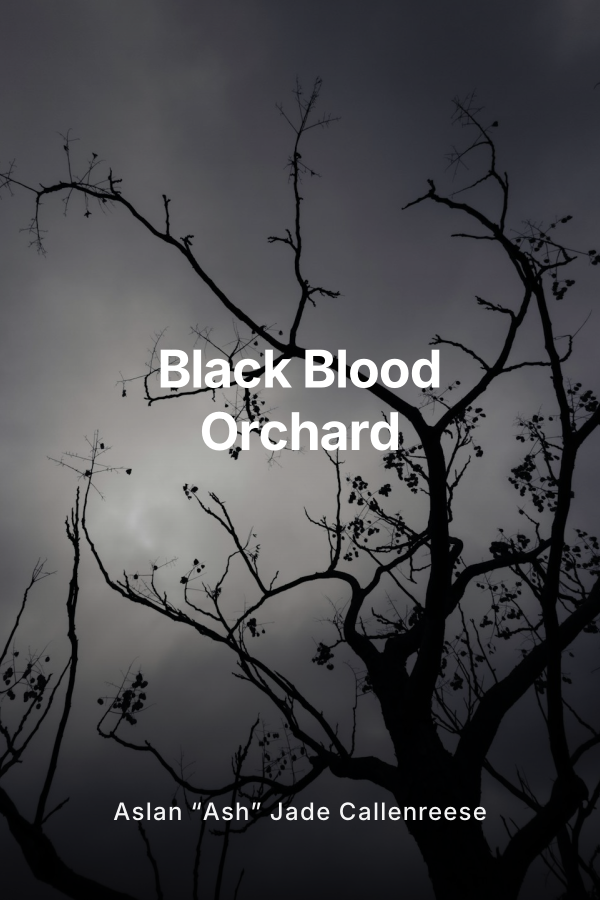
In a research complex buried beneath a nowhere town, exhausted prodigy Dr. Magnus Robbins is already hollowed out by sleepless nights and failed experiments when the world ends in something small and sweet.
It begins with an argument over candy.
On a slow night in the biocontainment wing, a fellow researcher unwraps an ancient piece of fruit chew found in a forgotten vending machine. The wrapper crackles, the sugar smells stale, and everyone laughs at the stupidity of eating it. Minutes later, the laughter turns to screams. There is no theatrical collapse, no cinematic seizure, only a twitch at the corner of a mouth, a smear of black along the gums, and then a savage, unfocused violence that does not fit inside human eyes.
By the time Magnus and the others wrestle their colleague to the ground, the blood on their lab coats has gone wrong. No bright red. Just something viscous and black, writhing under the surface as if thickened with ink and hunger.
What none of them see in those first frantic minutes are the worms.
They are coiled in the candy like tiny, patient seeds, waiting for warmth and skin. They do not need a bite to spread. A scratch is enough. A scrape. A shared pipette. Once they find a path inside, they race along nerves and veins, drinking color from the blood until it turns midnight. The earliest symptoms mimic rabies, psychosis, or a feverish rage. Given enough time, however, the human body becomes only scaffolding. Bone, tendon, and skin twist into grotesque architectures of centipede limbs, caterpillar segments, and obscene, unknowable forms that should never fit inside a corridor built for people.
Magnus has spent his brief career hunting cures for other people’s plagues. Now he must race to cure a contagion birthed from a joke, trapped in a warren of steel and glass where infection spreads through the smallest wound. The lab’s multiple floors, once an orderly hierarchy of experiments and storage, become levels of a sinking ship. The surviving staff barricade themselves on one floor, living on emergency rations and hope, while the floors above and below rot into echoing habitats for things that used to be human.
Every need becomes a descent into danger. Food stocks run low. Essential ingredients for a prototype treatment are locked in contaminated departments. Books and reference files that might hold a key to parasitic life cycles are stranded in darkened offices on other levels. To reach them, the survivors must ride an elevator that opens not on numbers but on stages of evolution, each floor crawling with forms more warped and aggressive than the last.
Here, the infection is a clock that ticks inside the flesh.
Those with early contact show faint symptoms: dark veins, bruising along the fingers, a metallic taste, and tiny movements in the skin like insects testing the edges of their new home. In these first hours, there is a narrow window to intervene. Magnus and his remaining colleagues discover, with equal parts horror and hope, that amputation can stop the spread if performed before the black blood climbs too far. A hand severed in time might buy a life. An arm sacrificed at the elbow might halt the worms at the shoulder.
Magnus pays the price in his own body.
As days blur and screams become background noise behind reinforced doors, Magnus pushes himself into a role he never wanted. No longer just a bright young scientist chasing theoretical breakthroughs, he becomes reluctant surgeon, strategist, executioner, and priest over a new religion of necessary suffering. The work demands choices that will not wash off in any sink. Which co worker deserves another experimental injection and another sleepless night of agony? Who must be sedated and left behind when the skin of their throat begins to shiver with something trying to push through? When is a colleague still a person and not a threat?
The cure he is racing toward is not a miracle. It is a compromise.
The more Magnus learns about the worms, the more he suspects they are not a random contaminant. Their structure is too elegant, their stages of growth too precise, their behavior too perfectly tuned to exploit the human body as both habitat and weapon. They unravel people in phases. Early infection maintains enough normal function to allow movement, speech, even pleading. Then aggression blooms. Then the metamorphosis begins, knitting segments, sprouting carapace, rearranging joints and jaws. The black blood serves as both nursery and fuel, pumping a thousand tiny lives through veins that bulb and split.
When Magnus finally coaxes a rough antidote from limited supplies and burning concentration, it arrives late for most of the people who need it. The treatment can flush out worms that have only begun to nest, restoring something close to normal at the cost of searing pain and lasting wounds. But it cannot undo what has already reshaped bone. Those who have drifted too far into monstrosity are beyond its reach, locked into forms that skitter along ceilings, coil through vents, or drag themselves with too many limbs and not enough face.
Saving anyone means abandoning many.
As the corridors grow more alien and the emergency lighting throws long, sickly shadows on walls printed with handprints and claw marks, the survivors dwindle. Trust fractures under the strain of concealed bites and hidden scratches. Simple accidents become death sentences. The elevator, once a dull part of the building, transforms into the most terrifying place in the complex: a metal box where everyone must stand close, watching one another’s hands, the twitch in an eyelid, the smear of black beneath a fingernail.
Magnus Robbins began this ordeal as a burnt out 24 year old genius with red hair, dark eyes, and the weary belief that science can eventually fix anything if given enough time and data. By the end, missing an arm and ringed in scars, he understands that some discoveries only offer less horrifying failures. His personal arc is carved in flesh and choice. He learns to lead not because he is the most willing, but because he is the least able to ignore the equations of survival. Each sacrifice teaches him a bitter arithmetic: how many lives a limb is worth, how many screams a cure earns, how much guilt a person can carry and still move forward.
“Black Blood Orchard” follows Magnus through four escalating movements within the dying lab. The infection evolves from a single reckless bite of expired candy into a contained apocalypse sealed behind concrete and steel. Each floor becomes a different circle of contamination, each new day a test of whether humanity can persist when the body itself is no longer a safe place to live.
The book’s horror is both external and internal. On the outside, there are centipede torsos made from friends, eyes sprouting along spine ridges, and chittering mouths opening in places no mouth belongs. Inside, there are the quieter terrors: guilt that tastes like metal, the cold distance that grows between people who have seen too much, the way a once trusted hand brushing your shoulder becomes a reason to flinch. Magnus grapples with the ethics of experimentation when his subjects are people he knows, weighs the moral weight of amputating limbs without true consent, and wrestles with the knowledge that his precious cure will arrive too late for most of the screaming shapes in the dark.
By the time the survivors understand the full, terrifying limits of what their antidote can and cannot do, the lab has become unlivable. Power falters. Alarms die. The air fills with a sweet, rotten humidity from biological containment breaches. Just leaving their barricaded floor means passing by rooms where things cling to ceilings, listening to wet sounds behind doors that no one dares open. The only escape left is not a safe corridor but a cleansing.
Fire.
With the cure finally rattling in vials that can only save a fraction of the infected population, Magnus and the last few survivors make an unforgivable decision. They seed the lab with flammable chemicals, rigging their workplace into a massive pyre. Every piece of equipment, every memory, every failure and breakthrough is slated to burn along with the monsters it helped create. Leaving means accepting that the world above might already be vulnerable, that a single overlooked worm on a sleeve or under a nail could carry the orchard of black blood into fresh soil.
The ending is not a clean triumph, but a jagged breath sucked through grit and ash. Only a handful stagger out, marked forever by the contagion and the choices they made. Magnus steps into the weak daylight missing an arm, his phantom limb buzzing with remembered worms, his pockets heavy with the formula for a cure that is as cruel as it is necessary. Behind him, the lab that once promised salvation burns, an artificial sun devouring everything it ever held.
“Black Blood Orchard” is a contained horror story of infection and responsibility, where the monstrous resides not only in the bodies warped by parasitic worms, but in the gray spaces of scientific duty, sacrifice, and survival. It asks what it costs to be the one who holds the scalpel and the syringe when there are no good options left, and whether a single tired young scientist can live with what he has to do in order to ensure that the black blood does not reach the wider world.