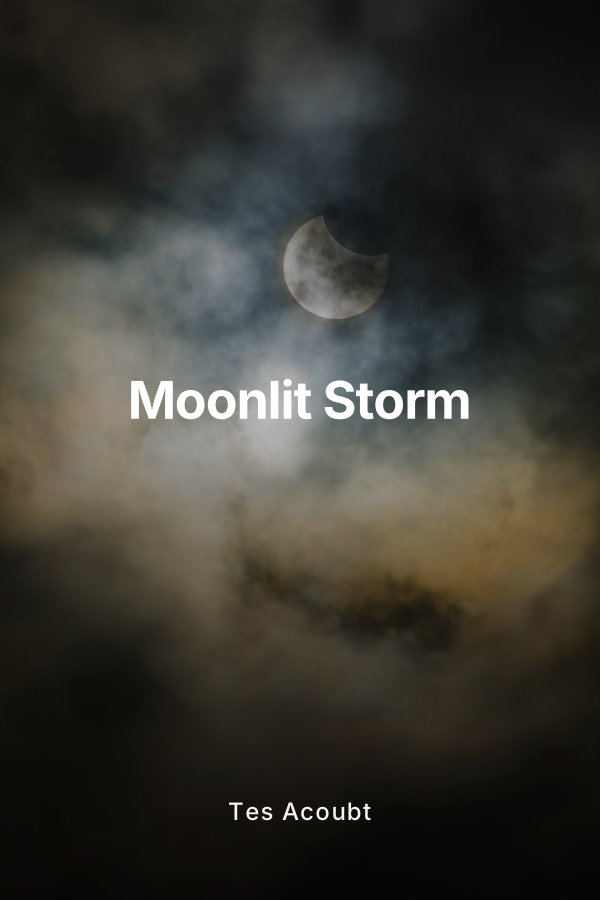
In the wake of his first brutal summer at Camp Half Blood, Malik Romero thought he knew what he was: Artemis’s impossible son, the demigod who should not exist, a glitch in Olympus that everyone hoped would stay quiet. He limped away from a storm titan, a broken prophecy, and Luke Castellan’s betrayal with a talking sword in his head and just enough fragile hope to promise himself one thing.
He would go back to camp next year. He would live. Somehow.
A year changes more than the calendar.
At thirteen, Malik has stretched taller and hardened with muscle, starting to look like a sharper, handsome echo of the mortal father he loves and the immortal mother who wants nothing to do with him. The world finally notices. At his stepsister’s loud Queens graduation party, relatives double‑take. Strangers stare. Flirtation and side comments slide off his shoulders, leaving his anxiety and low self worth untouched underneath the new attention. Malik cheers for his sister and pretends he is fine, because that is what he does best.
He is not fine.
Nightmares of his father’s torture still claw through his sleep. The prophecy about moons, tides, and a love that will break him still coils tight around his future. Frostbite, the conscious blade born from an unnamed god’s blessing, keeps up a constant running commentary in his head, part cruel drill sergeant, part reluctant guardian angel. The sarcasm that once shielded Malik from everything has dulled. In its place stands a quieter, more dangerous honesty: he is tired, he is scared, and he is so used to being disposable that even survival feels like a mistake.
When summer comes, Malik chooses Camp Half Blood again.
The bus ride back should be simple. Instead, it ends in fire and metal. As he crests Half Blood Hill, Malik stumbles straight into a war zone: bronze bulls tearing through the camp’s borders, cabins burning, friends screaming. Percy Jackson, Annabeth Chase, Clarisse La Rue, and a strange new kid named Tyson are already in the fight. Malik dives in, guided by Frostbite’s shouted warnings and his own reckless instinct, and learns the first bitter truth of the year.
The magical pine tree that protects the camp is dying.
Something is poisoning Thalia’s tree. Monsters are breaking through the borders with terrifying ease. The gods argue. Chiron is forced out. Tension simmers between cabins. And when Clarisse is granted a dangerous official quest to find the Golden Fleece and save the camp, Percy decides he will not sit out the end of the world just because Zeus’s rules say so.
Malik decides the same.
Unauthorized, unblessed, hauling his panic like extra baggage, he throws himself onto Percy’s secret quest to the Sea of Monsters. He is not the chosen hero, not the one with a prophecy pinned to his name, but storms have been circling his life since Dallas. He refuses to watch from the sidelines while the only place that ever felt like home dies.
What follows is a journey that weaves Malik’s story through the bones of the canon everyone knows, without ever replacing it.
On the road and at sea, Malik fights shoulder to shoulder with Percy, Annabeth, and Tyson, slipping into the gaps between their legendary moments. While they wrestle with prophecies and family drama, he battles older ghosts: the conviction that he is only worth what he can do with a sword, the sick twist in his stomach whenever girls at camp stare a little too long, the way his heart lurches when Maya or Clarisse snap at anyone who gets too close.
Maya rolls her eyes and snarks harder when other girls hover near Malik. Clarisse picks verbal fights and throws herself into danger with a ferocity that looks a lot like jealousy she will never admit. Ethan Nakamura, the one person who has always seen the broken boy under the bravado, remains his brother in arms. Deep down Ethan nurses an unspoken affection Malik will never return, because Malik’s heart tilts in a different direction entirely and he is too busy hating himself to notice anyone could ever want him.
C.C.’s spa peels back the next layer.
On an island where vanity becomes a weapon, Malik comes face to face with a polished, perfect version of himself that the sorceress would love to keep: confident, adored, stripped of doubt and pain. For a moment he is tempted. Then he realizes every compliment, every admiring stare, is aimed at a mask. C.C. wants the beauty, not the boy who grew it around scars. Malik’s refusal to trade his broken reality for a glittering lie marks the first time he chooses his own imperfect self over anyone else’s fantasy.
The Princess Andromeda shatters what is left.
Boarding the enemy cruise ship in secret, Malik expects monsters and traitors. He does not expect Luke. Once, Luke Castellan was the counselor who guided him through panic attacks and midnight terrors, the older brother who made camp bearable when Artemis’s rejection cut too deep. Seeing him on Kronos’s flagship, smiling that same easy smile while planning Olympus’s downfall, rips through Malik far more cleanly than any celestial bronze blade.
This time there is no sarcasm.
Malik’s anger is raw, stripped of jokes. He calls Luke out. He demands to know why he was left behind again, what he ever did except trust the wrong person twice. The confrontation is messy, dangerous, and utterly human, because this is not Percy’s destiny‑driven rivalry. It is one abandoned kid finally screaming at the adult who used his loyalty as leverage. Luke’s calm explanations about the gods’ hypocrisy sound different when you are the child of a goddess who never wanted you, and Malik has to decide whether that pain will drag him to Kronos’s side or push him to carve out a different path entirely.
Through chases, shipwrecks, Sirens, and Cyclopes, Malik keeps fighting. Not just with Frostbite’s icy blade, but with every breath he forces himself to keep taking. He is there when plans go wrong and when they miraculously work. He stands at Percy’s shoulder when choices about the Golden Fleece and Thalia’s tree threaten to crack the fragile peace of camp forever. He returns to Long Island with new scars, new enemies, and new knowledge that scares him more than any monster.
The Sea of Monsters was never only about saving the camp.
For Malik, it is about proving he can exist in a story that never picked him, that his life has weight even when he is not the main character in the prophecy. It is about learning that being “extremely handsome” does not fix years of neglect or the voice in his head that still tells him he is a mistake. It is about realizing that friendship can be fierce without turning romantic, that jealousy can hide genuine care, and that sometimes the loudest act of rebellion is simply refusing to disappear.
As Thalia’s tree stands restored and a new, dangerous possibility awakens on the hill, storms gather again on every horizon. Kronos is rising. The gods are lying by omission. Hunters whisper about the son Artemis should never have had. Somewhere on Olympus, the unknown patron who blessed Frostbite watches Malik more closely than ever, waiting for a move only he can make.
Malik Romero is still anxious. Still convinced, on bad nights, that the world would be better without him. Still caught between a mortal family that failed him and an immortal one that should never have created him at all.
He is also still here.
Not the hero of the prophecy. Not the chosen one on the book covers.
Just the demigod who refuses to stay in the background while gods and monsters decide the fate of the world, and who is finally starting to believe that his own life is worth saving along the way.