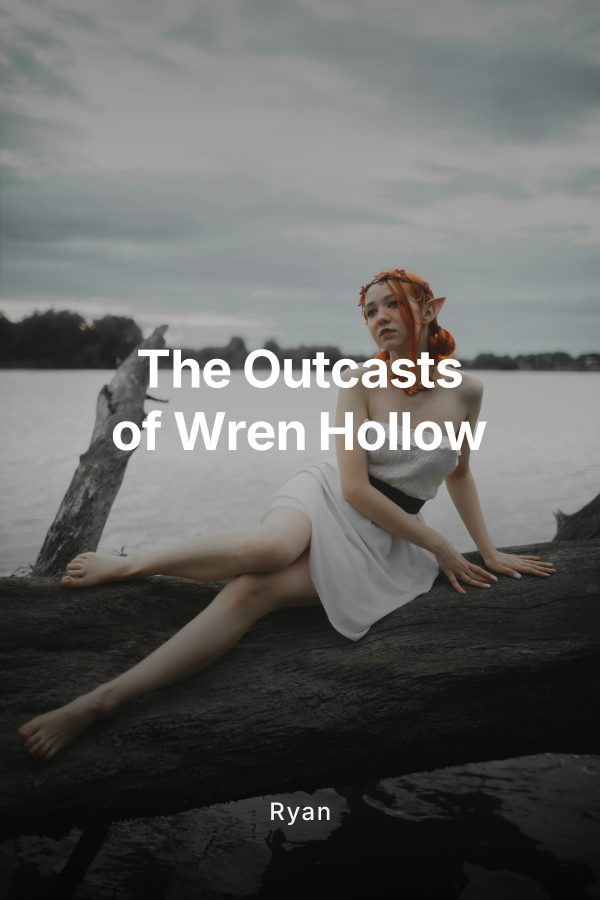
In the fading river town of Wren Hollow, everyone knows who does not belong. You can see it in the way teachers pause at certain names, in the whispers along locker rows, in the parents who lock their doors just a little tighter when some kids walk by. Those kids learn early how to live at the edges of other people’s lives.
They learn, too late, that edges are where monsters wait.
The Outcasts of Wren Hollow follows seven misfit kids who never meant to become a club, never asked to be chosen, and never believed anything truly terrible could happen in a place this quiet. Branded as losers for different reasons, each of them carries a private hurt and a secret they have never dared to say aloud. When a buried piece of the town’s history claws its way back into the present, they discover that every cruel nickname, every rumor, and every lonely walk home has been shaping them for a battle no one else can even see.
On the surface, this is a story about growing up in a place that loves its legends more than its children. Beneath that, it is about the terror of being invisible one day and hunted the next, about learning to trust the very people you once avoided in the halls, and about the moment when you realize the thing that made you a target might also be the thing that lets you fight back.
Blending small town horror with coming of age drama, The Outcasts of Wren Hollow explores what happens when a group of so called losers refuse to stay in the roles their town assigned them.
They will not stay quiet.
They will not stay afraid.
And the dark that watches them from the forgotten corners of Wren Hollow is about to find out what happens when the wrong kids are pushed too far.
This two chapter book sets the stage for a larger saga, starting with the long summer that changes everything.
Chapter 1: The Kids No One Wants lays the groundwork for the emotional heart of the story. In a town that worships its sports teams and clings to its reputation for old fashioned safety, the outcasts exist as background noise.
In the first subchapter, “Names on the Edge of the Attendance Sheet,” we meet the seven members of the future club. A bullied artist whose sketchbook is the only place she feels real. A new boy with scars no one talks about. A quiet overachiever who hears things in the walls at night. A tall, awkward athlete who crumbles every time the coach looks his way. A girl obsessed with urban legends who cannot stop chasing them. A kid genius who hides in the computer lab to avoid the cafeteria. And a class clown who uses jokes as armor against a home life he never mentions.
They do not start as friends. They barely start as human to each other, framed instead by what the town has already decided they are. Through overlapping school days, bus rides, and sidelong glances, the subchapter reveals how each of them has been gradually pushed to the fringe, carrying both small daily humiliations and one defining wound that will matter later. This section focuses on interior worlds and social tension, showing how ordinary cruelty lays the perfect groundwork for extraordinary fear.
The second subchapter, “The Rules of Being Invisible,” explores how survival has turned each outcast into a strategist. Stay quiet. Do not react. Laugh with them, not at them. Do not walk home alone. Pretend you are fine. Their unwritten rules keep them separate, even from one another.
Yet the same coping skills that help them slip through school corridors also give them an unusual way of seeing the town itself. They notice who takes which streets home and which houses never open their curtains. They see the cracks in Wren Hollow’s perfect picture: the shuttered factory, the closed bridge over the river, the small memorials that never quite go away. One by one, they begin to sense that something in their town is off, a wrongness that adults ignore or cannot bear to acknowledge.
As Chapter 1 closes, strange common threads begin to appear. They start to realize that, in different corners of Wren Hollow, they have all been seeing the same symbol drawn where it does not belong. On a forgotten underpass. Scratched into a desk. Carved into a park bench that no one sits on anymore. The symbol is older than any of them, older than the latest round of bullying or the most recent rumor. None of them knows yet that this mark is Wren Hollow’s original sin, and that their status as outsiders is no accident.
Chapter 2: The Town That Forgets pulls back from the kids to examine the larger machine that shaped them.
In the first subchapter, “Pretty on the Postcard,” Wren Hollow is introduced as it wants to be seen. A riverside town with glossy brochures and a fondness for its own history. There are summer festivals, old brick storefronts, and smiling photos in the local paper. Here, reputation matters more than reality. The town clings to familiar stories about hard work, tight knit neighborhoods, and the glory of past sports teams while averting its gaze from uncomfortable truths.
This section explores how adults cooperate in selective memory. Teachers bury old files in back offices. Police reports grow strangely thin the farther back they go. Parents wave away their children’s fears with the same practiced phrases. No one talks about the string of disappearances that occurred decades ago, or the summer when kids whispered about something in the river. Those events become local myths, softened into jokes or pushed into the same mental drawer as ghost stories.
Yet the myths have rules, and the outcasts are the ones who stumble across them. Because they walk home late, because they cut through empty lots to avoid certain bullies, because they wait in school after dark for a ride that never comes, they are the ones who see that the pretty postcard town is bordered by places that feel wrong. They hear unfinished conversations between adults, notice which families leave quietly and which houses stay empty for years. Wren Hollow remembers more than it pretends, and it does not forgive.
The second subchapter, “The Broken Line,” traces the hidden connection between the town’s forgotten horrors and the seven kids no one wants. Through old newspaper clippings, whispered warnings, and fleeting flashes of something in the corner of the eye, we begin to understand that Wren Hollow has always needed someone to carry its fear for it.
Across generations, a familiar pattern repeats. A handful of children gets marked as strange, unlucky, unsafe to sit with. They start seeing things the others do not. They talk to each other. Then something awful happens, the town shakes its head, and the story gets packed away under the label of tragedy or rumor.
Our seven outcasts are the next link in that chain, but with one critical difference. They are growing up in a world where secrets do not stay buried as easily, where cameras live in pockets and forgotten history can be searched with a few keystrokes. They are not content to accept that fear and disappearance are simply the cost of living in Wren Hollow. When they realize they share more than social exile, they stop being separate problems the town can ignore and start becoming a single, dangerous question.
Why them?
The Outcasts of Wren Hollow is aimed at readers who grew up on stories of haunted towns and fragile friendships, who remember what it felt like to be twelve or thirteen and know that adults were hiding something. It speaks to anyone who has ever been called too quiet, too weird, too much, or not enough. Through slow building dread, raw emotion, and the fierce, awkward courage of kids who have run out of places to hide, this story asks what really makes a monster: the thing in the dark, or the community that pretends not to see it.
Across its two opening chapters, the book plants the seeds for a larger confrontation. The club has not yet named itself, the true scope of Wren Hollow’s secret has not yet been revealed, and the danger still moves mostly in the margins. Yet one truth is already clear.
When the town’s oldest fear finally steps into the light, the only people standing in its way will be the kids it tried hardest to forget.