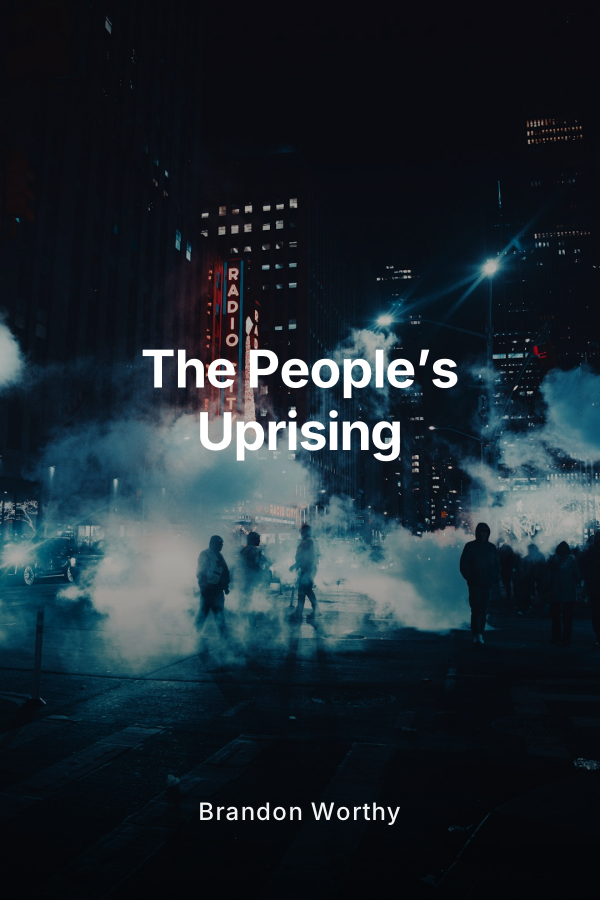
The People’s Uprising is a gritty, propulsive, and emotionally charged heist novel about poor and working class people across the United States who decide that if the system will not change for them, they will break it themselves.
In a single coordinated strike, every building that holds money becomes a target. From Manhattan’s marble towers to strip mall branches in Phoenix, from payday lenders in Detroit to rural credit unions in Kentucky, thousands of ordinary people walk into financial fortresses at the same time, guided by a shared code and a hidden network that has taken years to build.
At the center of that network is Amaru, a quiet strategist raised in poverty, and Kalifa, his sharp, relentless partner who believes planning is a form of love. Together they have spent years moving in shadows. They pay in crypto, avoid cameras, recruit through whispers, encrypted chats, and anonymous communiqués. Each city has its own local organizer, each organizer has their own scars, and every participant is bound by a simple rule: no harm to working class people. The goal is not chaos for its own sake. The goal is redistribution.
Yet nothing this big stays clean.
The story unfolds through seven interlocking points of view in a non-linear structure that jumps between past wounds, present action, and future consequences. Each chapter plunges the reader into a different corner of a fractured country.
Maria Gonzalez is a single mother in Phoenix buried under medical debt, watching her child’s life depend on forms and fees. Darnell Washington is a laid off Detroit factory worker whose pension vanished in a corporate shuffle. Sarah Chen in Seattle holds multiple degrees and enough student debt to crush three lifetimes. Robert Whitaker tries to keep his family’s land in rural Kentucky as agribusiness circles like a vulture. Aisha Johnson, a disabled veteran in Atlanta, fights a system that seems designed to deny her the benefits she was promised.
They live in different worlds but share the same invisible cage: an economy that quietly extracts from them and calls it normal.
Amaru and Kalifa find people like them in every major city. They train them, test them, and slowly convince them that coordinated risk may be safer than isolated survival. What begins as an anonymous online call to action becomes a disciplined national network. Each node is autonomous yet synced to a single clock. The language of this new underground is a mix of hood slang, activist code, and cold logistics. The stakes are life, prison, or something bigger than both.
When Zero Hour arrives, the country does not see a ragtag fringe. It sees grandmothers and gig workers, warehouse pickers and adjunct professors, farmhands and coders. It sees white, Black, brown, Indigenous, Asian, Arab, immigrant and native born, all walking into banks at the same instant.
Some cities follow the plan perfectly. One executes a flawless operation with no injuries and a clean exit, turning every stolen dollar into clinics, housing co-ops, debt relief funds, and community farms within days. Another cracks under pressure and aborts mid-heist, leaving shattered nerves and unanswered questions. One city goes rogue, discarding the code, escalating to violence and casualties that horrify the core organizers and give the state the excuse it needs for a nationwide state of emergency.
The success rate is staggering. Ninety one percent of the operations achieve their goal. Financial systems seize, then shudder back to life. Servers that power credit cards, payroll, corporate transfers, and hedge fund bets all lurch under the strain of synchronized withdrawal. Local branches stand empty while neighborhoods fill with hushed disbelief. Cash and digital assets begin to flow in directions they were never meant to travel.
Media channels scramble. Cable anchors reach for language that fits in a soundbite. Some call it terrorism, others a historic act of economic warfare, still others a crime story with a social media twist. Viral videos show masked figures dumping cash into mutual aid centers, school gyms, and long neglected community clinics. Anonymous statements flood the net, explaining why this was not just theft, but a forced correction in a rigged game. Hashtags surge, stitching together the personal stories that mass news once ignored.
Law enforcement is overwhelmed and late. Sirens scream through streets that are already quiet again. Local departments, state task forces, and federal agencies slam into the reality that the money is already gone and the people they chase look like everyone else.
In the middle of the institutional panic stands one conflicted federal agent. Raised in poverty and now sworn to defend the very system that once kept their family hungry, this agent sees every side at once. Through their eyes, the reader enters war rooms and surveillance hubs, listening as politicians and executives debate how hard to crack down on communities that are already on the edge. This agent’s path crosses with Amaru in a single tense encounter that leaves neither of them unchanged.
The uprisings are not just about taking. The stolen wealth is quickly turned into something tangible. Hospital bills vanish without explanation. Mortgages that were about to foreclosure are suddenly current. Old warehouses become food hubs. Abandoned lots turn into urban farms and training grounds for self sustaining agriculture. Rural cooperatives spring up across former company towns and exhausted farmland. Quietly, debts are paid down, tools are bought, and people begin to build the kind of safety nets that no law ever granted them.
But victory has a cost.
The rogue city’s bloodshed becomes the state’s excuse for military grade responses in poor neighborhoods around the country. Protesters and bystanders are swept up in mass arrests. Some local leaders disappear into secretive detention. The internal tensions inside the movement sharpen. Members who followed the code to the letter question whether any of it is still worth the human toll. Participants who tasted power for the first time wrestle with their own moral boundaries.
Amaru slips further from view. He was always the ghost in the network and now, as the country debates whether to come down with crushing force or pivot towards reform, he vanishes entirely. Officially he becomes a wanted domestic criminal. Unofficially he turns into myth, a name that means something different in every neighborhood where people have more food and fewer bills than they did the month before.
Kalifa is left behind in the open wound. She never planned to be the face of anything, but as pressure mounts, eyes turn toward her. She knows where some of the funds flowed, who is clean and who is compromised, which city leaders folded and which stood taller. She never sought the spotlight, yet the movement sees her as a tactical spine, the government sees her as leverage, and the public sees her as a symbol of the line between righteous defiance and unforgivable crime.
Amid the noise, a quieter story unfolds, almost invisible until the final pages. Years before the heists, before the movement even had a name, Amaru and Kalifa had a son. They were too young, too broke, too busy surviving and dreaming of revolt. They decided that their child would not live inside the world they were about to attack. They made him a promise: he would never know this was all built partially on his behalf.
Through scattered breadcrumbs woven across the novel, the reader glimpses scholarships that came from obscure community funds, an education subtlety paid for by money that moved in the dark, a young man with a gift for listening and a deep suspicion of simple answers. Only in the final chapter does his full role rise into focus.
As the country staggers through investigations, televised hearings, and behind the scenes negotiations, public sentiment refuses to settle. Too many lives have been changed in poor communities for the old rules to snap back into place. Under mounting international applause for grassroots redistribution and with their own citizens watching closely, leaders begin to agree to targeted wealth dispersion programs, debt forgiveness schemes, and structural reforms that would have been unthinkable before Zero Hour.
Into this uncertain new terrain steps the reluctant public leader the movement never expected: the son of the two people who built the original network and then hid him from it. He carries none of their outlaw mystique but all of their moral weight. He cannot romanticize the heists because he knows who bled and who prospered. He cannot dismiss them either because he has seen the tangible end of generational poverty all around him.
The People’s Uprising is not a fantasy of clean justice. It is a story of poor and working class people pushed beyond the brink who decide to weaponize coordination instead of individual despair. It asks where the real crime resides: in one night of systemic disruption or in the slow violence of an economy that writes entire communities off as collateral damage.
Told with journalistic clarity in the economic details, thriller pacing during the coordinated strikes, and intimate literary depth in the characters’ private reckoning, the novel moves through:
• Character focused chapters that immerse readers in the hardships, loyalties, and moral lines of participants in cities across the country.
• City specific heist chapters that reveal the nuanced variations between a perfect job, a failed attempt, and a catastrophic breach of the movement’s own rules.
• Aftermath chapters that follow neighborhoods as they tentatively step into a world with fewer debts, more clinics, new farms, and a fragile but real sense that poverty is not an unchangeable fact of life.
Across these threads, the book explores economic inequality, the difference between what is legal and what is just, media distortion, and the chaotic birth of new forms of community in the cracks of an old order.
As the last pages close, American finance has crashed and rebooted under pressure. Poverty, once treated as background noise, is now a central political fact that cannot be ignored. The original network is fragmented, some of its members imprisoned, others hidden, many simply melted back into ordinary life with extraordinary memories. Amaru is a legend. Kalifa is both feared and needed. Their son stands on stages they never imagined, trying to turn a one night uprising into a sustainable, humane future.
The People’s Uprising invites readers to walk the line between fear and hope, to feel the weight of each character’s choice, and to ask themselves what they would do if the price of leaving things as they are finally became higher than the cost of burning the system down and starting again.