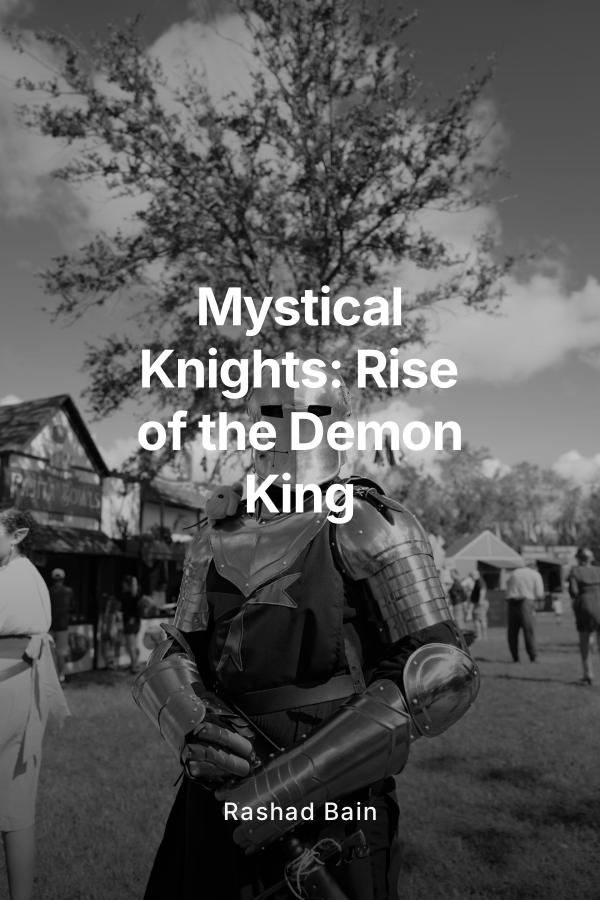
In a fractured cosmos ruled by magic, prophecy, and forgotten gods, two boys make two vows that will tear worlds apart.
One vow is born in ash and blood. The other in shadows and lies.
On the radiant world of Ragork, where every life is measured by the magic that flows in their veins, a child is born with nothing. No magic. No light. A mistake in a world that worships power. Abandoned at birth, he is given a new name and a new chance when a rising hero and his wife take him in and call him Charleston Elijah Charles. They are Mystical Knights in training, warriors whose duty is to guard the Magi Verse itself, and their love gives Charleston something magic never could: a reason to dream.
Charleston grows up under the blinding shadow of his adoptive father, Eric Ford Charles, the Holy Mystical Knight, a living legend chosen by the stars themselves. People call Eric a sun given human form, the guardian who can raise a world’s hope by taking a single step. To Charleston, he is simply “Dad.” To everyone else, Charleston is the shame of that sun, the magicless boy who will never become anything. Bullied, mocked, and dismissed, Charleston learns early that the world will not give him room to breathe. So he carves out his own space on a lonely hill outside town and trains with bleeding hands and burning lungs, fighting against a limit he cannot see but always feels strangling him.
Then the sky turns blood red.
On the day Charleston swears to his mother that he will become a Holy Mystical Knight no matter what anyone says, a towering demon drops from the heavens like the judgment of a god. Sixty meters of horned, molten terror reshapes the city into a war zone with one blast. The Holy Mystical Knight and his order stand between Ragork and annihilation, and Charleston watches his father hurl his very soul against an impossible darkness. The clash births a sun of pure destruction that does not choose its victims. Knights. Buildings. Dreams. Parents. All vanish in an instant.
Charleston runs home through smoke and rubble, lungs filled with dust and prayers, only to find his world collapsed into broken stone and a dying voice. His mother, pinned under ruined walls, forces one last task into her son’s shaking hands. Find your uncle. Survive. Live. In the chaos that follows, Charleston’s uncle Ruko drags him into a hidden basement and a waiting ship, speaking of secrets and an enemy far greater than a single demon. There is no time for answers, only a desperate order: “Promise me you will get stronger. Promise you will come back and save us all.” The boy’s throat is raw when he screams it back, a vow burned into his bones. The ship launches. The planet shrinks. Ragork and everyone he loves vanish behind him. All Charleston has left is that promise and the pain echoing in his chest.
Somewhere beyond light and distance, the second vow is forming.
In the dimension of Supra, realm of mind, light, and energy, three chosen warriors stand before the stars of destiny. Eric Ford Charles. Mortifer Hamlon. Azira Anima. Each must touch a star to be judged and transformed by the power of past Holy Knights. Azira’s star blooms with nature, gentle and vibrant. Mortifer’s star shines bright, then rots from within, devouring its own light until only bloodred darkness remains. Eric’s star seems small and insignificant, until his fingers reach it and the entire dimension erupts in warmth and radiance. In that moment, fate chooses Eric as the Holy Mystical Knight. His return to Ragork is a miracle, a rising sun that blankets the planet in joy. No one sees the shadow that falls over Mortifer’s heart.
Mortifer has bled for Ragork. Trained. Fought. Protected. He believed if he just worked harder, loved his world more, he would be enough. Supra shows him otherwise.
As the planet celebrates Eric’s ascension, Mortifer crumbles inside. A mysterious voice slips into the cracks, whispering the words his wounded pride aches to hear: “You were cheated. You are stronger. You deserve to be king, not him.” Those words coil around his disappointment like a serpent. They take all his fear of failure and humiliation and transform it into fuel. When the voice offers him a path to the throne, he takes it. Mortifer boards a ship, flies into the Magi Verse, and vanishes into a dimensional rift that will erase the boy he was and birth the king he will become.
He wakes in a dead dimension.
The forest he wanders through is wrong. The air hums with an old grieving energy. A tanto stained in phantom blood haunts his vision. Screams echo where no one stands. The voice calls him deeper, promising power, promising a crown. Mortifer’s pain, jealousy, and desperate hunger to matter twist into a single obsession. By the time he reaches the empty hall and sees the floating blade waiting for him, he is less a man and more a raw, exposed nerve. When the tanto urges him to take it and claims he will be a king, Mortifer’s hand does not hesitate. He believes he is stabbing the ghost of Eric, killing his inferiority once and for all. Instead, he is stabbing himself, binding his flesh and soul to a forgotten empire of shadows.
The Dark Kingdom awakens.
A serpent woman named Azula, descended from an underworld goddess, emerges from the silence and calls Mortifer “my king.” She tells him a story that feels like a reflection of his own: a brother who wanted to save mankind with power, only to be banished and betrayed. A realm built in exile. A legacy caged in the tanto itself, waiting for one worthy successor. In Mortifer, the blade sees someone who fought for a world that never truly saw him. Someone discarded by the same light he tried to serve. He listens. He understands. He accepts. When the crown of the Dark Kingdom settles on his head and his bloodred wings explode from his back, Mortifer makes his own vow: he will lead this kingdom into greatness, and every world and dimension will kneel. Not through mercy, but through fear.
From the shadows, six generals rise and pledge their loyalty. With their swords embedded in the resurrected ground, an army of darkness breathes again. Together, they fly before the cold white sun that has watched this forsaken dimension for ages. Their combined power strikes, turning that distant star into a bloodred omen that stains the Magi Verse. It is the birth of the Demon King.
While one vow hardens in darkness, the other survives in ice.
Charleston’s escape ship drifts through the Zone of Asthir, a vast region where wild light and dark magic collide and merge. The dormant boy in stasis becomes a vessel. Unknown energies pour through him, weaving into his once empty veins. The magicless child of Ragork is rewritten into something unheard of: a being who carries both light and dark in his core. A new breed of Ragorkian. A living paradox. When his ship finally crashes in the orbit of a distant world, it carries not just a boy, but the seed of an entire era.
That world is Vorg.
Forged after the annihilation of their previous home, Vorg is a planet built by survivors who refuse to let history repeat itself. On Creation Day, they flood their cities and skies with color, music, and ritual, honoring both the devastation that birthed their world and the hope that sustains it. Their culture remembers the old clan of Discipulites, the shared bloodline they once held with Ragorkians, and the fragile alliances that shaped the cosmos. When Charleston’s ship appears as a dangerous chunk of rock threatening their station, the people of Vorg do not yet know that inside it sleeps a boy whose pain and promise will drag their celebrations into the storm.
Charleston awakens in terror to a blinding beam cutting through the rock around him, his mind still half in a childhood dream and half in the last moments on Ragork. He sees light, thinks of death, and slips into a coma again. By the time he opens his eyes in a medical center on Vorg, surrounded by strangers, royalty, and scientists, his last clear memory is the desperate voice of his uncle and the word “promise” echoing in his skull. Every time he repeats it under his breath, he tastes smoke and hears his mother’s last “I love you.” He does not yet understand that the magic inside him has changed, or that his very existence is a threat and a miracle combined.
On Vorg, Charleston is thrust into a new world of politics, technology, and cultures layered with their own traumas and myths. King Varon VII recognizes a name from the boy’s story and flinches. Ruko Dariearmy was once his comrade, and Eric Ford Charles a legend he admired from afar. The planet’s leaders and warriors must decide whether Charleston is a liability, a weapon, or a child in need of a home. In the stern yet protective Captain Yuno, the fierce commander Varonika, and the sharp minded Dr. Salavantor, Charleston finds new orbiting stars to clash and bond with. They are his guides and skeptics, his drill sergeants and accidental family. Through them, he begins to feel curiosity again. To taste joy between waves of grief. To rediscover the hunger for adventure threaded through the pain.
But the Magi Verse does not care that he is still learning how to breathe.
The bloodred sun Mortifer created is more than symbolism. It is a wound in the sky, a promise of conquest. The Dark Kingdom stirs in its lost dimension, marshaling armies, reshaping forgotten ruins into fortresses, and reaching its influence through cracks in reality. Mortifer remembers every slight, every time he was looked past, every cheer that was never for him. He watches the worlds beyond his throne and sees only fuel for his greatness. Yet beneath the armor and wings, the boy who once wanted to protect Ragork still exists, buried under resentment and the intoxicating warmth of being adored by his own subjects.
“Mystical Knights: Rise of the Demon King” follows these two parallel journeys.
Charleston’s path is one of clawing upward from nothing. From magicless outcast to a warrior forged by both light and dark, he must decide what kind of strength he really wants. His promise to save Ragork is a weight that nearly breaks him, yet it is also the fire that keeps him standing every time he is told he should not even exist. Through training, missions, and battles on Vorg and beyond, he collides with towering monsters, ancient secrets, and dimensions that question his sanity. He faces terror that strips him to the bone but also moments of soaring joy and absurd humor that refuse to let the story drown in despair. The more he grows, the more he wonders: is being the “greatest” really about power, or about how deeply you are willing to feel, to hurt, and to keep moving anyway?
Mortifer’s path is a descent framed as an ascension.
He begins as a defender desperate to prove his worth, then gradually becomes a king who demands the universe recognize it. His fear of being forgotten, his jealousy of Eric, and his belief that kindness is weakness twist into a philosophy of domination. Yet his story is not written as a simple villain’s tale. Readers are invited into the rawness of his betrayal, the loneliness of leadership, and the seduction of a kingdom that finally loves him unconditionally. When he razes worlds and corrupts suns, it is not from random cruelty, but from an unbearable conviction that this is the only way he will never be cast aside again.
Across five intense, immersive chapters, the book layers pain, fear, curiosity, joy, and the hunger for adventure into a narrative that feels like standing in the blast radius of a star being born. It builds an entire Magi Verse of intertwined worlds, each with its own scars and wonders: the ruined sanctity of Ragork, the resurrected steel and song of Vorg, the mind bending radiance of Supra, and the cold, majestic terror of the Dark Kingdom. Magic is not just a visual spectacle here, but a living presence that readers can almost smell and hear. Battles crackle with kinetic energy and emotional stakes. Quiet moments linger on trembling hands, half healed wounds, and the inner arguments both boys wage with themselves long after the fighting stops.
Ultimately, “Mystical Knights: Rise of the Demon King” is about two promises.
Charleston’s promise to come back, to save, to become strong enough that no one he loves has to die again.
Mortifer’s unspoken promise to never be powerless again, to become so great that the cosmos is forced to remember him.
Their vows drag them toward an inevitable collision, where light and dark are not clean opposites, and heroism and monstrosity blur. In that clash, readers are asked the same question that haunts every page of this story:
What are you willing to sacrifice to become the greatest version of yourself, and at what point does greatness become a curse you can never escape?