In the wide, wind swept country of the American West, ten year old Stacey Barstow believes her family’s ranch is the safest place on earth. Long brown hair, bright green eyes, and a heart full of cowboy legends, she patrols the property in her treasured cowgirl sheriff gear. Her white hat sits firm on her head, a yellow bandana guards her neck, and her special blue denim overalls feel like armor against the world. Her toy pop guns ride in their holsters, her silver buckles shine, and her fake sheriff’s badge glitters on her bib like a promise.
Stacey is not just playing. In her mind, she carries a duty. She keeps watch over the barns, the fences, the dust roads, and the shadows. The ranch is her town, the cattle are her citizens, and her family is the heart she has sworn to protect. She loves the stories of brave cowboys who ride into danger without flinching, and she tries to live up to them every day, despite the secret that gnaws at her confidence. Her overworked bladder and bowels mean she still needs cloth diapers under her overalls, a reality that makes her feel like a baby trapped inside a sheriff’s hat. Only her family knows, and they treat it as a medical need, not a shame. Still, Stacey aches over it, praying no one outside the ranch will ever find out.
Everything changes the day two bored teenage boys decide that the little sheriff has ridden too high for too long. While Stacey proudly patrols the ranch, pretending to stare down invisible bandits, the boys lie in wait. She is not afraid of danger because, in her heart, danger has always been a game. These boys turn it into something else entirely.
One of them creeps behind her and presses a fake gun into the small of her back. The cold shape, the sharp command, the sudden threat of “stick up” shatters her illusion. Stacey freezes, hands in the air, convinced the gun is real. The other boy mocks her bravery as he strips her of her badge and her hard earned allowance money. They call her a disgraced sheriff with no authority, no power, no right to the symbols she cherishes. Her overalls, once her trusty armor, become the next target.
With a powerful magnet, the boys rip away the heart of her costume. Her belt buckle snaps off, her belt slumps to the ground, and they ignore her pleas when she begs them to spare her overalls. They call her protection a joke unfit for someone as pathetic as her. Button by button, clasp by clasp, they dismantle the security she has built around herself. Her overalls slide away, and her last defense falls with them, exposing the truth she has dreaded.
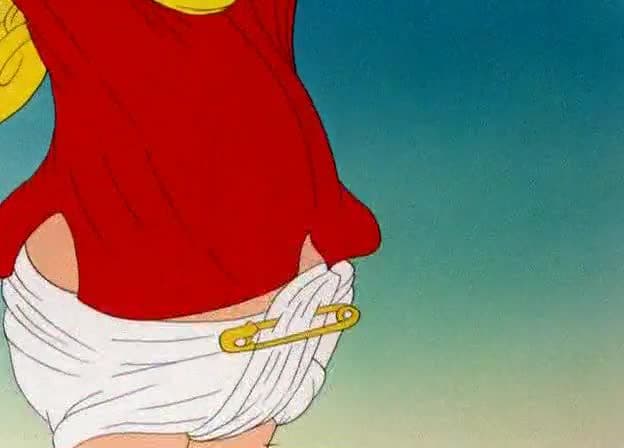
Standing in the dust, in a white bulky cloth diaper fastened with a gold safety pin, Stacey is forced to face the cruel eyes of the boys who wanted only one thing: to break her. Their taunts bite deeper than any bruise. They call her names that stab at the core of her identity, mocking her as a big baby in a sheriff’s costume, a coward in diapers, a joke of a lawkeeper who cannot even control her own body. Stacey’s legs tremble. Her heart cracks open. She tries to explain that it was never her choice, that her parents are just trying to help her, but the boys are past listening. Their goal is not understanding. It is domination.
They shove her toward the nearby town’s back alleys, a place her parents told her to avoid, a landscape of concrete and shadows where teenagers gather. Desperate, Stacey begs to turn back, but the gun jabs harder into her back, and the order is clear. She must walk. With her belt and overalls left behind on the ranch dirt, arms still raised, she shuffles forward, the padding at her waist turned into a target. Every step is a betrayal of the girl she believed herself to be.
In the alleys, the cruelty multiplies. Older teens circle her like vultures. They laugh, point, and unleash a torrent of insults that echo off the brick walls. They mock her sheriff’s title, her diaper, her helpless stance, her tears. Her age does not lessen their contempt. To them she is not a child who needs protection. She is prey. They talk about treating her like a baby instead of an outlaw, about a playpen instead of a jail cell, about how a “baby sheriff” has no need for dignity, only diapers.
Dragged into the center of their attention, Stacey faces a nightmare she never imagined. While she cries and begs for mercy, they promise her none. The boys boast that they have captured a disgraced sheriff and invite everyone to strip away whatever is left. Her clothing is peeled from her until all that remains is a white undershirt, her diaper, and the humiliation that wraps tighter than any fabric. Barefoot, legs shaking, arms still in the air because the fake gun will not move from her back, she stands as a living joke.
When the anxiety overwhelms her body, her worst fear becomes reality. Her bladder and bowels give out under the pressure, flooding her diaper as the crowd recoils with loud disgust and cruel laughter. Their comments twist her accident into proof of everything they have said about her. She feels herself sink inside, believing their words, accepting the idea that she is nothing more than a big baby who never deserved her hat, her badge, or her role.
But stories of the West are not only made of the darkest canyons. They also hold unexpected riders who arrive when all hope seems lost. Just as her diaper is tugged and yanked, just as she stands on the brink of being stripped entirely, a familiar shout cuts through the jeers. Her older brother Aaron storms into the alley, all righteous anger and protective fire. With his buzz cut hair, stern jaw, and matching green eyes, he looks every bit the defender she has always dreamed of being.
Aaron snatches the magnet, demands the return of her money and badge, and makes it crystal clear that no one who touches his sister will ever forget the consequences. The same boys who sneered at Stacey buckle under Aaron’s glare. In his hands, their bravado collapses. He lifts them by their collars, shakes loose their lies, and leaves them with a warning that anchors the scene in silence. The crowd scatters, not because the game ended, but because they finally see that they have crossed a line they never should have approached.
For Stacey, the rescue is not the end but the beginning of a second, different journey. Still frozen, still half undressed and filthy, she stands in front of the one person whose opinion matters as much as her own. Aaron does not laugh. He does not stare. He kneels, gathers her clothes in his arms, pulls her diaper back into place with care, and holds her as if she is not a spectacle but his little sister who needs comfort more than anything. In his embrace, her sobs return full force, and the armor she once thought she wore in denim is replaced by something stronger. Family.
Back at the ranch, safety looks different than Stacey once imagined. Her mother washes away the grime and shame in a warm bath, drying her gently and wrapping her in a towel. On the changing table, Stacey’s embarrassment surges again as she feels exposed, yet her mother’s hands are tender, steady, and sure. With wipes and ointment, powder and a fresh cloth diaper pinned again with the same gold safety pin, her mother treats her not as a spectacle but as a deeply loved child who has survived something terrible.
Each small act becomes a quiet declaration. You are not ruined. You are not worthless. You are safe. Her mother sings a lullaby from Stacey’s younger days, repeating it until the sobs soften into sniffles. When Stacey calls herself a big crybaby who will be in diapers forever, her mother leans close and whispers a new story into her ear. She tells Stacey she is stronger than the insults, stronger than the fear, and that bravery has nothing to do with dry pants and everything to do with getting back up. She shares that special herbs are growing in the garden to ease Stacey’s body over time, a practical hope that chips away at the despair.
Piece by piece, they rebuild Stacey’s image of herself. A white undershirt is slipped on. A green tank top covers it. Pink socks warm her feet. The fake sheriff’s badge is pinned not to overalls this time but to her chest, flush against her heart. Her mother settles her hat back on her head like a crown and asks if her little sheriff is ready to come downstairs. Stacey’s answer, a firm “Yes, Ma’am,” marks a turning point. The girl who walked into the alley as prey now walks out of her room as someone who has looked into shame’s eyes and still chooses to stand.
That night, the ranch fills with laughter, gentle jokes, and the clack of toy pop guns. Aaron and their parents honor Stacey without denying what happened. They do not erase the pain but wrap it in belonging. Her diaper still protects her, padding under her clothes and rustling when she moves, but it no longer feels like a prison. Paired with her badge, it becomes what it always should have been: a tool that helps her live as fully as she can, not a chain that defines who she is.
With the help of her family, Stacey mends what the bullies tried to break. Using the magnet they abandoned, her mother recovers the buttons and clasps that once held her overalls together and sews them back in place. The battered pair is restored and waiting for a new belt. When Stacey steps into them again, she no longer believes that the denim is her only armor. It is a symbol now, a piece of a larger truth that includes tears, terror, love, and stubborn courage.
“Little Sheriff, Big Storm” is a fierce, emotional story about humiliation, rescue, and the kind of strength that grows out of being broken in public and rebuilt in private. It follows Stacey through the darkest humiliation a child can face and into the healing warmth of a family that refuses to let her identity be written by bullies. Dialogue heavy and vividly detailed, the book puts readers inside Stacey’s mind and heart from the first confident patrol across the ranch to the last quiet promise she makes to herself as she returns to her rounds.
At its core, this story is not about diapers, magnets, or guns, real or fake. It is about control taken and control reclaimed. It is about how cruelty can strip away symbols but cannot touch the deeper bonds of love. It asks hard questions about what it means to be brave when every defense is yanked away, and it answers them through the steady hands of a brother who arrives in time and a mother who refuses to let shame be the final word.
Stacey ends where she began, wearing her cowgirl sheriff gear, patrolling the ranch she calls home. Yet everything is different. She no longer believes that heroism looks perfect. She knows that sometimes courage lives in trembling legs, tear streaked cheeks, and padded protection that feels softer than any armor. Her badge may be fake, her hat may be made for play, and her diapers may still rustle when she walks, but her heart has grown into something unshakable. She is ready for the next storm, not because she expects to stay spotless, but because she now understands that even the dirtiest moments can be cleaned up, faced down, and turned into the foundation of a stronger self.
In a world that often confuses toughness with cruelty, “Little Sheriff, Big Storm” offers a different vision of strength. It reminds readers that the truest courage is not the absence of fear or humiliation, but the choice to stand up again, to wear your hat, clip on your badge, and keep watching over the people and places you love, no matter what anyone else has tried to take from you.