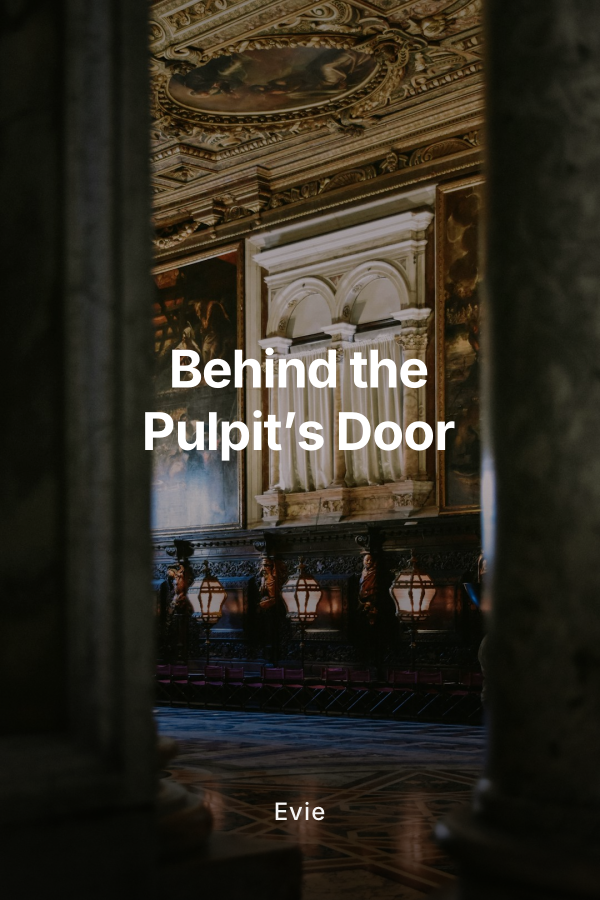
This book follows Abigail Hart, a twenty eight year old pastor’s wife in a small American town where everyone believes they know their neighbors and their faith. At the center of this town stands Pastor Jonathan Hart, the beloved spiritual leader whose sermons move congregations to tears and whose smiling family is held up as the model of Christian perfection. The church sees devotion, generosity, and kindness. Abigail sees his other face.
Told entirely from Abi’s point of view, the story lives inside her skin and behind her smile. In public she is the quiet woman at Jonathan’s arm, modest and gracious, always ready with a polite nod and a practiced laugh. In private she is a prisoner in a sprawling parsonage that feels more like a cage than a home. Jonathan controls every aspect of her life. He withholds money, tracks every receipt, and turns Scripture into a weapon he wields to justify cruelty. What the town calls “a man of God” Abi knows as a meticulous abuser who uses his authority, his intelligence, and his Bible to break her body, her mind, and her will.
The book does not look away from the brutality. Abi’s memories and present moments are rendered in vivid, physical detail as she endures beatings, coerced sex labeled as “wifely duties,” and ritualized punishments that follow Sunday services. Within the walls of their big, elegant house, words like “submission,” “obedience,” and “head of the household” twist into tools of domination. Jonathan’s violence is not chaotic. It is systematic and deliberate, planned to leave as few marks as possible where the congregation might notice, and always cloaked in religious language that tells Abi she is the problem, she is the sin, she is the reason he must “correct” her.
At the same time, the narrative never forgets that Abi is more than what Jonathan has done to her. Beneath the obedience there is a woman who once had plans of her own, a woman who does not believe in the God her husband claims to represent, and a mother whose love for her three children has become her only anchor in a life that otherwise feels beyond her control. Her inner world is rich with fear, tenderness, guilt, and small acts of defiance that exist entirely in thought. Readers are invited into her dissociation during the worst moments, the way she leaves her body in her mind, counts breaths, stares at patterns on the ceiling, or clings to tiny details to survive what is happening to her.
The children form a quiet resistance that no one else sees. Daniel, twelve years old and already crushed under the expectation that he will one day take his father’s place behind the pulpit, becomes his mother’s unspoken ally. He understands far more than a child should. He anticipates his father’s moods, distracts him when he senses a storm coming, and develops his own private rules to protect his younger siblings. His rage and helplessness simmer under the surface as he lives a double life, star athlete and model son in public, shield and lookout in private.
William, ten, is a sensitive boy who retreats into drawing. Over time his notebooks fill with images that carry more truth than words he is too afraid to speak. Through Abi’s eyes we see the way his quiet hugs, his small hands tending her bruises, and his habit of leaving supplies where she can find them become lifelines. He rarely defies his father outright, but his loyalty to his mother is absolute. His art becomes a coded record of what this perfect family really looks like when the doors are shut.
Amy, nine, adored by her father and treated like his little princess, lives caught between affection and confusion. She sees things she cannot quite understand. She hears muffled noises through walls, sees her mother flinch at sudden movements, and begins to sense that the man who spoils her is not the hero the town believes he is. Her love for both parents creates a painful innocence. Through her playful questions, her clumsy attempts to help, and the unguarded truths that occasionally slip from her mouth in front of others, she becomes the most unpredictable factor in the fragile balance Abi is trying to maintain.
The heart of the book is Abi’s dawning realization that there is no way out that does not risk everything she loves. When she secretly begins to skim from the strict monthly grocery money Jonathan doles out, she believes she has finally found a sliver of hope. Every hidden dollar becomes a silent act of rebellion and a promise she whispers to herself in the dark. The day he discovers her plan becomes the story’s pivot. His reaction is calculated and catastrophic, a punishment designed to crush not only her body but every remaining scrap of belief that escape is possible.
From that point, the narrative shifts from a story of hoped for escape to a study of survival without rescue. Abi learns to live with the knowledge that help will not come from the church that idolizes her husband, nor from authorities easily charmed by the respected pastor, nor from a legal system that would likely hand him the children and leave her with nothing. The most devastating moments arise not from the violence itself but from the repeated confirmation that the world outside their house is ready to side with him, to question her, to ask what she did to provoke him, to insist that a godly wife endures and forgives.
Instead of building toward a triumphant break for freedom, the book delves into what it means to endure. It explores the small, daily strategies that allow Abi and her children to carve out a sense of family within captivity. They develop code words for danger, routines for when Jonathan’s footsteps sound a certain way in the hall, and quiet rituals of care that never cross his line of suspicion. A glass placed in a certain spot, a song hummed in the kitchen, a bedroom light left on a little longer than usual all become signals. Survival becomes a language only they speak.
The small town setting intensifies the isolation. Everyone knows Abi by name, yet no one sees her. The same people who praise Jonathan after Sunday sermons pass her in the grocery store and comment on how “blessed” she is, how “lucky” to have such a devoted husband. Neighborhood gatherings, school events, church functions, and community traditions appear warm and wholesome on the surface. Through Abi’s eyes, each one becomes another stage where she must perform the role of grateful wife while carrying fresh bruises beneath modest sleeves and carefully applied makeup.
Across five chapters, the book follows the Hart family through a full arc of seasons in church life: holiday services, revivals, counseling sessions, midweek Bible studies, and pastoral visits. Each public milestone is mirrored by a private one at home. An especially moving sermon has its echo in a particularly severe night. A generous donation from the congregation funds a home renovation that adds both comfort and new ways for Jonathan to isolate Abi. Moments when the town celebrates Jonathan’s compassion coincide with his most merciless punishments behind the pulpit’s door.
The story does not offer easy answers or neat resolutions. It refuses to redeem Jonathan, refuses to soften his responsibility, and refuses to blame Abi for staying. Instead it asks readers to sit with the complexity of her choices in a world tilted against her. It shows how power, religion, gender expectation, and community dynamics can combine to trap a woman in danger while convincing everyone around her that she is blessed beyond measure. The children’s loyalty complicates everything. Their love for their mother and their own survival instincts bind them together, even as they begin to understand that they are growing up in a house built on a lie.
By the final pages, Abi has not escaped in any literal sense. Jonathan remains on the pulpit, the town continues to admire him, and the mansion stands pristine from the outside. Yet something inside Abi and her children has changed. They carry a shared awareness that what happens in their home is not God, not love, and not her fault. Their secret acts of care have grown into a quiet, stubborn resistance that Jonathan cannot fully destroy. It is not liberation, but it is not surrender either. It is a choice to cling to each other and to the truth they know, even if no one else believes it.
“Behind the Pulpit’s Door” is a stark, unflinching psychological drama about domestic violence and spiritual abuse hidden beneath religious respectability. It invites readers into the suffocating intimacy of one woman’s daily life under a man revered by everyone but her. In doing so, it raises difficult questions about faith, authority, and the myths communities build around those they choose to follow. Above all, it shines light on the unseen courage it takes simply to survive when escape is not an option and the only strength left is the strength to keep breathing, to keep loving, and to keep seeing clearly inside a world determined to look away.