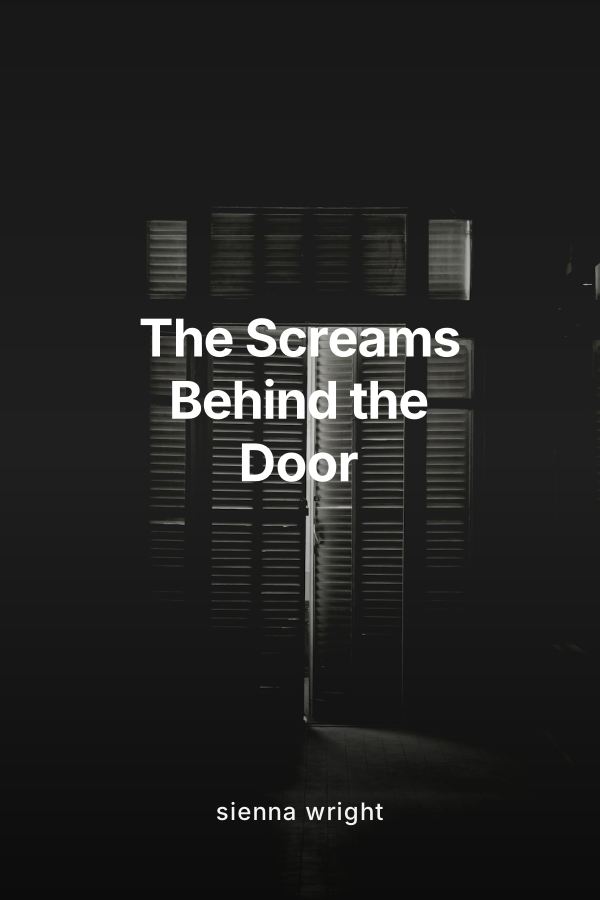
This book is a dark, emotionally charged Stranger Things story that asks a brutal question: what happens when the person who always jumps in front of the bullet is forced to stand back and listen instead?
When a new human threat tied to the Upside Down targets Robin Buckley and Steve Harrington, a cruel decision is made. Robin is dragged into the next room. Steve is chained to a chair with one purpose only. He is not allowed to look. He is not allowed to move. He is not allowed to save her. He is only allowed to listen.
Across two intense chapters, the book explores a single horrifying ordeal and the haunting aftermath that follows. The first chapter unfolds in a suffocating present, locked within four walls and a single closed door. Robin becomes the target of a calculated, graphic torment designed not simply to break her body, but to shatter Steve’s mind. Every scream, every choked laugh, every hoarse plea carries through the thin barrier, turning sound into a weapon that cuts them both. The reader stays with Steve as his imagination fills in the details he cannot see, and with Robin as she fights to stay herself while someone else tries to remake her in fear and agony.
The second chapter follows the escape and the long shadow it casts. Freedom does not mean the end of pain. Their bodies leave that room, but their minds do not follow so easily. The narrative traces the fractures that appear afterward: the way Steve cannot bear closed doors, the way Robin’s humor becomes both sharper and more fragile, the way their usual banter stumbles and chokes on what they refuse to say out loud. Friends try to help, but no one else heard what Steve heard, and no one else endured what Robin endured. Together they must decide whether to dig into the wound or let it fester.
This is not a story of simple heroism or easy comfort. It is about helplessness taken to its furthest point and about a bond that has to pass through fire instead of just banter and bruises. Robin is not just a victim, and Steve is not just an onlooker. Her resilience and refusal to fully break become the lifeline that keeps him from drowning in guilt, even while she bleeds for it. His raw, ugly desperation to trade places with her becomes its own sort of faithfulness, warped by the situation but impossible to ignore.
The Screams Behind the Door is written for readers who want their hurt and comfort with the hurt laid bare, who are interested in the psychological cost of violence rather than only its spectacle. The torture itself is graphic and unflinching, but the deepest wounds in the story are emotional. The book explores themes of survivor guilt, the different shapes courage can take, and the way friendship can become both a weapon and a shield when a sadistic mind decides to exploit it.
Throughout, the familiar world of Hawkins becomes a darker, more intimate stage. There are no sweeping battles here, no huge groups charging into the Upside Down. There is only a boy who used to be a king of the hallway, a girl who never fit into any of the boxes offered to her, and a closed door that traps both of them on opposite sides of the same nightmare.
By the end, there is no miracle that makes everything go back to normal. What they gain instead is something quieter and more realistic. They learn how to talk around and then through the worst of it, how to share a memory that hurts to touch, and how to stay in each other’s line of sight when darkness feels too close. Trauma does not stop existing, but it stops being something each has to face alone.
For fans of tense, character focused horror and emotionally candid hurt and comfort, The Screams Behind the Door offers a story that lingers. It digs into what it means to love a friend so much that their suffering feels like your own, and what it takes to keep that love alive when a stranger decides that bond is exactly what they want to break.