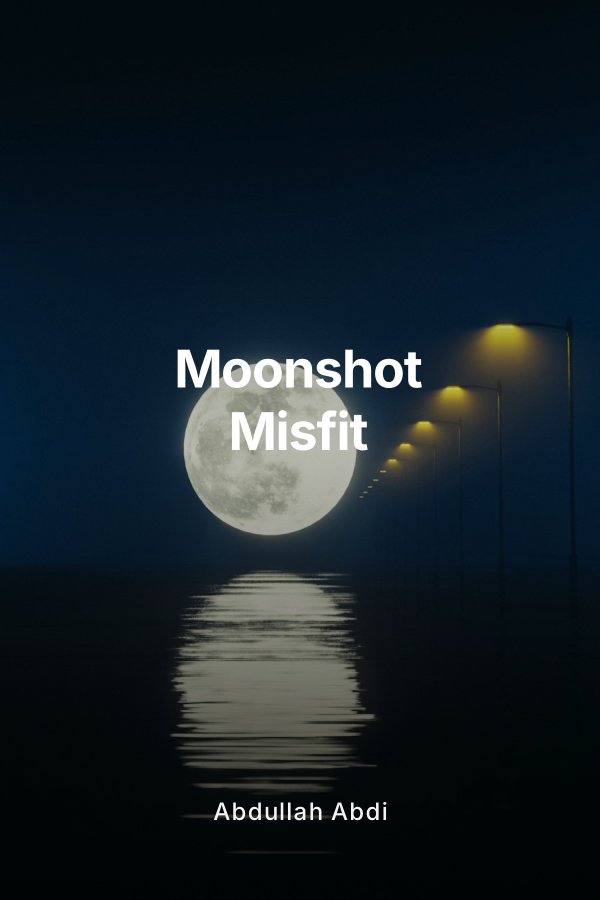
In the summer of 2005, while one very famous son of Poseidon is busy accidentally kicking off a godly custody battle over a lightning bolt, another demigod crashes into the story of Olympus from a completely different angle.
His name is Malik Romero, and fate hates his guts.
Malik is twelve, painfully good at being the family disappointment, and even better at pretending that does not sting. His dad, Adam Thorne, is a brilliant astrophysics professor at NYU who can map the stars but somehow misses the black hole forming in his own kid’s chest. Malik lives in a Brooklyn brownstone full of step-siblings, piano recitals, honor roll certificates, and framed family photos where he is either cropped out or conveniently “at a friend’s house.” He has no idea who his real mother is. Adam says she is some busy businesswoman on the other side of the world.
Malik does not buy that. He also cannot prove otherwise.
He is too tall, too quiet, too stubborn. His eyes are a strange molten silver, his hair a wild mess of dark curls, and every relative has a different theory about which side of the family tree cursed him with “that attitude.” He gets in trouble for things everyone else gets away with. He is blamed when a vase breaks across the room. He is grounded when the twins fight each other. Somehow, even gravity feels like it falls harder on him.
It all collapses at Adam and Nicole’s anniversary party.
The house is full of professors, polished colleagues, and extended family who speak to Malik like he is the unpredictable dog that might bite. Jokes are made at his expense. Relatives prod him about his grades, his “bad influence,” his “phases.” No one notices when he slips out to the porch to talk to himself and the stars.
Unfortunately, his dad notices when the quiet turns into shouting.
An argument explodes in front of everyone. Malik’s anger finally leaks out, his father’s temper snaps, and the perfect image Adam has built for years fractures in an ugly, public way. Guests leave in uncomfortable silence. His stepmother Nicole pretends this is not the best night of her life. After the house empties, Adam does something irreversible.
He tells Malik he is done.
He packs a single duffel bag.
He orders a taxi.
What is supposed to be a threat about “military school” or “a relative upstate” turns into something much, much worse.
Because the cab that picks Malik up never speaks. The doors lock with a soft click. The driver’s eyes in the rearview mirror look wrong. Deep in his chest, Malik feels the same icy pressure he has felt during every freak accident that ever circled around him. He bangs on the divider.
The driver turns, and her face is wrong, too. Bone-white. Predatory. Something that should not exist, with hunger in her eyes and fire at the edges of her smile.
Malik has never heard the word empousa, but survival instinct is a pretty good substitute for Greek vocabulary.
What follows is a panicked, bloody mess on a dark New York bridge. Malik shatters glass with a seatbelt buckle. The car jerks toward the railing. There is a struggle over the wheel. A crash. The river below claws him under. Rock and water smash into his skull.
Then nothing.
He wakes up to antiseptic, pain, and the soft sound of water. An infirmary bed. A wooden ceiling. A basin glinting nearby. A girl watching him.
Her name is Maya, a sharp-eyed daughter of Athena with ink-stained fingers and a serious problem minding her own business. She knows this boy is trouble from the second he starts muttering to himself in a hoarse voice, trying to talk down the panic building in his own head. She also knows, within about thirteen seconds, that he is one of the most beautiful, infuriating people she has ever met.
This is Malik’s first introduction to Camp Half‑Blood.
He does not take it well.
Gods? Demigods? Monsters out of myths he only half remembers from school? A divine parent he has never met while his mortal father kicks him out like spare trash? It is all too big, too bizarre, and yet it explains why the world has never seemed to play fair with him.
Under the peeling paint and homey porches of the Big House, he meets Chiron the centaur and Mr. D, the camp’s resident grumpy god with a leopard-print fashion problem. Malik’s reaction to being told he is a demigod is roughly: “Absolutely not, try again.” Mr. D keeps mispronouncing his name, which does not help.
Still, something at camp fits.
The cabins are full of kids who also attract freak accidents and cosmic attention. The training field is full of people who understand what it is like to wake up from nightmares that feel more memory than dream. For once, Malik is not the only weird one. He is still the black sheep, just in a different flock.
He lands in Hermes Cabin among pranksters and strays, including the Stoll brothers and Ethan Nakamura. Ethan, quiet and intense, becomes his best friend within days. Clarisse La Rue, the terrifying daughter of Ares, develops an inconvenient crush that looks suspiciously like bullying. Maya keeps pretending she does not care, then blushes every time he catches her staring.
Malik discovers that he is good with a blade, surprisingly fast, and a natural at snarky commentary under pressure. He also discovers that the gods are every bit as selfish and complicated as the humans he left behind. Nightmares of his father being tortured twist his sleep into something jagged. A mysterious voice presses at the edges of his mind.
When a brutal dinner brawl breaks out and Malik steps in to defend Ethan, everything explodes again.
Silver light. The sky shifting. All of Camp Half‑Blood watching.
Malik is claimed.
Not by the goddess of love, or wisdom, or war, or the sea.
By Artemis, sworn virgin goddess of the hunt. Patron of maidens.
The goddess who, very clearly, should not have demigod children at all.
The moon hangs, impossibly bright over the dining pavilion. A silver symbol burns above Malik’s head. Campers whisper. Some stare in awe. Others look at him like walking heresy. Malik sits there with bleeding knuckles, a racing heart, and one single thought:
Of course my godly parent is someone who is not supposed to have kids.
He is shuffled into Cabin Eight, Artemis’s cabin, a place that should be empty and is somehow his. The silver decor feels cold and beautiful and wrong. The goddess herself never appears. No words. No gentle hand on his shoulder. Just a symbol in the sky and the suffocating awareness that even among demigods, he is the mistake.
Then comes the Oracle.
Green mist. The chill of something ancient and watching. The cracked voice that tells him his future in words that feel like knives wrapped in riddles. Two he loves will lead to his downfall. The moon’s tide, a love that will wrench him apart, a choice that will burn. Malik staggers away from the attic sick with fear and secretly, desperately hoping he misheard.
He does not mishear. He decides to do something even more reckless.
If Artemis will not come to him, he will force the gods to look at him another way: through a quest.
He pesters Chiron. Annoys Mr. D. Asks for a mission no one in their right mind would give a twelve‑year‑old with self worth held together by duct tape and sarcasm. He gets what he wants, in a terrible, twisted way.
His first quest is a death sentence in disguise.
A storm is building in the south, not just with wind and thunder but with something much older crouched inside it. Typhon, primordial titan of storms and destruction, stirs in human disguise near Texas. Malik insists on going. Maybe it is to prove himself. Maybe it is to protect the camp that finally gave him a place, even a shaky one. Maybe part of him does not care what happens to him.
He takes Ethan with him. He accepts a sword gifted by Charles Beckendorf. He leaves behind a map and note from Maya, a battered wrist guard from Clarisse, a quiet, supportive look from Luke Castellan, the golden‑boy counselor who feels suspiciously like the older brother Malik always wanted.
On the road, for six long, terrifying days, Malik discovers that the world is full of monsters hiding in plain sight.
There are fanged things at rest stops. Something wrong in a museum’s shadow. Chases in bus stations. Brutal fights that leave him bruised and shaking. He meets Aphrodite, who takes instant offense to his existence as Artemis’s son and amuses herself by turning their life‑or‑death quest into a humiliating costume drama.
Malik survives on adrenaline, dumb luck, and the stubborn refusal to die before he figures out who he really is. He and Ethan grow closer through near‑death experiences, whispered confessions, and bad motel coffee. Malik’s mental health frays under the strain. Panic claws up his throat. The voice in his head grows sharper.
In Dallas, they finally confront Typhon.
He is no roaring, mountain‑tall giant here, but a polished, bald man in a perfect Italian suit with a storm in his eyes. He hits like rage given form. He breaks bones like twigs. Malik and Ethan are swatted aside again and again, their fingers snapped, their weapons shattered, their courage cracked but not quite destroyed.
In the worst moment, when Malik realizes this might be the end, something unseen intervenes.
His broken sword floods with power. An unnamed god, watching from Olympus, blesses the blade. Malik’s grip steadies. Cold clarity floods his mind. Using new strength he never asked for, he manages to neutralize Typhon and drive him down, not vanquished forever but forced back to the Underworld’s cage.
Before Malik can question who helped him and why, the world blurs again. A “fat dude in an ugly leopard shirt” appears just long enough to put them both on flights back to New York. They limp back into Camp Half‑Blood as minor legends: the kids who went south to poke a storm titan and somehow came back mostly alive.
There is a feast in their honor. Wreaths and cheers. Malik meets Percy Jackson in passing, a fellow disaster magnet with his own grudge against the gods. They share a mutual, silent understanding that the Olympians are a mess.
For the rest of the summer, life at Camp Half‑Blood becomes almost, almost normal.
There is training and late‑night campfires. Terrible sing‑alongs. Crushes Malik is not ready to name. He spends Fourth of July with Luke and the Hermes cabin watching fireworks explode over the sound, soda in hand, laughter on the air. For the first time in his life, he starts to believe that maybe he can belong somewhere.
Then Luke betrays them.
The boy Malik had started to see as an older brother reveals a darker agenda, one tied to the gods’ oldest enemies. Malik is left reeling, a familiar pattern repeating in godly colors: trust, then abandonment, then the sick feeling of being used.
In the echoing silence of that heartbreak, the voice in Malik’s head finally becomes clear.
It is his sword.
The blessing placed on the blade has never faded. It has a personality now, something like a louder, more obnoxious version of Malik himself. It jokes. It insults. It refuses to let him sink entirely into his own darkness. Malik names it Frostbite, because of course he does.
As summer ends, Malik boards the camp shuttle that will take him back to the mortal world and the complicated mess waiting there. He watches the woods slide past, the cabins receding in the distance, the boundary line of camp shimmering like a promise and a warning.
He is still the mistake, the anomaly, the demigod who should not exist.
He is also alive, changed, and no longer willing to be invisible.
In the distance, the sea glitters.
Storms are already brewing for next summer.
And somewhere on Olympus, an unknown god keeps watching Malik Romero, son of Artemis, very closely.