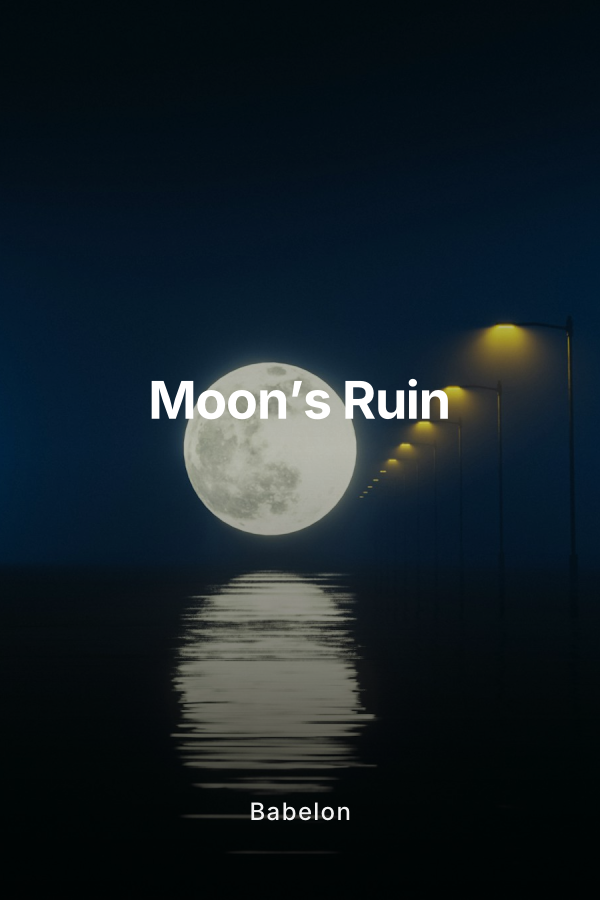
In a ruin of rotting wood and forgotten prayers, monster hunter Elias Crowe discovers that the worst thing he ever stalked was his own reflection. “Moon’s Ruin” coils itself around a single night of cursed revelation, tracing the slow, terrible unmasking of a man who built a life on slaying beasts, only to learn that his most relentless quarry has always been caged beneath his own skin.
The book follows Elias through a storm drenched countryside toward a forsaken chapel where his final hunt awaits. By reputation he is a savior of villages, a scourge of crypt and woods, a man whose silver blades have ended countless abominations. Yet shards of his past refuse to stay buried. Blood that does not wash away. Cries that never leave his ears. A hunger he has always explained away as rage. As thunder rolls over the land and the moon climbs from its shroud of cloud, the lines between hunter and hunted twist together into something raw and obscene.
Across one chapter divided into two long, suffocating subchapters, the story delivers a slow crescendo of dread that narrows like a noose. The first subchapter lingers in psychological shadow and memory. The second plunges into full, graphic metamorphosis. Together, they reveal that the true horror is not simply becoming a beast, but realizing that the beast has already chosen you, molded you, and waited with patient, animal certainty for the night you stop pretending to be human.
In Subchapter I, “The Hunter Under Glass,” the narrative tracks Elias on what he believes will be his final, redemptive hunt. He travels to an abandoned chapel on the edge of a drowned graveyard, where villagers swear a werewolf has been feeding on the lost and the lonely. The building is a carcass of faith, its stained glass split, its icons flayed by time. Through dripping corridors and dust choked pews, Elias confronts not a snarling monster but the evidence of something far more intimate: dried claw marks that match the width of his own hands, echoes of screams that trigger memories he cannot place, a scent of old blood that stirs hunger instead of disgust.
As he pushes deeper into the chapel’s throat, flashbacks slice into his thoughts, exposing a pattern he has never allowed himself to see. Hunts that began too late, as if he had needed time for the creature to feed. Victims whose remains were arranged in grotesque familiarity. Episodes of blacked out hours around every full moon cloaked in the convenient excuse of exhaustion. Each recollection runs like a fractured mirror, reflecting not heroism but careful self deception.
Elias’s identity begins to unravel. Once a man certain of his purpose, he now finds himself afraid of his own footsteps. The chapel becomes a hall of distorted reflections: cracked glass repeating his face in jagged fragments, wet stone casting his shadow longer and more lupine with every lightning flash. Symbols of faith twist and decay around him. Wooden saints gaze down with worm eaten eyes. A lone crucifix hangs askew, its suffering figure warped, the ribs raised like exposed bone.
The moon drags itself into the sky, pale and fat, framed by the shattered rose window. Its light crawls into the chapel and pours over Elias, revealing things daylight had always spared him. Old scars itch. His jaw aches. His teeth feel too crowded. He starts to smell his own sweat like prey blood. Each breath brings the musk of damp fur, though the chapel is empty. In this subchapter, the horror is mostly internal. Words, memories, and sensations conspire to corner him, stripping away the comfort of the hunter’s story he has worn for years. The reader feels the tightening of an invisible trap, the sense that something ancient inside him is waking, stretching, and smiling.
Subchapter II, “The Beast Within the Skin,” unfolds the promised nightmare in full, unrelenting detail. Where the first part haunted the mind, the second desecrates the body. Under the direct stare of the rising moon, the transformation begins, not as a sudden lurch but as a creeping invasion of pain, like invisible hands kneading his bones, testing their limits.
The narrative lingers on each stage with dark, gothic lyricism and stark physical horror. Joints swell and grind, tendons strain and sing like taut wire. Fingers warp, nails blacken and lengthen into curved talons that tear through his gloves and then his own palms as he claws at himself, trying to peel the change away. His spine arches until it feels like a rusted blade forced to bend. Vertebrae crack one by one, each snap echoing in the hollowed chapel like distant gunshots.
Elias’s skin becomes a prison that cannot hold its captive. Purple bruises bloom beneath the surface. Veins bulge like cords. Then the real grotesquerie begins. Rents open in his flesh, hair forcing its way through in damp, bloody patches, matting with sweat and gore. His mouth floods with saliva, his teeth crowding, grinding, then erupting into jagged fangs that split his gums. The prose dwells on the taste of iron, the choking, bubbling cries that break from him when his human voice collapses into wet, animal sound.
Despite the ferocity of the change, Elias’s consciousness does not vanish at once. For a while he is caught between bodies, a mind nailed to a mutating frame. He feels his skull reshape from the inside as bones slide and lengthen, cheekbones grinding, nose flattening, jaws stretching outward into a muzzle made for rending rather than speech. Every new growth, every snapping tendon becomes a grotesque revelation: this is what he was always meant to be. This is why violence felt so natural, why the smell of blood quieted his thoughts like prayer.
Around him, the chapel reacts like a living witness. Pews splinter beneath his thrashing limbs. Candles topple, their flames licking at the puddles of blood and wax. The fallen crucifix swings on its nail as the floor shakes, as if turning its head away in horror. Stained glass, already cracked, shatters inward at the height of his convulsions, showering him with colored shards that stick to his forming fur like jeweled scabs. Moonlight pours through the wound in the wall, turning the carnage into something almost ceremonial.
The second subchapter also pulls briefly into an external vantage in a few key moments, hinting at distant villagers hearing the unnatural howls that claw across the fields, seeing the silhouette of a monstrous shape framed in the chapel’s broken window. Their terror, their prayers, their helplessness further emphasize the annihilation of Elias’s humanity. Once their guardian, he has become the nightmare they will whisper about for generations.
By the end of the transformation, Elias’s mind frays. Names fall away. Language dissolves. Memories of faces and voices smear into shapeless impressions of fear, warmth, and the coppery perfume of blood. What remains sharp are sensations. The wind’s touch on his new fur. The roar of his own heartbeat, steady and unafraid. The overwhelming tapestry of scents beyond the chapel walls, each human presence a bright, pulsing signal in the dark.
The final pages fix on the terrifying equilibrium of his new existence. The creature that rises on digitigrade legs among the ruins of the chapel is not a mindless beast but a dark synthesis of man and monster. There are flickers of recognition when he glimpses his reflection in a puddle, a warped memory that this face once wore different bones. Yet hunger washes over everything. The last trace of Elias, the hunter who once believed in silver and salvation, flickers like a candle drowning in its own wax.
“Moon’s Ruin” closes on a quiet, soul curdling image. Outside, the storm exhausts itself. The moon stands unchallenged. From within the broken chapel a single low growl unspools into the night, thick with anticipation. Somewhere beyond the graves, a village sleeps, believing the worst is behind them because their famed hunter went out to save them. Inside the beast’s skull, there is a loathsome peace. No more doubts. No more questions. Only the certainty of teeth, of pursuit, of the hunt resumed in its truest form.
The book as a whole is a concentrated exploration of gothic dread, bodily desecration, and the betrayal of self. It does not simply portray a man turning into a monster; it charts the collapse of an identity carefully built atop a monstrous truth. Elias Crowe’s story is a dirge for anyone who thinks they can stand above the darkness they wield. Under the slow, merciless rise of the moon, every mask rots, every story cracks, and the hunter finally understands that he was never the cure. He was the disease, waiting to bloom.