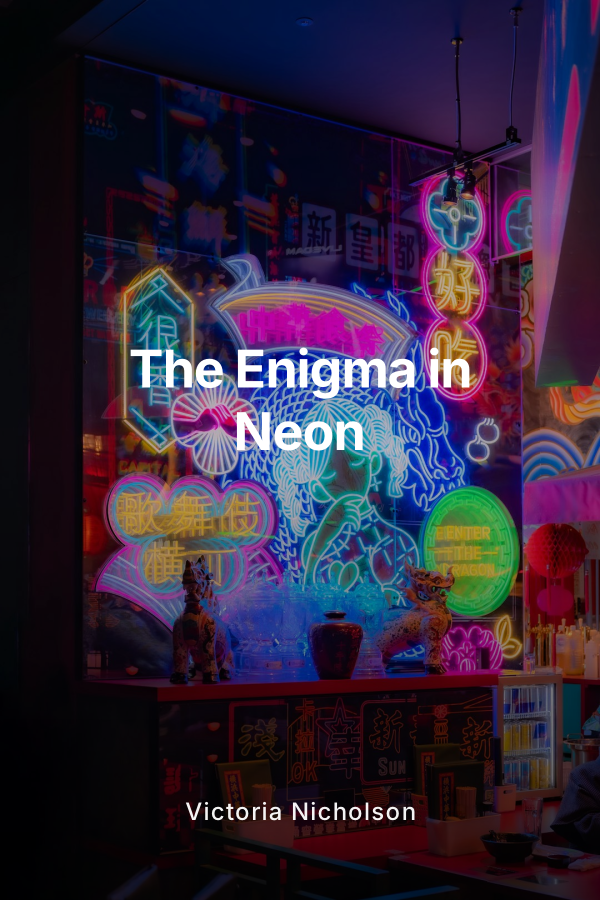
In the high floors of a glass tower in Seoul, where the city sprawls out like circuitry and the bass from private penthouse parties rattles the windows, there is a girl everyone is certain does not exist.
Her name is Juno.
White hair falls in a long wolfcut around her narrow face, the ends feathered and wild, catching colored light like frost. Pale green eyes, rimmed in kohl, look almost translucent under the neon. Her arms bear ink that slips beneath ethereal, drifting fabrics, and her hands glitter under stacked rings and chains that chime when she moves. There is a small silver glint in her nose, constellations of metal climbing the cartilage of both ears. She looks like innocence stepped out of a painting and lost its way into a club.
Everyone thinks she is a story.
For years, BTS have spoken about her in late night studios, in half‑joking interviews, in quiet backstage corners. A friend. A muse. A girlfriend. A girl they have known since she was sixteen, whose channel they watched explode in real time until she stood beside the largest creators on the planet and then stepped forward into music and took that too. Her face exists in thumbnails with impossible view counts, in playlists with looping choruses, yet in this smaller, insulated world of idols and their guarded circles, no one has met her.
She is their myth. Their excuse. Their “imaginary girlfriend.”
Jimin, of all people, insists she is real.
For a year now, he has said the words “my girlfriend” with a soft, stubborn pride. For a year, his members have taken his phone when he is not looking to scroll through photos and videos that could almost be edits if you did not know better. For a year, their friends have laughed and called her a shared hallucination, a convenient phantom for a man who writes love‑sore lyrics and blushes when the others tease him.
Then Jackson Wang hosts a party that glows with the reckless intensity of people who are tired of their own legends. BTS are staying the night. Idols filter in from every direction: PSY with his booming laugh, G‑Dragon and T.O.P with their impossible cool, Stray Kids loud in a corner, TXT buzzing with the jittery excitement of younger brothers, GOT7 at home in Jackson’s curated chaos, members from Seventeen, ATEEZ, Twice, Blackpink, IU, Jessi, TXT again in orbit around their seniors. Phones are locked away the moment they arrive, tucked into velvet pouches by staff with polite, firm smiles.
In this space there is no choreography, no cameras, no reputations to manage. Only music, dim light, smoke, the ripe sweetness of alcohol, and a sense that something is about to happen.
Juno arrives and the myth walks through the door.
The Enigma in Neon follows a single night that unravels slowly, luxuriously, in all its messy glitter. It is a story about being seen for the first time by those who thought you were a rumor. About the strange, electric intimacy of a girl whose life is lived in front of millions, stepping into a room where nobody can press record. About a relationship that has stayed carefully offstage, suddenly thrown under the warm spotlight of laughter, dares, and the quiet, awed attention of peers who have lived their entire lives under scrutiny.
At the center of the book is Juno herself, a wildly popular YouTuber whose content spills across genres and defies categorization. She is chaos and control at once, able to turn any idea into an event, any camera angle into a story millions will click. More recently she has stepped into the music scene, her tracks pouring through clubs and headphone wires. The combination of her angelic aesthetic and sharp, mischievous spirit confuses those who expect a sweet ingénue and instead find a woman who inhales from a blunt like she was born to it, beats everyone at drinking games, and still listens with impossible gentleness when someone confesses a late‑night fear.
Beside her is Jimin, six years older, who has watched her grow from a girl still figuring out how to exist in her own skin into a woman who wears layered silver and smoky eyeliner like armor. Their love is not new, but tonight it is newly public. There is a tenderness in the way he adjusts a chain at her throat, the way he reads every micro‑expression at the edges of her smile. There is also a possessiveness that hums under his skin, not sharp with jealousy, but warm with pride, an instinct to make her visible in a world that has only known her as story.
Over the course of the night, the book traces Juno’s path through this dense constellation of idols.
In one corner, TXT fanboy openly, stumbling over compliments about her most chaotic videos and the song that got them through tour rehearsals. Their awkward admiration breaks into comfortable teasing as she fires jokes back, undercutting her own myth with clumsy dance moves and a shriek of laughter when she loses a round of a drinking game. In another room, PSY claps her on the back and calls her a fellow entertainer, recognizing the particular exhaustion that comes from making everything bigger, louder, more unforgettable.
A circle forms around a low table for truth or dare and the air thickens with equal parts weed smoke and anticipation. Questions pry at how Jimin kept her secret so long, at which song of hers is really about him, at who fell in love first. Dares escalate from mild to indecent, nudging them toward displays of affection that, in this rare sanctuary, feel safer than they ever could in public. Laughter grows looser, more reckless. The edges of shyness dissolve.
Later, the book slides into the small intimate geography of a kitchen lit only by fridge light and the slow curl of smoke. A smoking game becomes an excuse for proximity, for the slow exchange of breath, for the kind of kiss that tastes like shared vice and unspoken promises. In the quiet clatter of glass against countertop, Juno discovers how it feels to be desired deliberately, not as an online persona, not as a concept, but as a body in someone’s hands. Jimin’s touch is confident enough to be guiding and gentle enough to be generous, testing her boundaries by instinct rather than script.
All around them, the party tilts further into decadence. People dance with abandon, grinding against whichever warm body is closest, not caring who sees. A couple disappears behind barely closed doors. On a couch in the open, one of Jimin’s own members forgets the world exists, too lost in someone’s mouth to bother with shame. The point is not scandal but release. The book treats this not as titillation for its own sake, but as a backdrop for Juno’s revelation that in this hidden world, the strict lines that govern their public lives can be smudged, if only for a few hours.
The Enigma in Neon does not shy away from eroticism. It inhabits it. The language is lush, sensory, unafraid of desire in all its physical detail. Yet sex here is never divorced from vulnerability. Juno and Jimin’s bodies speak as fluently as their private jokes, their shared history, their understanding of where to press and when to ease back, of when to pull someone closer and when to let them move. Their rough edges in the bedroom are wrapped around a core of trust that has been built carefully, away from cameras and expectations.
When they finally leave the party, high and pleasantly wrecked, the city outside feels strangely quieter, the streets almost tender in their emptiness. In the close interior of the car, the power dynamic shifts again, intimate and raw, their banter from earlier stripped down to something possessive and private. Juno’s wildness has sharpened into a kind of devotion; Jimin’s relaxed charm has distilled into focus and hunger, softened only by the way his hands steady rather than restrain. What they do on that drive is as much an act of surrender as it is of pleasure.
In Jimin’s apartment, the night reaches its most intense and vulnerable point. His room reveals itself as an extension of his inner life: dark, sensual, carefully curated, the kind of space where a person can come undone without feeling watched. Here, the two of them test limits and explore how far trust can bend without breaking. Roughness is not a violation but a language. Overstimulation becomes a shared ambition, a dare between lovers who know precisely how to read the difference between overwhelmed and frightened. The scenes are raw, but threaded with whispered softness, with the small rituals of aftercare that are as erotic in their own way as anything that came before.
Beneath the body heat and the neon, beneath the games and the smoke, the book is ultimately about belonging.
Juno belongs to herself first. To her channel, to her audience, to the strange hybrid world she carved on the internet where no one could tell her that she did not fit. Tonight, she also belongs in this roomful of idols who finally learn that the “imaginary” girl is very real and very much their equal. Her success no longer exists as a punchline to a running joke, but as a fact they can touch, laugh with, drink beside.
Jimin belongs to her as much as she does to him. His possessiveness is not ownership but declaration. The world has been allowed to believe he is alone for so long that calling her “my girl” aloud in front of these people becomes an act of rebellion and, perhaps, relief. His dominance in private is another kind of confession: that he trusts her enough to show the parts of himself that the polished idol never can.
By the time dawn begins to smear light across the city, The Enigma in Neon has taken the reader through a complete transformation. Juno is no longer an inside joke or a phantom. She is not even primarily the famous YouTuber whose face glitches across millions of screens. She is a woman who arrived at a party on the edge of a world that had pretended she wasn’t real and left with that illusion shattered, her hand threaded with the man who always knew she was.
The book leaves them tangled in sheets and soft exhaustion, the echo of bass replaced by the slow, steady rhythm of shared breathing. Outside, the world they know will wake up to curated feeds and controlled narratives. Inside, for a little while yet, they exist in a private mythology that needs no proof, no cameras, and no audience.
She was never imaginary.
They simply had not been invited into the room yet.