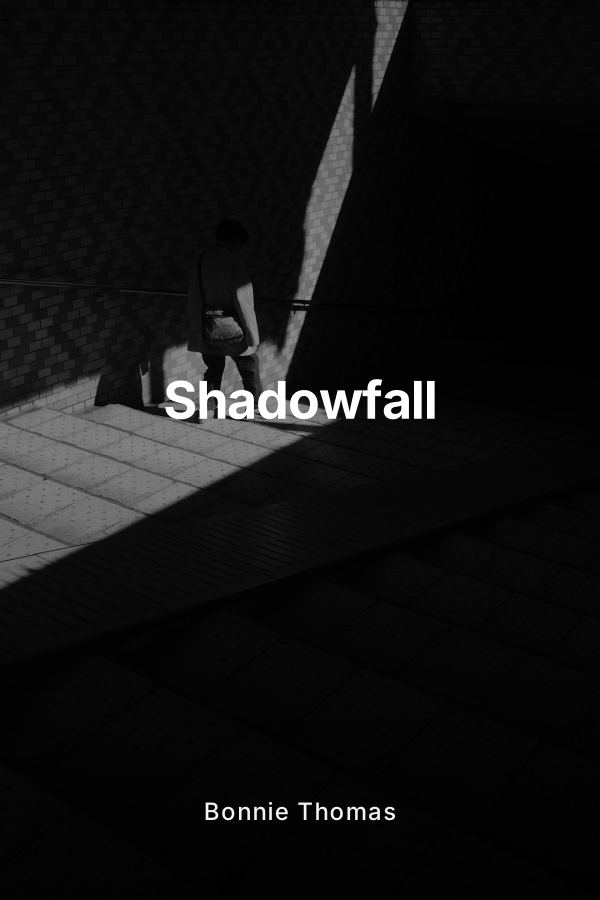
In New York City’s fractured skyline, heroes shine on billboards while monsters lurk in alleys. The Hero Agency sells polished smiles, sponsored rescues, and perfect public images. In the spaces between their spotlights, something else moves. Something the cameras never quite catch.
They call him Shadow.
An S+ class anomaly with terrifying control over darkness and forbidden magic, Shadow appears where the official heroes fail. He slips from rooftop to rooftop, cuts down high level villains alone, and vanishes before sirens can arrive. To the agency he is a menace, a walking PR disaster, a reminder that power outside their control exists. To the criminals who survive him, he is a whispered nightmare.
To himself, he is just Kiyotaka Ayanakoji, a 17 year old boy who watched his parents die at the hands of a masked assassin and then found that the world had no place, no guide, and no mercy for a child powered by darkness.
Shadowfall is a gritty, irreverent superhero story that blends sharp comedy with raw emotional depth, following Kiyotaka’s journey from weaponized loneliness to reluctant belonging, from calculated self destruction to fragile, hard won hope.
When a new threat surfaces, the cracks in the hero system start to split open. The Fatui, a clandestine organization of five elite officers armed with advanced technology and elemental abilities, launch a coordinated assault on the Hero Agency itself. They are former heroes and high level criminals who know the system from the inside, and they move with a purpose that goes beyond chaos.
Their leader is the man who slaughtered Kiyotaka’s parents.
The agency’s finest, including the prestigious youth team Star Force, are suddenly outmatched. Elemental powers that once dazzled crowds now barely hold the line. In the city’s darkest hours, the one person who keeps turning Fatui victories into stalemates is the vigilante they have spent years trying to capture.
Shadow.
Backed into a corner and facing a war they cannot win alone, the agency makes a choice it swore never to make. Star Force is ordered to work with Shadow.
Star Force, the media’s darlings, are everything Kiyotaka is not: official, adored, and loudly, chaotically close knit. They are teenagers who learned to be heroes together, bickering like siblings and bleeding like soldiers.
Jacob, their fire wielding leader, is a charismatic, stubborn tactician who burns with a sense of duty and refuses to give up on anyone once they are his. Ethan, their initial rival turned ally, brings sharp edges and a competitive streak. A calm, brilliant water user holds the team together with strategy and level headed insight. An earth user acts as their protective big sibling, a walking fortress with a surprising emotional gentleness. A whirlwind wind user provides relentless comic relief and instant commentary on everything, including the sudden, undeniable tension between Shadow and Jacob.
To Star Force, the idea of cooperating with Shadow sounds like a nightmare. He is sarcastic, blunt, and frighteningly powerful, dismissing their protocols and mocking their PR cleanups. He lives in the gray area they have been trained to avoid. Yet on the battlefield he moves with lethal precision, protecting civilians even while ignoring orders, and his presence means the difference between survival and defeat.
Forced into an uneasy alliance, Kiyotaka and Star Force clash in every way that matters. His menacing wit and cold efficiency collide with their banter, rules, and idealism. Jacob and Kiyotaka in particular ignite on contact, fire and shadow snapping at each other in every briefing and every street fight.
Their rivalry quickly becomes the heart of the chaos.
But beneath the quips and verbal sparring, cracks appear in Kiyotaka’s armor. Battle after battle against Fatui officers strips away his distance. He cages his pain behind sarcasm and calculated violence, yet Star Force keeps showing up, again and again, refusing to treat him as a tool or a monster.
Jacob sees the way Kiyotaka throws himself into the worst of the fight, taking hits no sane person would accept, pushing his dark magic to horrifying extremes. Shadow’s power grows stronger with pain and negative emotion, and Kiyotaka knows exactly how to exploit that. He treats his own body as fuel, cutting and breaking himself mid combat in carefully controlled self harm to trigger surges of shadow and cursed energy.
It works. The ground splits, enemies fall, and darkness answers his call with terrifying obedience.
It is killing him.
In the middle of shattered streets and burning rooftops, Jacob becomes the first person who refuses to accept Kiyotaka’s self destruction as the price of saving others. When he sees Shadow bleed on purpose for more strength, he intervenes. He grabs his wrist, steps into the path of that spiraling darkness, and chooses the boy over the power.
That choice changes everything.
Shadowfall traces their relationship as it evolves from defensive rivalry into reluctant partnership and, slowly, something far more fragile and intimate. Between brutal set pieces and high stakes missions, quieter moments begin to carve out space where Kiyotaka has never allowed anyone to stand.
Late at night in the Star Force base, after missions that leave the city cracked and his hands shaking, Jacob finds Kiyotaka in the dark, hiding among his shadows to stave off the memories. Instead of staying at a safe distance, Jacob sits beside him. He offers warmth instead of judgment, a steady presence instead of orders.
There are nights when Kiyotaka wakes from nightmares of his parents’ deaths with shadows clinging to the walls like oil, choking the light. Jacob is there, pulling him close, grounding him with gentle touches and murmured reassurances until the magic recedes. Soft kisses trace over scars Kiyotaka once used as tools, turning marks of pain into proof that he is still here, still wanted, still chosen.
The rest of Star Force becomes the found family Kiyotaka never believed he deserved. The wind user teases them both mercilessly, loudly shipping Jacob and Shadow in the middle of mission briefings. The earth user wordlessly sits beside Kiyotaka when things get too loud, a quiet, hulking shield that says “you are safe” without a single word. The water user draws him into strategy sessions, treating his insight as vital instead of dangerous. Ethan, once the loudest voice against the vigilante, begrudgingly becomes his rival in a different way, pushing him in training and standing at his back in battle.
Their banter, movie nights, shared meals, and ridiculous arguments about trivial things start to pull Kiyotaka away from the edge he has lived on for years. Every joke, every shared smile, every time they pull him into the circle without asking becomes another thread tying him back to life.
Against this evolving backdrop of found family and fragile healing, the war with the Fatui escalates. Each officer confronts Star Force and Shadow with different distortions of power and betrayal. Advanced tech tampers with abilities, elemental showdowns rip through skyscrapers, and the city becomes a board in a larger, unseen game.
At the center of that game waits the Fatui leader, the man who murdered Kiyotaka’s parents. Their inevitable confrontation looms over every chapter, a shadow on the horizon. For Kiyotaka, the entire world has narrowed to that face, that voice, that final reckoning.
When the showdown finally comes, the cost is enormous. Allies bleed, buildings fall, and Kiyotaka peels back every remaining safety he had ever kept around his power. His calculated self harm, driven by a singular need for revenge and fueled by years of unprocessed grief, pushes his dark magic past anything he has ever attempted.
He is seconds away from killing the man who destroyed his childhood, from ending the threat in the harshest, most final way possible, consequences be damned. Shadows coil around his enemy’s throat. The air shakes with lethal intent.
Jacob steps in.
He does not come with a speech about justice or some flawless moral code. He comes with shaking hands, bruises, and eyes that see Kiyotaka, not his power. He reminds him of warm nights, of laughter in the Star Force lounge, of cuddles after nightmares where no one asked him to bleed for strength. He holds him while the darkness claws for escape and asks him to choose something he has never been able to choose before.
Mercy.
Not for the Fatui leader, but for himself.
In a moment of blistering emotional clarity, Kiyotaka lets go. The shadows recede instead of killing. The Fatui leader survives, captured and imprisoned instead of erased. In the aftermath, Kiyotaka shakes with the force of what he almost did and what he chose not to do, shaking not from weakness but because mercy, for the first time, hurt more than violence.
The decision sends ripples through the world. The agency secures their new high profile prisoner, political storm clouds gather, and the remnants of the Fatui scatter into the shadows, setting the stage for future arcs and deeper conspiracies. Yet inside the walls of the Star Force base, the immediate fallout is smaller and far more important.
Kiyotaka does not disappear back into the alleys as he always promised he would. He does not return to the anonymity of the rooftops and the solitary rituals of pain and power. He stays.
Not for the agency. Not even for the idea of being a hero.
He stays for them.
For the team that refuses to let him spiral alone. For Jacob, whose arms have become the only place that quiets the storm in his head. For the siblings he never expected to gain, who relentlessly tug him into group photos, throw popcorn at him during movie nights, and act scandalized whenever they walk in on him and Jacob curled up together.
Shadowfall ends its first major arc on a quiet, intimate image in stark contrast to the chaos that came before. In a dim room at the Star Force headquarters, the city’s newest unofficial member lies wrapped in a warm blanket, head resting against Jacob’s chest. Jacob’s fingers trace idle circles over healed and healing scars, pressing gentle kisses against old wounds that no longer define the boy who bears them.
Around them, the rest of Star Force doze in mismatched chairs and tangled piles on couches, keeping watch without making a grand statement about it. They are just there, like a family that has finally admitted it has one more member.
Outside, the world still argues about vigilantes and heroes, about what Shadow truly is. Crime has not vanished. Corruption still lurks. The Fatui leader sits in a reinforced cell, and somewhere in the darkness, greater threats begin to stir.
But inside that room, Kiyotaka Ayanakoji is not a weapon or an urban legend or a headline. He is a boy finally allowed to sleep without a blade in his hand, a living contradiction held by someone who refuses to let him fall back into calculated self destruction.
Shadowfall is a story about how laughter can coexist with trauma, how brutal battles can share space with soft kisses and shared snacks, and how the loudest, bloodiest struggles sometimes happen inside a person’s own mind.
It is about found family that quite literally saves a boy from himself.
Across roughly ten thousand words and five structured chapters, the book will guide readers through:
- The rise of Shadow as New York’s terrifying vigilante and his clash filled first encounters with the polished, elemental Star Force
- The unraveling mystery and escalating threat of the Fatui, tied inextricably to Kiyotaka’s past and the agency’s failures
- The slow burn, rivals to lovers bond between Kiyotaka and Jacob, built on banter, battle, comfort, and the hard work of healing
- The raw depiction of self harm, calculated power abuse, and the intervention of friends who refuse to stand by and watch him break himself for their sake
- The climactic choice between revenge and mercy that redefines what it means for Kiyotaka to be powerful
- The tentative, fragile peace where a once isolated vigilante chooses to join a team, not as a weapon, but as family
Shadowfall invites readers into a world of capes and conspiracies that refuses to stay clean or simple, and into the heart of a boy who learns that the bravest act he can commit is not to fight alone in the dark, but to let others stand with him in the light.