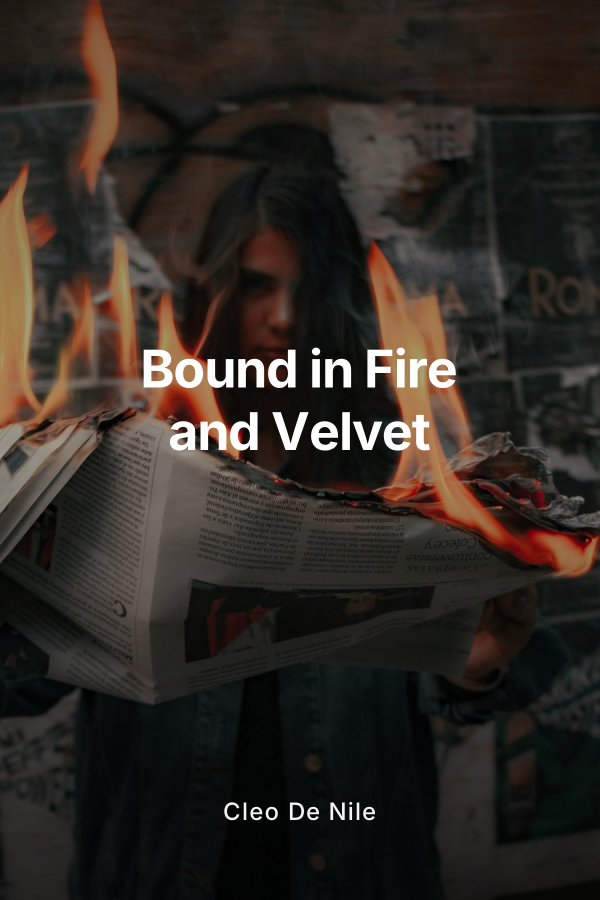
In a world ruled in shadows by money, legacy, and ruthless alliances, Irie Monét and Theodore Arellano are nothing more than signatures on a contract.
On paper, they are perfect.
Irie is the daughter of Afro‑Dominican power players from New York, born into a dynasty that blends business, politics, and influence from Harlem to the Bronx. A polyglot strategist with a sultry, scratchy voice that can calm storms and command rooms, she is trained to be the mind at the table, the negotiator whose words draw blood more cleanly than any weapon.
Theo is heir to an Italian‑American empire that built itself on steel, concrete, and carefully sharpened charm. A natural leader with a deep, resonant voice, brutal combat instincts, and a terrifying capacity for focus, he is groomed to be the shield and the sword of his family’s interests.
At fifteen, they meet once. It is awkward, incomplete, and unpleasant. Braces, half‑glimpsed faces, barbed comments, bruised egos. Their parents sign their marriage contract for them, merging two powerful lineages. Irie and Theo are not even in the room.
They decide they hate each other anyway.
Two years later, at seventeen, hatred is the least of their problems.
Across the globe, the children of billionaires, politicians, moguls, and old dynasties begin to disappear. Kidnapped with surgical precision, they reappear inside an isolated, secretive facility buried under layers of false identities and black‑ops secrecy.
Here, heirs are not just hostages.
They are being turned into weapons.
The program is refined and merciless. Constant surveillance. Silent trackers. Publicly ranked missions. Punishments that begin with isolation and end with children vanishing overnight. Forbidden romance. Manufactured rivalries. Survival drills that blur training and real danger until no one can tell the difference.
Among the captives are:
- Choy Zhang, the calculating son of a Chinese tycoon
- Leah Montgomery, a fierce Australian sharpshooter with a wicked sense of humor
- Lara, a French prodigy with a gift for manipulation and subterfuge
- A restless Spanish heir with a silver tongue and murky loyalties
- KK, a bright, loud, dread‑headed girl from Wisconsin who adopts Irie as her “mom” and refuses to let go
And somewhere in the middle of that volatile mix, Irie Monét and Theodore Arellano are reunited at last.
Gone are the braces and the half‑formed features. Irie is all soft curls down her back, hazel‑green eyes, and quiet fire. Theo stands tall, blue‑green gaze sharp, jaw set, every inch the weapon his family paid to craft. The facility throws them together under fluorescent lights and security cameras. For the first time, they see each other fully.
The attraction is instant.
So is the hostility.
They spit harsh words in fluent sarcasm. They roll their eyes, snap, and refuse to sit too close. Irie calls him Arellano like it is an insult. Theo throws her own attitude back in her face. Their tension crackles loud enough that even the other captives eventually ask, “What is wrong with you two?”
The answer is simple and utterly complicated.
They are married.
They did not choose it.
And if they refuse to play along, both their families burn.
Forced into proximity through missions, drills, and dormitory politics, they are assigned roles that mirror the lives they were born to live. Irie, with her languages and intuitive mind, becomes a strategist, code‑breaker, and covert operations specialist. Theo, with his combat reflexes and steady instinct, is placed at the tip of the spear: field leader, front‑line protector, the one who runs into danger.
The facility intends to forge them into perfect tools.
Instead, it forges something far more dangerous.
In the field, Irie and Theo are oil and water at first. She plans; he charges. She negotiates; he knocks down doors. Yet the missions keep forcing them to rely on one another. A misstep here, a missing piece of intel there, a betrayal staged by the program to test their loyalties.
When Irie risks herself for a teammate, Theo explodes in terror disguised as anger. When Theo throws himself into danger, Irie learns what it feels like to scream without making a sound.
Somewhere between the shouting and the silence, something shifts.
Theo finds himself listening for Irie’s voice across a room, tension easing at the scratchy, melodic sound he once called annoying. He makes excuses to keep her talking. Pretends he is bored. Lies to himself.
Irie, who hates being touched without consent, realizes she does not flinch when Theo’s hand closes around her wrist to pull her out of the line of fire. She finds her palm drifting to his jaw in conversations, thumb tracing absent circles as if his face belongs under her hand.
Habits begin to form. Rituals.
In public, they bicker. In private, they keep saving each other.
He steps in front of her when things explode. She stands between him and his self‑destructive guilt. He holds her through thunderstorms and survival tests in the wild, tucking her inside his sleeping bag or even his shirt to shelter her from the dark and the noise. She bandages his wounds with trembling hands and wet lashes, whispering in Spanglish that he does not get to hurt himself, because when he hurts, she bleeds too.
The program watches them. Learns them.
And starts to use them against themselves.
A carefully engineered mission failure drives a wedge between them. Theo pulls away, convinced that closeness is a liability. Irie, hurt and raw, steps into reckless danger to distract herself from the hollow he leaves.
Their bond becomes both their greatest strength and their most vulnerable point.
Older trainees like DJ, who reads people as easily as mission briefs, begin to speak truths neither of them is ready to face. DJ tells Irie what Theo has been quietly enduring for her: burns from grabbing a coffee pot he hates just to keep her company, forced sips of things he despises just to stay by her side, plates cleaned simply because she stopped eating. DJ tells Theo what Irie’s tears mean, how she never cries for anyone else, how silence around him is not indifference but trust so deep it terrifies her.
Under the weight of these revelations, their performances crack.
Theo’s anger caves into guilt. He punishes himself with extra training, sleepless nights, more missions. Irie, who sees too much, refuses to let him shatter himself to atone for making her cry. She learns how to stop him with a back hug, a hand on his jaw, a whisper of, “Theo, that is enough for today.”
Their language stops being mostly verbal.
A pulled‑back hand and a soft use of his full name, “Theodore,” become a boundary he respects instantly. Her silence becomes a red alert. His deep, strained “Rie, do not go quiet on me. Say something, please,” becomes a plea and a promise.
Arguments mellow from weapons into tools. They still snap. They still clash. But they learn to ask, “Did I hurt you just now?” instead of hiding behind pride. Fights end with hands linked, jaw cupped, forehead pressed quietly to shoulder, not with doors slammed and distance stretched.
And when the debris finally falls on Irie during a mission gone sideways, burying her under concrete and dust, Theo’s last illusion dies.
He digs her out with bleeding fingers and shaking hands. He wipes dirt from her lips with his thumb, checks for breath, and kisses her as if it is the only way to prove she is alive. His body moves before his mind catches up. His heart confesses in the one language even he cannot fake.
After that, kissing becomes another weapon in their private arsenal.
Sometimes it is soft, a thank you pressed to her wrist, a reassurance brushed against his brow. Sometimes it is explosive, slammed between argument and apology, used to silence words that would cut too deep. Sometimes it is hungry and unsteady in dark storage rooms and unused corridors, interrupted by teammates and emergency alarms.
The next day, they often pretend nothing happened.
Their bodies keep telling the truth anyway.
He shows up at her cubicle and complains in front of roommates and friends that she left without kissing him. She calls him spoiled and hisses at him to lower his voice, only for him to shrug and say, “Why not? You are my wife.” She threatens to make him wait. He sulks, restless, until she gives in with a laugh and a kiss that grounds them both.
KK, the sixteen‑year‑old hurricane who calls Irie “mom” and Theo “dad,” is outraged when Theo tries to reclaim bedtime cuddles. Teammates joke, call him whipped, ask him to blink twice if Irie has him on a leash. He snarls and swears and never once moves away from the comfort of her hand on his jaw.
Every new ritual, every careless endearment, every almost‑confession pushes them closer to the truth the facility already suspects.
Irie Monét and Theodore Arellano are no longer just two names on a contract.
They are a unit.
The program wanted to turn them into polished instruments of power, perfectly tuned and interchangeable, loyal only to the agenda behind the glass.
Instead, it created something unpredictable and unstoppable.
Two teenagers, weaponized by trauma and training, now tied together by a bond that refuses to die. Two heirs, once enemies by arrangement, now willing to defy orders, rewrite missions, and shatter chains to protect each other and the fragile found family that has grown around them.
Bound in Fire and Velvet follows Irie and Theo from their first reunion under fluorescent lights, through betrayal, jealousy, and broken trust, into a love that is all bruised knuckles and soft hands, sharp words and gentler apologies, thunderstorm cuddles and battlefield kisses.
Over five chapters and ten subchapters, the book explores:
- The brutal ecosystem of the facility, where elite teens from every continent are ranked, tested, and broken into roles that serve an unseen power
- The slow, reluctant transformation of an arranged, resented bond into a partnership built on survival, respect, and wordless devotion
- The intimate rituals of touch, scent, voice, and quiet that become their survival code under constant surveillance
- The way power, love, and vulnerability tangle when two people designed to be strong alone discover they are strongest together
- The growing realization that if they do not bend the rules of this game, they will be used to reinforce it
Enemies to partners.
Contract to connection.
Obligation to obsession.
This is not a soft love story in a gentle world. It is a romance forged in captivity and conflict, where tenderness is rebellion, and a single whispered “mi amor” in the dark is more dangerous than any gun.
Bound in Fire and Velvet is for readers who crave:
- Enemies to lovers arcs built on real emotional work, not just banter
- Forced proximity that turns into chosen closeness
- A protective, physically expressive boy quietly undone by the girl he once swore to hate
- A brilliant, gentle girl who learns that her softness is not a weakness but a weapon
- Found family, high stakes, and a slow‑burn romance that kisses hard, argues harder, and still chooses to stay
Behind the contracts, the kidnappings, and the missions, one truth rises from the wreckage.
They were never meant to love each other.
They do anyway.
And once Irie Monét and Theodore Arellano decide they are each other’s home, the world that built this prison will learn what it means to be on the wrong side of their loyalty.