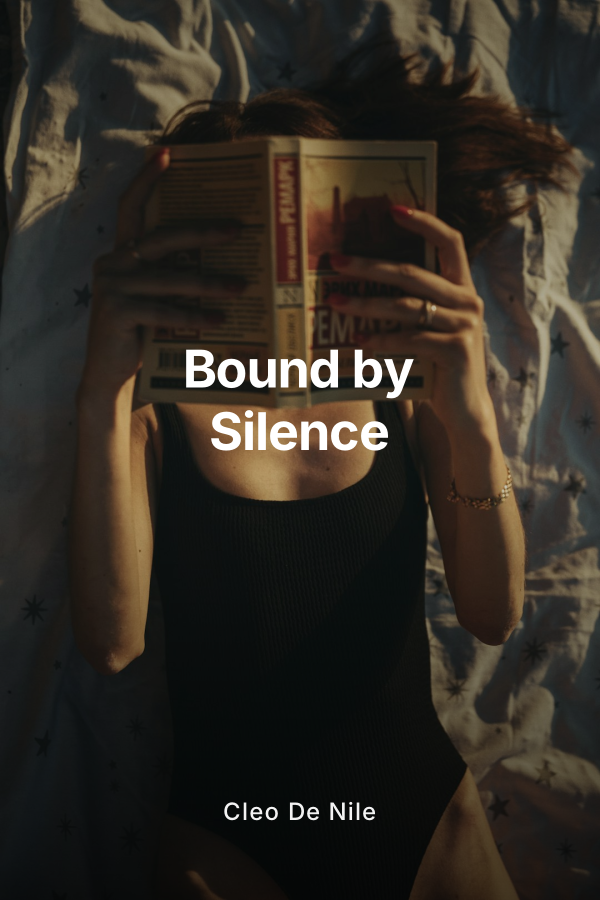
In a world where bloodlines are currency and children are collateral, Irie Monét and Theodore Arellano are signed into marriage before they are old enough to vote, drive, or even understand what love is supposed to feel like.
She is the brilliant Afro‑Dominican daughter of an Atlanta political dynasty, raised to be polished, multilingual, and presentable but never asked what she wants. To Irie, the marriage contract is proof that she was sold, not cherished. Her name, her future, her life, all inked away in someone else’s handwriting.
He is the heir of an Italian‑American corporate empire, raised on legacy, duty, and sacrifice. To Theo, the marriage is a fact of life he was trained to accept. At fifteen, he believed obedience was honor. At seventeen, he can no longer stand the taste of it in his mouth.
They meet briefly as teenagers, both awkward and half‑hidden behind time and distance, and both leave with the same impression: I want nothing to do with you.
Then the world takes that choice away too.
A covert global program abducts the heirs of the world’s most powerful families: a Chinese tycoon’s quiet genius son, an Australian heiress with a soldier’s instincts, a French strategist with ice in her veins, a Spanish tech savant, and more. In total, a dozen teens vanish into a hidden facility that calls itself an academy but functions as a forge.
There, missions are not assignments. They are experiments.
The trainees are tracked, monitored, ranked, and humiliated. Failure has consequences that are never fully explained but always felt. Some disappear. Some break. The rest learn to bend before they are snapped.
Irie is assessed, dissected, and weaponized as a strategist. Her value lies in the way she can read a room in one glance, hear the lie under the truth, and flip a negotiation with three precise sentences. Her voice is a tool the program intends to sharpen, because people will do unthinkable things when comforted by a sound that soft.
Theo is molded into the perfect shield. His strength, reflexes, and command presence make him a natural combat leader, the kind of person others instinctively cluster behind. The facility teaches him to move like a weapon, to think like a tactician, and to feel nothing he cannot use.
Their captors see something in the way Irie thinks five steps ahead and Theo controls the physical space around her. So they bind them together.
Paired trials become their new reality: tense negotiation drills where Irie must deescalate a volatile “target” while Theo stands at her side, forbidden to move unless she signals. War‑game simulations where she manages alliances and he commands the security perimeter. Political crisis scenarios where a single misalignment between them costs virtual “lives” that are treated like real failures.
On paper, they are an optimal duo: mind and muscle, language and leverage, empathy and enforcement. In practice, they are two wounded teenagers who still resent the sight of each other’s name.
Their public interactions are sharp and cold. Irie wields politeness like armor. Theo hides behind sarcasm and discipline. Every argument between them is about logistics on the surface and about deep betrayal underneath. They are not just fighting each other; they are fighting what the other represents. She sees him as the face of the system that signed her away. He sees her hatred as a mirror of his own weakness for never having resisted.
The facility watches this friction and decides to exploit it.
Over time, under relentless pressure and shared danger, the edges begin to blur. In the aftermath of missions that leave them bruised and shaking, something shifts. Theo starts to notice how Irie goes silent when she is truly hurt, how she withdraws instead of exploding. Irie starts to notice how his hands tremble after a near miss, how he trains himself into exhaustion when guilt eats at him.
Touch becomes their first language of surrender.
He reaches for her hand under the table during evaluations, seeking a grounding point he will never name. She absently holds his jaw while talking to someone else, turning his face toward her with a lazy grip that becomes a ritual. He pulls her by the waist out of danger before he even thinks. She rests her fingers in his hair or on his cheek, tracing the lines of his face while he talks, while he vents, while he breathes.
What begins as instinct becomes a map of who they are together.
Irie, who never thought of herself as physically affectionate, finds herself focused entirely on Theo’s cuts, bruises, and ragged breaths after every mission. Her world narrows to bandages and antiseptic and the way he flinches when she presses too close to bone. Her eyes gloss with tears she refuses to let fall as she cleans his wounds. “Please don’t do that again,” she whispers once, after he throws himself into a reckless move to save another teammate. When he tries to shrug it off, she adds in a voice that shakes, “When you do things like that, you hurt me too.”
For someone raised to be a shield, Theo has never considered that his body might belong to someone else’s peace of mind.
Theo, who has been taught to read terrain and opponents, learns to read her instead. He learns the tight set of her shoulders that means she is holding pain in. The way she goes blank when someone crosses a line. The way her voice loses all color when she feels dismissed. He learns to come sit beside her when she isolates, to take her chin in his hand and ask, low and careful, “What’s wrong?” until she either speaks or simply leans.
Still, they do not name any of it.
They do not think the words I love you. They think Why do you get under my skin like this and I hate that you can calm me down. Their bond annoys them as much as it soothes them. They resent how much power the other has to affect them and, quietly, how much safety comes with it.
That safety is what allows them to start seeing clearly.
During a strategy simulation, Irie pushes too far into a restricted system and stumbles onto files she was never meant to see: lists of previous cohorts, notes on “noncompliant” trainees who vanished, behavioral studies tied to arranged marriages and enforced attachments. The program is not training diplomats and operatives. It is selecting which heirs will be obedient enough to be trusted with real power and which will be quietly removed.
Their marriage is not an inconvenience the facility works around. It is a designed pressure point.
In debrief logs, Irie finds phrases like “Attachment increases controllability” and “Separation escalates compliance.” She sees their names in the margin of case studies written about them as if they are subjects, not people. She sees her family’s signature approving her placement. She realizes their parents did not just lose them. They chose to hand them over.
Theo sees the same files and feels his carefully constructed belief in duty begin to fracture. Every lesson about honor turns sour. Every time he parroted “legacy” and “responsibility” as a teenager foams up in his chest like guilt. He has been complicit all along, even in his ignorance.
The turning point comes during a mission where Irie is used as bait in a live scenario. The handler gives Theo an order that cuts through him: prioritize the mission outcome over her immediate safety.
If he obeys, he preserves his record and the team’s standing. If he disobeys, he risks punishment and destabilization. Either way, their captors learn something about how far he will go.
Irie, reading the pattern faster than he does, alters the plan mid‑operation. Theo delays just long enough to keep her from being cornered. When they return, bruised but alive, they deliver a perfect lie to the debrief room, backing each other’s story with united precision.
They have crossed an invisible line together.
That night, in a narrow hallway between surveillance cameras, they finally admit one truth, not in words but in the way they look at each other: this place is the enemy. Their only way out, literal or emotional, is through each other.
From there, their partnership sharpens.
They learn to play the game: to perform obedience while mapping the facility’s blind spots. They build a quiet network among their fellow trainees, turning former rivals into wary allies. They fail publicly when it serves them, succeed spectacularly when they need more latitude, and always, always protect each other first.
Their emotional evolution is not smooth. Theo’s “soft dominance” misfires in a public briefing when he cuts Irie off sharply, using a tone that freezes the room and slices through her trust. She does not scream or storm out. She retreats instead, turning “Theo” back into “Theodore,” answering in one‑word responses, treating him like any other teammate. The absence of her tenderness hurts more than any argument.
Later, in a quiet corner, he stumbles through an apology, composure breaking as he confesses that it is not just the moment that haunts him, it is the way she vanished emotionally while still standing right beside him. “Please don’t do that to me again. That quiet thing, where you disappear while you’re still right here. I don’t handle that well.”
She hears what he cannot quite say: I need you.
Irie makes her own mistakes. In one field exercise, she throws herself between danger and another trainee, taking a risk Theo deems unforgivable. His fear lights up as anger, and he pushes her too hard with his words, driving her to tears he hates but does not yet understand. A blunt older trainee spells it out for him later: “She cries because she loves you. Anyone else, she would have slapped.”
Theo’s realization turns inward before it reaches outward. He punishes himself with brutal extra training, half hoping exhaustion will scrub the image of her crying out of his mind. It does not. It only worries her. When Irie pulls him aside, asking in a shaking voice why he is doing this to himself, he finally admits that he is trying to forget her tears. Her answer is simple and devastating: “You say you don’t like me crying, but right now you’re the reason I’m crying again.”
From that point, their care becomes deliberate.
Irie wraps a hand around his arm and tells him, quietly but firmly, when he has had enough for one day. Theo leans into her without pretense, resting his forehead against her shoulder or his head against her stomach, letting her presence pull him back from the edge. She rubs the back of his neck, traces his jawline, speaks in Spanglish when she is too tired to filter herself, and he listens as if her voice is the only thing tethering him to the floor.
He never stops pretending he is unbothered, but his body gives him away. The second her hand touches him, he reacts. The second she pulls away, he follows, even if only with his eyes. He never asks for more, yet every fiber of him leans toward her whenever she is near.
The line between survival partnership and something more finally snaps during a mission that nearly crushes Irie under collapsing debris. Theo digs her out with shaking hands, soot and dust smeared across his face. When she coughs and forces herself upright, he cups her cheeks as if he needs proof she is solid. Dirt streaks her lips. He wipes it away on instinct. His body moves before his mind catches up, closing the distance between them for a kiss that is not planned, not practiced, and not gentle.
It is not about romance in that instant. It is about oxygen.
Afterward, he just holds her, arms locked, as if letting go might invite the ceiling to fall again.
That first kiss opens a door neither of them can close, even though they try to act as if nothing has changed. Arguments still flare. Missions still demand obedience. The facility still looms over them, watching, measuring, waiting. But in storage rooms, in shadowed hallways, in tents during storms, the tension between them erupts into heated makeouts that feel like both rebellion and refuge.
He becomes restless when they are interrupted, leg bouncing, jaw clenched, waiting for the chance to finish what the world will not let them start. She teases him for his impatience with lines that slide between playful and provocative, sometimes laced with Spanish he does not fully understand but feels at a cellular level. “Mission first, mouth later,” she chides, even as she is the one tugging him closer by the collar.
Eventually, words catch up to what their hands and mouths have already admitted.
Late one night, when adrenaline has faded and fear still hangs thick in the dark, Theo presses his forehead to her shoulder and blurts, rough and embarrassed, that he cannot think straight when she is close, that her voice and her scent are too much, that she has no idea how deeply she has carved into him. Irie, who has been tracing the veins on his hand and memorizing the shape of his jaw for months, finally tells him she loves his dominance, his hands, the way he takes the weight off her shoulders without insisting she is weak. “Handle it then,” she murmurs once, deliberately handing him the reins because she trusts him not to tighten them into a leash.
Bound by Silence follows their journey from hostile strangers trapped by a contract they never chose, to reluctant partners forced to survive an inhuman system, to a quietly ferocious pair who learn to weaponize vulnerability against the very institution that thought it could use their attachment as a leash.
It is a story about power and the children it devours, about systems that see love as a tool, and about two teenagers who refuse to let anyone else define what their bond means. It explores trauma without glorifying it, intimacy without reducing it to spectacle, and romance as something built not on instant chemistry but on whispered apologies, trembling hands, and the choice to stay even when leaving would be easier.
As Irie and Theo inch closer to uncovering the full truth behind the facility and the network that feeds it, they must decide what they are willing to sacrifice: their safety, their families’ reputations, their own carefully constructed images, and perhaps even their chance at a quiet future, in order to free not only themselves but every other child born into a legacy written in someone else’s ink.
At its heart, this book is not just about an arranged marriage in a gilded cage. It is about what happens when two people who were treated as assets learn that their greatest act of rebellion is to choose each other, on their own terms, in a world that never asked what they wanted in the first place.