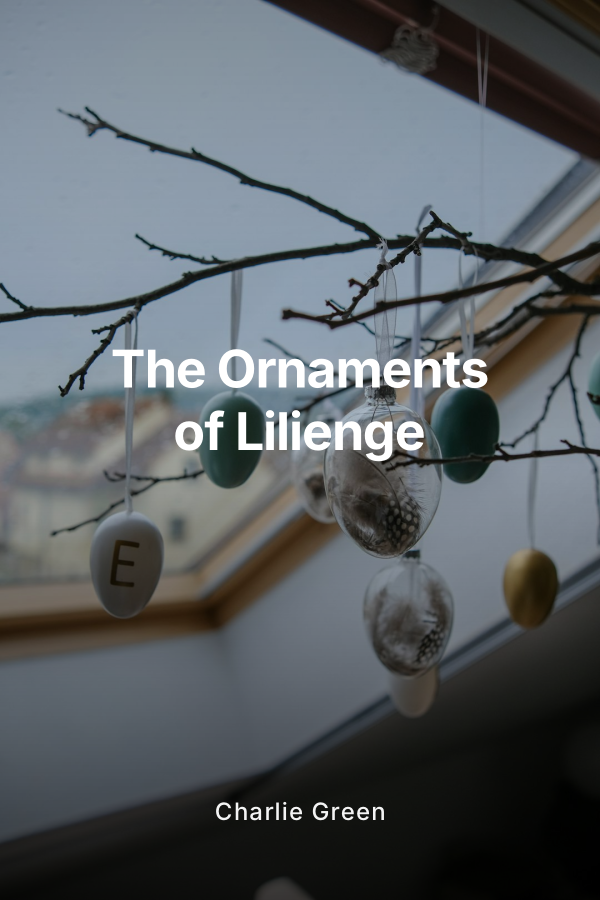
This book is a dark psychological fantasy about a girl named Nana whose pain becomes the engine of a better world and the bait in a divine trap.
At its heart stands Lilienge, a feminine god who speaks in the language of wounded girls and secret hopes. She offers one wish to any girl who signs her contract. In return, Lilienge keeps their souls as ornaments that fuel her magic, reshaping their bodies and lives into tools that harvest emotional energy through suffering. The more they hurt, the more radiant the world becomes for everyone else.
Nana’s life is built out of contradictions. In public she seems like the perfect girl next door: petite, slender, with shoulder length purple hair and vivid green eyes, always a blush on her face and a shy smile on her lips. She dresses neatly and simply, wears a ribboned choker like a charm of innocence, and moves through the world as a gentle presence that draws people in. Behind that softness, however, lies brutality that began inside her own home.
Her mother, once a loving housewife, returned to work and stepped into a secret industry that treated Nana’s body as its main product. Drugged nights blurred into blank spaces in Nana’s memory. Photographs of her sleeping body, private acts recorded without consent, and a constant insistence that her pleasure did not matter carved deep fractures into her sense of self. The betrayal grows worse when her older brother chooses complicity over protection, and when classmates cloak threats in forced intimacy.
Nana learns to survive by splitting herself in two. One side remains sweet, flirtatious, eager to please. The other turns cold, strategic, and unflinching, surfacing only when she is pushed past her limits. Her body becomes a commodity in the shadows, her emotions a battlefield only she can see. She behaves as if she is older than she really is, though in truth she is younger than everyone assumes, trapped in an existence that demands adult decisions from a child who was never allowed to become one.
In the midst of this, a client with a gentle manner and careful smile offers Nana a temporary escape. A day at a carnival, a delicate white dress scattered with flowers, a carriage ride and a tall Christmas tree in a warm living room hint at the life she could have had. Yet even this tenderness is tangled with imbalance and control, another thread in a web where affection and exploitation constantly blur.
When Nana discovers the full extent of her mother’s violations, she collapses. Shock, grief, and rage collide until she reaches a point of dangerous clarity. She wants everything to stop. She wants power. She wants to matter in a way that is not just financial gain for others. It is in this fragile state that Lilienge appears.
Lilienge does not threaten or demand. She empathizes. She knows the stories that never reach the light, the quiet despair of girls who believe their bodies are their only value. With carefully chosen words, she convinces Nana that one wish could set the scales right. Freedom, safety, power, revenge, a chance to reshape the meaning of her pain. Any single desire, if Nana will only accept the condition.
The cost is simple. Nana’s soul will become an ornament, something beautiful and malleable in Lilienge’s collection. From that point on, Nana’s existence will be bound to a magical system that gathers emotional energy from human suffering and channels it into global improvement. Fewer wars, less chaos, more stability for the majority, all drawn from the torment of a hidden few. Individual agony turns into collective progress.
Nana accepts the contract. Her wish grants her power she never possessed before, but it also seals her fate. She becomes part of an invisible workforce of girls whose souls gleam silently in Lilienge’s realm while their bodies walk the world as vessels of selective catastrophe. Their tragedies are not random. They are calibrated for maximum emotional yield, feeding a cosmos that rewards pain with order.
The book follows Nana as she navigates this new existence, trying to reconcile the knowledge that her personal suffering contributes to a better world. Her dual personality becomes both a shield and a weapon. The soft facade allows her to blend in and lure empathy, while the ruthless core drives her to test the edges of the contract, searching for loopholes or weaknesses in Lilienge’s design.
As she confronts echoes from her past mother, brother, clients, classmates she begins to notice patterns in the way Lilienge selects her girls. They are not random victims. They are those whom the world has already failed so completely that divine exploitation can present itself as a rescue. Nana understands that she is both a casualty and a collaborator now.
Each chapter deepens this tension. Nana grows more powerful, yet more bound. Her body becomes an instrument capable of channeling sorcery through touch, intimacy, and emotional entanglement. Her relationships take on a new sharpness, as every interaction carries the possibility of triggering a surge of energy for Lilienge’s species. The better Nana becomes at drawing out others feelings, the more she questions whether she is still herself at all.
As the story unfolds, Nana discovers that her individual tale is part of a much larger cycle. Lilienge’s ornaments form a silent choir of lost girls, each with her own history of betrayal, coercion, and broken trust. Their combined suffering has gradually made the world safer, cleaner, more stable for people who will never know the true cost. There are fewer visible horrors, yet a hidden pantheon of pain sustains the calm.
Nana finds herself asking impossible questions. Is a peaceful world justified if it is built on the secret misery of a chosen few. Are her sacrifices and scars a necessary price for everyone else’s comfort. Does her wish still belong to her, or has it been swallowed by a system that manipulates compassion as easily as it manipulates cruelty.
The book does not offer easy comfort. Instead, it tracks the evolution of a girl who refuses to see herself purely as a victim or a monster. Nana pushes against the boundaries of her contract, testing Lilienge’s patience and the stability of the magical network itself. Her sadistic side explores what happens when suffering is no longer controlled, while her lingering innocence clings to the hope that some fragment of her life can still be her own.
By the final chapters, Nana stands at a crossroads that could redefine the balance between private torment and collective benefit. She can accept her role as one more ornament in Lilienge’s carefully arranged gallery or risk tearing the structure apart, even if that means plunging the world back into visible chaos. Her choice will determine whether her suffering remains a silent sacrifice or becomes a spark that exposes the entire system.
"The Ornaments of Lilienge" is a haunting exploration of exploitation, consent, and the seductive logic that justifies harm in the name of the greater good. Through Nana’s fractured psyche and the divine contract that binds her, the story probes how far a person can be pushed before they either break completely or become something terrifyingly new.
Intended for mature readers, this book combines dark fantasy and psychological drama to examine a world where every healed wound casts a shadow, and every wish carries a price that cannot be unseen once it is finally understood.