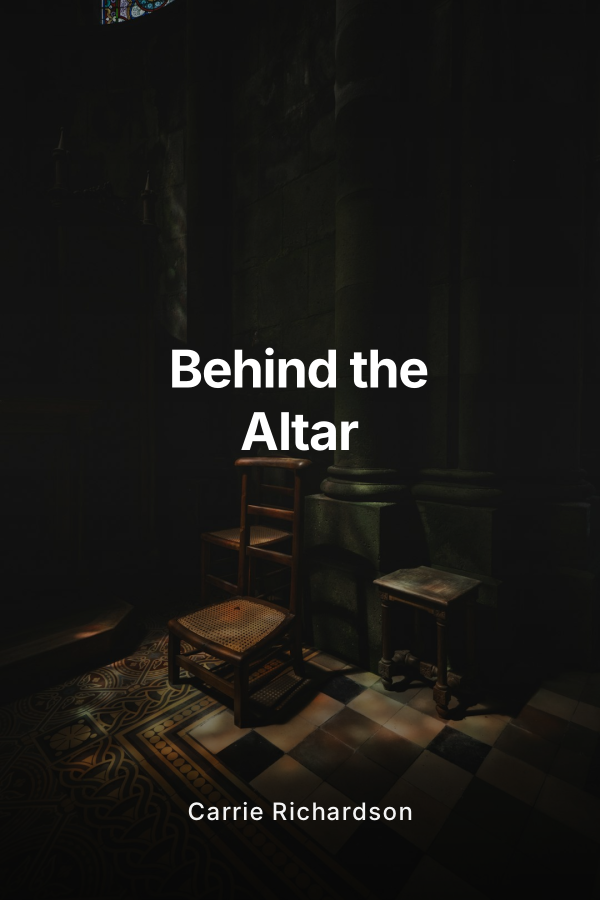
Summary:
In a quiet American town that prides itself on its faith and neighborly warmth, one family stands above the rest. The Whitlocks are the example everyone cites when they talk about “a godly home.” Their white columned house sits high on the hill, their children are well dressed and polite, and at the center of it all is Pastor Jonathan Whitlock, the man everyone calls simply Pastor Jon.
He is the spiritual heart of the community, the voice people trust in their darkest nights. He marries their children, buries their dead, prays over their sickness, and stands at their bedsides when no one else shows up. At the pulpit he is tender, steady, and wise, weaving Scripture and story into a message of hope. In public he is the perfect husband, always ready with a gentle hand on his young wife’s shoulder and a smile that tells the world he adores her.
Only Abigail knows the truth that lives behind the doors of their immaculate mansion.
“Behind the Altar” is a dark, intimate psychological drama told entirely through Abi’s eyes. At twenty eight she has already lived a lifetime inside a cage that looks, from the outside, like a blessing. She has the home, the clothes, the beautiful children, and a husband the town almost reveres. She also has bruises where no one will see, secrets tucked under long sleeves and practiced smiles, and a soul that has been slowly stripped of voice, dignity, and faith.
Every kindness Jon shows in public has its mirror image in private. The same hands that cup a church member’s shoulder in comfort become instruments of control and punishment behind closed doors. The same Scripture he proclaims on Sunday becomes a weapon he wields at night, verse by verse, to justify every slap, every demand, every violation of her body and mind. He calls it discipline, headship, wifely duty, obedience. Abi calls it what it is, though only in the safety of her own thoughts: abuse in the name of a God she no longer believes in.
The town refuses to see what is in front of them. They admire Abi’s quietness, her deference, her careful presence at Jon’s side. They make her into the ideal pastor’s wife in their own minds and will not let go of the picture, even when small cracks begin to show. A neighbor notices a flinch and looks away. A church elder sees a controlling tone and excuses it as spiritual leadership. A women’s group friend glimpses a bruise and decides it must be an accident, because the alternative would shatter everything they have built around Pastor Jon.
Abi becomes an expert in performance. She learns when to laugh on cue, when to lay her hand just so on Jon’s arm, when to excuse herself before her voice shakes. She measures every word, every step, every facial movement to keep the story intact: the story the town loves, the story that protects the man who hurts her, the story that traps her children in a home that looks ideal from the outside.
Her children are the only light she has left, and even that light is complicated. Daniel, twelve years old, carries his father’s expectations on narrow shoulders that already strain under the weight. Jon is grooming him to inherit the pulpit one day, pressing him into a mold he never chose. Dan sees far more than Jon understands. He hears the muffled sounds through the walls, notices the way his mother moves the next morning, catches what lies beneath his father’s honeyed words. He wants to protect his siblings and his mother, but he also knows any misstep might put them all in greater danger.
William, ten, lives close to Abi’s side whenever he can. Sensitive, observant, and drawn to quiet corners with sketchbook in hand, he watches the world with a different kind of attention. He feels the shifts in the house before anyone else, senses tension in the air, and absorbs the sorrow that his mother tries so hard to hide. To Jon he is the weaker son, the boy who needs toughening. To Abi he is a mirror of her own tenderness, a child she desperately wants to keep unbroken.
Amelia, nine, is her father’s angel in everyone’s eyes. Jon dotes on her, spoils her, lifts her high as the symbol of his gentle heart. Amy loves her mother and hates seeing her hurt, yet she clings to the belief that her daddy could never truly be cruel. She is too young to hold both truths at once, so she chooses the one that keeps her world from splitting in two. Her ribbons and leotards, her cartwheels in sunny rooms, become the bright distraction everyone is eager to embrace.
Across five chapters, “Behind the Altar” traces Abi’s existence within this suffocating double life. Each chapter peels back another layer of the facade and another layer of Abi’s inner world.
The first chapter introduces the town, the church, and the glittering image of the Whitlock family as everyone else sees them. Through Abi’s mind the reader learns how much effort it takes to look perfect, how carefully she manages every public interaction, and how deeply the community depends on Jon remaining untarnished. The chapter ends where Abi’s Sundays always end: with a shift from the glow of the sanctuary to the darkness of the house, when the Pastor becomes only Jonathan and Scripture becomes his favorite tool of domination.
The second chapter moves closer through Abi’s memories and present day routines. It explores how Jon isolated her over the years, taking away work, friendships, and money of her own, until she became what he wanted: a silent wife at his arm, an ornament he could control. The reader witnesses the mechanics of that control in detail how he monitors her spending, checks receipts, criticizes her body, dictates her clothing, and redefines their marriage bed as a place where her consent no longer matters. Through Abi’s POV, the physical and sexual violations are described not as distant events but as invasion and erasure, woven into her daily life.
The third chapter centers the children within this warped sanctuary. We see how Jon’s strict, calculated love shapes each of them differently and how Abi navigates the impossible task of protecting them when she cannot even protect herself. Daniel’s quiet rebellion, William’s anxious closeness, and Amelia’s wilful innocence all develop under Abi’s watchful, terrified care. The chapter shows Abigail’s small acts of resistance, the ways she tries to absorb the blows meant for them, and the moments when her body becomes a shield. It also reveals how the children learn, each in their own way, to participate in the family performance whenever outsiders step near.
The fourth chapter turns outward again to the enablers and the ones who almost see. A church elder praises Abi’s submission while half noticing the stiffness in her posture. A women’s ministry leader pulls Abi aside, not to ask if she is safe, but to remind her to support her husband more enthusiastically. A neighbor hears something through an open window and chooses silence over confrontation. Here the story lays bare a community that would rather protect its golden pastor than confront evil within its own walls. Abi recognizes that even if she spoke, there is no guarantee anyone would believe her, and that knowledge presses her deeper into resignation.
The final chapter brings the threads together and tightens them. There are consequences for small acts of defiance. An overheard conversation, a misplaced receipt, or the hint of reluctance in the bedroom becomes fuel for Jon’s calculated rage. His punishments grow colder, more methodical, as he senses her internal resistance even when her mouth stays shut. Abi begins to realize that the escape fantasies she sometimes lingers on are not plans, only dreams she uses to survive. The town continues to praise Jon. The church continues to grow. The house on the hill remains a symbol of success.
The book closes not with rescue but with a chilling stillness. Abi watches her husband at the pulpit, his voice filling the sanctuary, her children in their usual places. From her seat she observes the distance between the man everyone worships and the man who uses her body as an outlet for his need for control and his hunger for power. Her faith is gone. Her hope is thin and quiet. All that remains is her determination to endure for the sake of her children, even as she fears what staying will do to them.
The final image hints at the legacy being formed: a slight hardening in one child’s eyes, a copied gesture of Jon’s, a tiny rehearsal of dominance that Abi alone notices. The town applauds their pastor. Abi adjusts her sleeve, hiding what should have been impossible to miss. Life in the small town continues exactly as before.
“Behind the Altar” does not offer easy redemption or a triumphant escape. It lingers instead in the raw truth of a woman trapped by a man who has mastered both Scripture and performance, in a community that would rather keep its illusions than confront the cost. It asks hard questions about spiritual authority, marital obedience, and the way a whole town can become complicit by looking away. Through Abi’s unflinching, intimate point of view, the reader is drawn into a world where faith is twisted into a cage and love becomes indistinguishable from control, then left with a haunting recognition of how easily such a story can be hidden in plain sight.