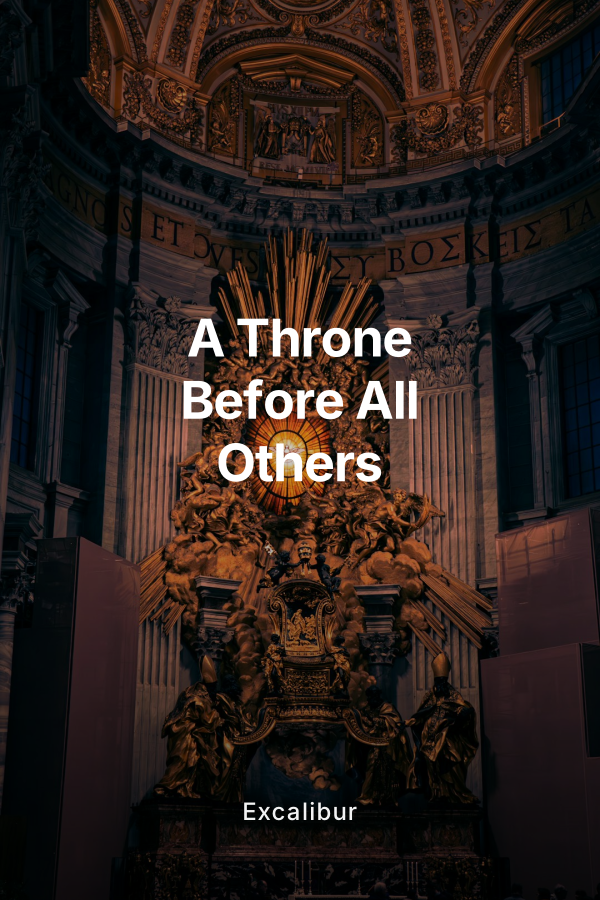
Summary:
A single broadcast interrupts a thousand worlds.
No crawl of text. No prologue. No battlefield roar. Just a man standing still while titans of war move and die around him, their chaos folding into an eerie pattern. The guns, the blades, the screams begin to orbit his silence. He does not command. He does not plead. He simply exists, and reality behaves.
On countless screens across countless universes, legends watch.
Star Wars icons feel something colder than Sith ambition, a kind of power that does not need rage to bend the galaxy. Marvel and DC paragons study him for the familiar hairline crack in every unbeatable foe and find only a clean, impenetrable surface. Heroes from worlds of quirks and devil fruits search instinctively for the warmth that crowns their greatest champions and meet a void that looks back. Soldiers in hopeless wars recognize the shape of a new, terrible constant. It is not a king, not a savior, not even a tyrant.
It is a force of nature pretending very convincingly to be a man.
Yet the heart of this story does not belong to the onlookers in distant universes. It belongs to nineteen figures who already know his shadow, and to the one who cast it.
The Primarchs.
In A Throne Before All Others, the camera does not flinch away from their faces as the Emperor of Mankind is revealed through a foreign gaze. Each chapter plunges into a different axis of reaction, peeling back the armor of the Primarchs without long speeches or grand declarations. Changes in breathing. The angle of a jaw. A quiet refusal to look away. This is a book of silences and the violence inside them.
Lion El’Jonson watches the projection like a war not yet begun, dissecting the discipline wrapped around the Emperor’s stillness. Fulgrim measures poise and perfection as if the entire slaughter is a performance staged for him alone. Perturabo does not even see a father, only geometry and inexorable outcomes, while Rogal Dorn weighs every motion against a private ledger of necessity and cost.
Leman Russ laughs once, short and sharp, then drops into a solemnity that says he knows exactly when this power will be unleashed and when it should have been. Jaghatai Khan recognizes pure movement within stillness, the terrible grace of a storm that chooses, moment by moment, not to move. Sanguinius looks like he has seen this ending before. Vulkan feels the pain of those who die on the Emperor’s behalf. Mortarion watches for endurance more than victory, annoyed at suffering that ends too quickly to mean anything.
Konrad Curze refuses to focus on the fighting at all, instead tracking the ripples of dread in everyone else. Corvus Corax shrinks from being observed while forced to confront the one man whose presence can never be hidden. Angron nearly vibrates out of his seat, his leashed fury a brutal counterpoint to an Emperor who kills without needing to rage.
Magnus the Red watches a different battle entirely, glimpsing the unseen consequences of such unchecked will. Roboute Guilliman starts drafting entire systems of governance in his mind, because every display of strength is also a blueprint for an empire. Horus Lupercal holds himself perfectly neutral while every brother steals glances at him to see how they ought to feel. Lorgar Aurelian drowns in meaning, this quiet footage confirming every desperate need within him to worship or to revolt.
Ferrus Manus counts failure points and calculates how one man can be both lynchpin and flaw. Vulkan feels the burn of sacrifice. Alpharius and Omegon study not the Emperor, but the act of watching itself, tracking how narratives shift as this being is introduced into each universe’s mythology. Someone sees one twin. Someone else sees two. Neither is sure what is true.
No one cheers.
Across five tightly woven chapters, A Throne Before All Others builds an escalating tapestry of tension where almost nothing is said aloud. Instead, the drama unfolds in glances exchanged between brothers, in subtle shifts of faith and loyalty, in the realization that their father’s presence reduces even the largest universes to background scenery.
Chapter by chapter, the book explores:
• Power without warmth
How absolute control, stripped of overt emotion, unsettles heroes who define themselves by passion, hope, or rage. The Emperor exists outside their familiar moral vocabulary, and that gap frightens them more than any display of force.
• Authority without consent
The Primarchs confront a quiet horror: their entire existence may be less a relationship and more a design. Each reaction reveals a different answer to the question, "If he is inevitable, what does that make me?"
• Faith, doubt, and the absence of gods
Lorgar, Magnus, and Sanguinius become the emotional fulcrum of the narrative as they wrestle with divinity that refuses to name itself, and with the knowledge that other universes are now forced to interpret a figure who has already rewritten theirs.
• Brotherhood under surveillance
As outside fandoms and foreign heroes observe the Emperor, the Primarchs begin to watch each other instead. Horus feels the weight of invisible expectations. Russ measures how far he is willing to go to oppose what he loves. Guilliman grapples with the logistics of ruling in the shadow of something no one can safely oppose.
• The cost of existing near a storm
Vulkan, Mortarion, Curze, and Corax embody different survival strategies: compassion, numbness, terror, and retreat. Their internal fractures widen as they see how insignificant individual pain looks beside such enormous, efficient brutality.
The climax is not a battle, but a realization. The different universes do not fully understand what they have witnessed, yet they understand enough to avert their gaze. Some decide never to cross this path. Some start plotting how they might. A few, dangerously, begin to wonder what it would mean to have such a figure of their own.
For the Primarchs, there is no such distance. They leave the screening room with nothing outwardly changed. Still, something vital has shifted. They have seen their father without the stories, without the pageantry, without the excuses. They have witnessed how beings who have never known him instinctively recoil from what he represents.
From that point onward, every victory will taste different. Every order will carry a new subtext. Every loyalty will be tested against the memory of that unmoving figure around whom entire armies curled like smoke.
A Throne Before All Others is a high tension, character focused exploration of power, worship, and the quiet moments where destinies tilt. It speaks to readers who crave psychological drama rather than simple spectacle, who enjoy cross universe encounters as mirrors instead of battles, and who understand that the loudest turning points often arrive in rooms where no one speaks at all.
The screen showed a man who rearranged the world by standing still.
The real story begins when the screen turns black and nineteen sons walk away knowing they will never see him the same way again, while entire universes, shaken and uncertain, pretend they never saw him at all.